

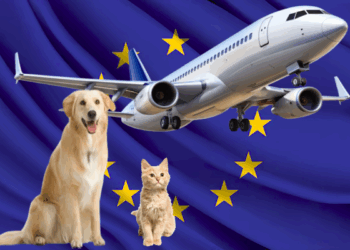
Brussels – Mandatory microchipping and registration for all dogs and cats in the EU, a ban on mutilation for shows, exhibitions and competitions, and a ban on keeping animals tethered, except in cases of necessity such as for medical treatment. New developments on the horizon for many pet owners: the European Parliament has given final approval to the first European rules on the breeding, keeping, traceability, import, and management of dogs and cats.
The new regulation is the result of an agreement already reached with the Council. All that is needed is the go-ahead from Member States, and the entire process will be complete. At that point, sellers, breeders, and shelters will have four years from the date the legislation comes into force to comply. For pet owners who do not intend to sell their animals, the requirement will take effect after 10 years for dog owners and after 15 years for cat owners.
The changes were adopted by 558 votes to 35, with 52 abstentions. Among the main changes is the requirement for all dogs and cats kept in the EU, including those in private ownership, to be identifiable via microchips and registered in interoperable national databases. To close the loopholes that allow dogs and cats to enter the EU as non-commercial pets, only to be subsequently sold, the new legislation also extends to the movement of non-commercial animals.
In practice, animals imported from non-EU countries for sale must be microchipped before entering the EU and subsequently registered in a national database. All owners of pets entering the EU will be required to pre-register their microchipped pet in a database at least five working days before arrival, unless it is already registered in a database in an EU country.
In the interests of animal welfare, breeding between parents and offspring, and between siblings and other close relatives, will be prohibited; furthermore, breeding dogs and cats to confer on them exaggerated or excessive characteristics that pose significant health risks will be prohibited. The use of choke collars or spiked collars without built-in safety mechanisms is also prohibited.
“Our message is clear: a pet is a member of the family, not an object or a toy,” says a satisfied Veronika Vrecionová (ECR), rapporteur for the text and chair of the Committee on Agriculture and Rural Development. “At last, we have stricter rules on breeding and traceability that will help us tackle those who view animals as a means of making a quick profit.”
Valentina Palmisano, a Member of the European Parliament for the Five Star Movement, also welcomed the move, stating that the approval of the regulation “is a remedy to the deplorable problem of stray animals, which, particularly in southern Italy, remains a safety issue as well as a matter of respect for the animals themselves.”
English version by the Translation Service of Withub![[foto: Wikimedia Commons]](https://www.eunews.it/wp-content/uploads/2026/02/Cats_dogs-350x250.jpg)


![Da sinistra: il presidente del Consiglio europeo, Antonio Costa; il presidente dell'Ucraina, Volodymir Zelensky: la presidente della Commissione europea, Ursula von der Leyen [Bruxelles, 18 giugno 2024. Foto: European Council]](https://www.eunews.it/wp-content/uploads/2026/06/euco_ua260618-120x86.jpg)
![[foto: Saverio De Giglio/imagoeconomica]](https://www.eunews.it/wp-content/uploads/2026/10/cpt-120x86.png)