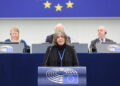
![Ursula von der Leyen alla plenaria di Strasburgo, 20 maggio [Foto: EC - Audiovisual Service]](https://www.eunews.it/wp-content/uploads/2026/05/P-069763_00-01_02-HIGH-732475.jpg)
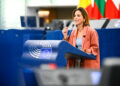
Brussels – “The Single Market remains our most effective tool, not only for prosperity but also for strategic influence. Because with 450 million people and a market of EUR 18 trillion, Europe has the power to set global standards,” said Ursula von der Leyen, President of the European Commission, opening her speech at today’s (20 May) plenary session at the European Parliament. She acknowledges the results, yet underscores that they remain insufficient. “At times of restless technological change, climate urgency and geopolitical competition, just preserving the Single Market as we know is not enough,” she notes. But “it can only remain fit for purpose if we modernise it, complete it and adapt it to the challenges of today,” she explains. In particular, it is necessary to “remove the barriers that still persist in our Single Market” and exploit its full potential, including through agreements with partners around the world. The single market “must become an instrument of European strategic independence.”
Firstly, the President calls on governments to remove national bottlenecks. To achieve this, the European Union has drawn up EU Inc, “a single set of rules that apply all across Europe.” At the national level, however, “we have to crack down on gold-plating across the Union” and “We must make it easier to scale up across Europe.”
Attention must also be focused on the digital sector. According to von der Leyen, the EU is in a good position, but now it needs to “create an environment that stimulates the demand for European digital solutions here at home.” In this regard, the Chips Act was launched three years ago, which “unlocked more than EUR 32 billion in semiconductor investments across Europe.” And “to strengthen Europe’s role in the semiconductor value chain“, the President announced the presentation of a Chips Act 2.0 and the Cloud and AI Development Act, to support the growth of the artificial intelligence ecosystem. This summer, von der Leyen explained, the call for proposals for the first AI gigafactories (large computing centres equipped with thousands of specialised chips designed to train and run artificial intelligence models on an industrial scale) will be opened.
The President also highlights the importance of sustainability, which “must be baked into our market rules.” The EU’s climate targets and circular economy policies require “a Single Market that incentivises clean innovation and, of course, eliminates barriers to trade in low-carbon goods and services,” she explains, adding that “with the Industrial Accelerator Act, we are creating lead markets for clean products across our Union.”
However, the Commission is setting its sights on forging mutually beneficial trade relationships, seeing these as a means to European independence. “You know that we are working hard on Europe’s independence – and the Single Market must help bring this to life. Since the pandemic, our companies have faced a long series of supply chain disruptions. Our Single Market can help. We must continue to leverage the scale to conclude new trade deals, for example,” she said. “This year, we have concluded with India, Australia, Mercosur, Switzerland. Later today, I will head to Mexico where we will finalise our modernised global agreement, and Mexico is a key supplier for critical raw materials,” she announced. But for von der Leyen and her team, “more can be done” because “the Single Market can also facilitate the coordination of strategic investments and aggregate demand,” for example in the energy sector. Here, the Commission is focusing on RESourceEU, a new Centre for Critical Raw Materials, the Networks Package, and an Electrification Action Plan due “in a few weeks.”
Finally, on the inclusion front, von der Leyen announced a fair labour mobility package, which includes the European Social Security Passport, the digitisation of the recognition of professional qualifications, and the strengthening of the European Labour Authority. On the social front, the President highlighted the first European strategy against poverty, adopted two weeks ago. All this in anticipation of the future Quality Jobs Act.
Reactions
However, von der Leyen’s speech did not fully convince the House. Spanish EPP MEP Dolors Montserrat (EPP) called for concrete action. “We ask the Commission to ensure that this is not just another promise and that deadlines, measurable targets, commitments, and responsibilities are met,” she said during the debate. “The single market is not just an economic policy, but a geopolitical tool with which we can counter Putin’s threats, compete on equal terms with China and the United States, diversify European supply chains, and safeguard the future of our young people by creating quality jobs,” she added.
The French liberal and leader of Renew Europe, Valérie Hayer, also focused on competitiveness. “There are 27 different regulatory systems coexisting within the EU,” she said, “which amounts to 110 per cent in internal tariffs on services. We impose barriers on ourselves that we would never accept from our competitors. Meanwhile, in the United States, a company operates within a single regulatory framework. In China, the state throws its full weight behind national champions. In Europe, however, we lose €500 billion in growth every year. This is the price of our fragmentation,” she explained.
Terry Reintke, the German co-chair of the Greens group, also highlighted the impact of the single market. Since its creation in 1993, “it has increased our GDP by between 12 and 22 per cent.” Its strength, the MEP pointed out, is not merely economic because “today it represents European security, as it gives the EU the strength to shape its own future.” Therefore, “completing the single market is the answer to security policies in the European Union, to American folly, to Russian aggression, and to Chinese competition.” However, progress is needed: “We need a true circular economy to reduce our dependence on raw materials, move towards climate neutrality, and create sustainable competitiveness.”
The stark reality of von der Leyen’s words is also a cause for concern for the group leader of the Progressive Alliance of Socialists and Democrats (S&D), Iratxe García Pérez. “What use is the world’s largest market if millions of Europeans cannot fill their fridges, pay their rent, or turn on the heating?” she asked at the start of her speech. “Our single market will not survive the 21st century, if it becomes a machine serving the few while poverty, precariousness, and fear grow,” she added. European competitiveness, she said, “will only be sustainable if it has a social conscience“. According to García Pérez, “Europe needs a law on quality work. For this reason, I thank the President for announcing it.” But that is not enough: “We need a genuine European care pact, because Europe cannot have a strong economy based on exhausted women and invisible care,” she stated. “Furthermore, all Member States must fully implement the Minimum Wage Directive.”
Kinga Gál, Vice-President of Patriots for Europe (PfE), painted a worrying picture of the European economy: a struggling industrial sector, businesses under pressure, and households paying “many times more for energy than their global competitors.” According to the MEP, the blame lies with a poorly managed green transition and excessive regulation. While welcoming simplification, she warned that this must not result in greater centralisation or a “strengthening of the Commission’s power.”
Criticism of the Commission also came from Patryk Jaki, co-chair of the European Conservatives and Reformists (ECR): “Back in 2008, the EU’s GDP was more than 100 per cent of the US total. Today it stands at just 65 per cent,” recalled the MEP, who did not fail to point the finger at the Emissions Trading Scheme (ETS). “When it was introduced, the cost was around 15 euros per tonne. Today it stands at €65, a 250 per cent increase. This has led to a rise of over 100 per cent in wholesale energy prices and over 200 per cent in average household energy costs,” he said.
Key points highlighted by García Pérez: “The far right wants to convince us that the green transition is the problem, but the reality is exactly the opposite” because Europe “has few fossil fuel reserves, and every euro spent on oil and gas ends up funding those who scorn European democratic values.” Hence, the call to accelerate the Green Deal, invest in renewable energy and clean industry, and use the European Competitiveness Fund to support workers during occupational transitions because “‘Made in Europe’ will only make sense if it also means decent work in Europe.”
English version by the Translation Service of Withub![[Foto: EC - Audiovisual Service]](https://www.eunews.it/wp-content/uploads/2026/05/P-068845_00-59_02-HIGH-316232-350x250.jpg)