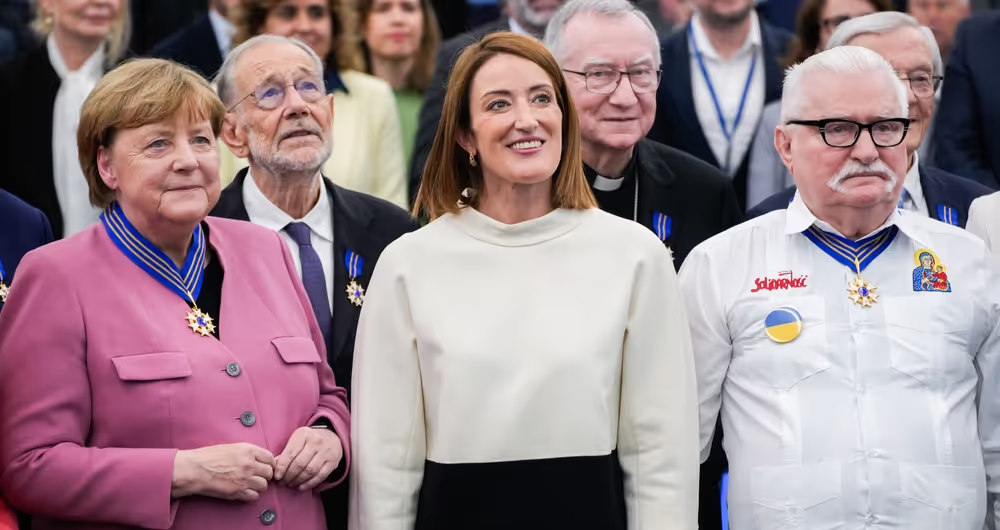
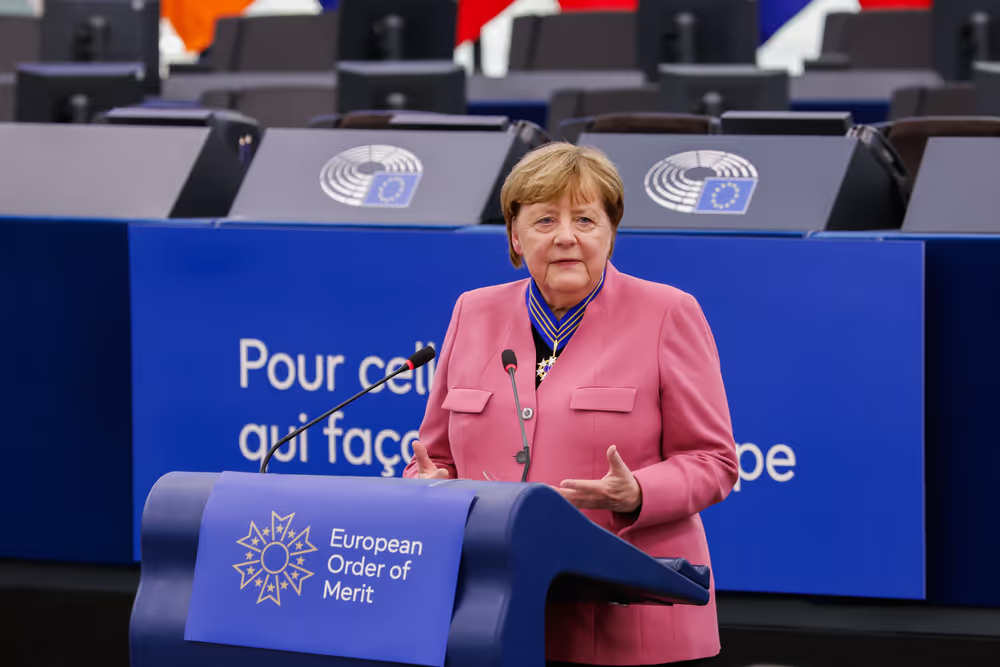
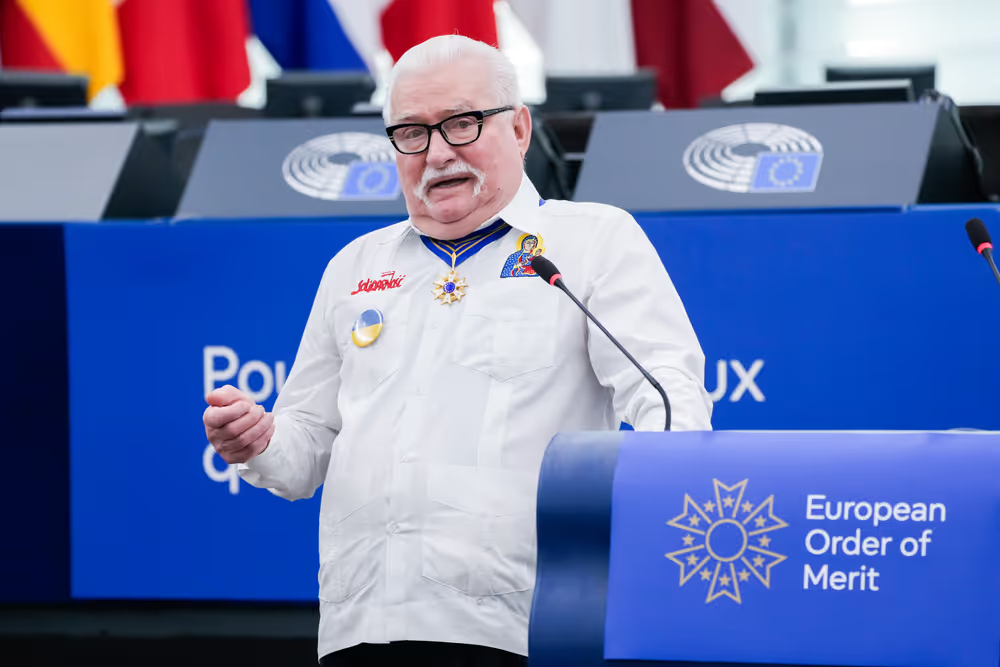
The Strasbourg hemicycle rises to its feet for a gentleman of eighty-two whose moustache, now sculpted by the years, has become an iconographic attribute on a par with Che Guevara’s beret. Lech Wałęsa sits beside Jerzy Buzek, the former Polish prime minister who once presided over this Parliament. Before them, Roberta Metsola reads the citation for the inaugural European Order of Merit, an award established in 2025 to mark the seventy-fifth anniversary of the Schuman Declaration. On the list of Distinguished Members, the highest category, three names: Wałęsa, Angela Merkel, Volodymyr Zelensky. The last of the three is absent, held back by the front line, and sends a video message from an office in Kyiv, with the Ukrainian and European flags behind him; the other two sit in the same hemicycle, a few metres apart.
It is 19 May 2026, and the first time these two biographies have intersected in an institutional setting in fifteen years. When Metsola pronounces Merkel’s name, however, a chorus of boos breaks out. The squad of MEPs from PiS (acronym of the Polish for “Law and Justice”, conservative) and Konfederacja abandons the chamber and lines up in the corridor with placards accusing the chancellor of having ruined the Union; Adam Bielan, head of the PiS delegation, reproaches her for not having known when to stay silent; Mariusz Kamiński speaks openly of blood on her hands. Wałęsa, asked about it on the sidelines, calls the boycott political stupidity, adding that he needs no advisers to decide whether or not to accept an award. It is the most generous gesture the founding father of Solidarność has ever made towards the woman from the March of Brandenburg.
When Wałęsa climbs the wall of the Lenin Shipyard in Gdańsk in August 1980, he is thirty-seven years old, has four children, works as an electrician; he has been sacked and rehired several times. Angela Kasner, the future Merkel, is twenty-six, a doctoral student in quantum chemistry at the Academy of Sciences in East Berlin, speaks excellent Russian, and has grown up in Templin, seventy kilometres north of the capital, in the rectory of her father, a left-leaning Lutheran pastor who had moved from Hamburg in 1954, a few months after Angela’s birth, as a matter of missionary conviction. Between Gdańsk and Templin lie roughly seven hundred kilometres; between the shipyard and the rectory lies the Soviet system, the same iron frame read from two opposite ends.
The Pole’s biography contains nothing of the intellectual: Catholic, working class, profoundly shaped by the teaching of Karol Wojtyła, who became John Paul II in 1978. It is the combination of these three dimensions that makes him the man of the Nobel ceremony in Oslo on 5 December 1983, accepted in forced absence for fear of not being allowed to re-enter the country, represented on the podium by his wife, Danuta. The young Kasner, in those same years, travels to Warsaw on an academic exchange (she has recounted this on several occasions) and finds there a political language her provincial setting could not offer. Wałęsa’s Poland, between 1980 and 1981, is the only experiment in pluralism inside the Warsaw Pact; the place where the workers’ movement strikes against the single party, and where Solidarność (at its peak it counted more than ten million members, a quarter of the Polish population) forces the regime to the negotiating table.
There is also the matter of blood, brought to light by a 2013 biography that the Italian press never absorbed. Merkel’s paternal grandfather, Ludwik Marian Kaźmierczak, was ethnically Polish, born in Posen in 1896, the illegitimate son of a Wojciechowski and a Kaźmierczak, raised Catholic, conscripted into the Imperial German Army in 1915 and later transferred to the Polish army, the so-called Armata blu, to fight for the independence of the reconstituted Poland. Having moved to Berlin and married Margarete Pörschke in 1925, he Germanised the family name to Kasner in 1930, yet continued to visit relatives in Poznań until the war. The chancellor’s father, Horst Kasner, was born Horst Kaźmierczak. Merkel is one-quarter Polish; she said so publicly for the first time at a church assembly in Hamburg in 1995, and repeated it in 2000. This is not tabloid genealogy, but a key to understanding: in Templin, under the regime, the family’s identity papers still bore the stamps of the province of Posen.
On the face of it, an unbridgeable distance. Wałęsa is Roman Catholic, devoted to the Black Madonna of Częstochowa, and has worn a Marian pin on his lapel since the 1980s that he has never removed; he practises confession and speaks of the rosary as a “political companion.” Merkel is a pastor’s daughter, attended the Junge Gemeinde, the youth community, in her father’s rectory, and maintains a sober, anti-rhetorical relationship with faith. On the rare occasions she speaks about it publicly, she cites Dietrich Bonhoeffer and the Protestant ethic of responsibility. Beneath the religious surface, though, the overlaps run deep: both belong to the family of European Christian democracy (in the broad sense given to it by Adenauer, Schuman, De Gasperi); both distrust ideology; both built their careers on a patience that younger interlocutors have often mistaken for opportunism. Above all: both emerged from communism without accumulated hatred, but with an experiential knowledge their Western contemporaries could never have acquired. This, more than the Posen genealogy, is the real bridge between them.
The bridge, the Bösebrücke, connects, in the pre-1989 Berlin of the Wiedervereinigung (German reunification), the former eastern sector of Prenzlauer Berg to the western one of Wedding/Gesundbrunnen. They cross it together only once. On 9 November 2009, in the rain, at five in the afternoon: Merkel, umbrella, blue overcoat, walks through the Bornholmer Straße crossing, which includes the bridge, with Mikhail Gorbachev on her left and Wałęsa on her right. It was here, on the evening of 9 November 1989, that the border between East Berlin and West Berlin was opened for the first time. A monument in front of the local station, its Gothic lettering still legible, commemorates the spot.
The crowd presses forward, chanting “Gorby, Gorby.” Twenty years earlier to the day, the border guard Harald Jäger, confronted by a crowd impossible to contain, had taken it upon himself to raise the barrier; that evening the young Angela Kasner had walked across, gone to a pub in West Berlin for a beer with her sister, and then returned home to Templin because she had a sauna booked at four the following afternoon. She would repeat the sauna detail in many interviews, as a small badge of East German normality. On the bridge, twenty years later, the chancellor thanks Gorbachev for having “courageously let things happen” and thanks Wałęsa and Solidarność for having opened the way to German reunification in 1989. The Pole, in his evening address at the Brandenburger Tor, reverses the axis: it was John Paul II, he says, who was the real strategist behind the fall; the front had opened nine years earlier in Gdańsk, not in Berlin. Merkel does not contradict him. On the contrary, in the central passage of her speech, she will refer expressly to “our neighbours in the East,” a formula calculated not to separate the Poles from the Hungarians and the Czechs. At a dinner afterwards at the Kanzleramt, the chancellor’s residence, in February 2010, Wałęsa joked about the small number of women in the Polish delegation, and Merkel, in return, recalled that in 1990, at the pacifist marches in East Berlin, the women far outnumbered the men; the exchange unfolded in an atmosphere of informality and confidence. I assumed it was an indiscretion, but later found it printed in archival materials.
From that bridge onward, however, the contacts become more ceremonial, and the political relations deteriorate. During the first Tusk government, Gazeta Wyborcza described Merkel as the most Poland-friendly chancellor Berlin had ever seen. On 1 May 2011, Germany opened its labour market to Polish citizens, and on 28 November of the same year, the foreign minister, Radosław Sikorski, delivered a speech in Berlin declaring that he feared German power less than German inaction. Then two fractures: Nord Stream 2, agreed in 2015 between Gazprom and five Western partners, shielded by the chancellor even after the poisoning of Aleksei Navalny in August 2020. Merkel pressed the large red mushroom-shaped button that symbolised the release of the valve opening the gas flow, after joking that she really did know a thing or two about molecules… Then the PiS government, installed on 16 November 2015, with which dialogue became immediately difficult owing to the reforms of the judiciary and of public broadcasting. Merkel chose in both cases a line of patient management: never break with Warsaw, but never stop raising, in the guise of gentle criticism, the question of the rule of law. That is what she did on 7 February 2017, on her first visit to Warsaw in the PiS era, when, facing Beata Szydło, she invoked the inspiration Solidarność had given her generation and spoke of the necessity of media pluralism. A clear citation, wrapped in impeccable manners.
The price, in Poland, was steep. Seen from Warsaw, Germany appeared for years as the country that preached values while funding the adversarial source. When in October 2025 Merkel, in an interview with the Hungarian channel Partizan, claimed to have proposed in June 2021 a new format for direct EU-Russia dialogue only to see it torpedoed by Poland and the Baltic states, Warsaw’s response was immediate. Sikorski, back as foreign minister in the Tusk government, replied that the chancellor had forgotten how her own government had treated Polish objections in 2007. Katarzyna Pełczyńska-Nałęcz, former ambassador to Moscow and now minister for regional development, spoke of fuel for Russian propaganda. Mariusz Błaszczak, PiS parliamentary leader, called on Tusk to “distance himself from his old friend.” Merkel’s Polish legacy had begun to be rewritten, and the chancellor, normally so careful with tone, had stumbled into a rare rhetorical misstep.
Here the third name in the Strasbourg trio enters the field. On 3 March 2025, eight days after the pitiful scene and charade at the Oval Office between Trump, Vance and Zelensky (the one in which the American president reproached his Ukrainian counterpart for having “no cards in his hand”), Wałęsa published on his Facebook page a letter also signed by Adam Michnik, Bogdan Lis, Władysław Frasyniuk, Seweryn Blumsztajn, and thirty-four other former political prisoners of communist Poland. Attached was a photograph from 2010 in which Wałęsa himself was shaking Trump’s hand at Mar-a-Lago. The letter spoke of “horror and disgust” and described the atmosphere of the Oval Office encounter as “a reflection of the interrogations of the Służba Bezpieczeństwa,” the Warsaw secret police of the 1970s: the judges and prosecutors, Wałęsa wrote, used to repeat to him the same phrase Trump had addressed to Zelensky. It was a European document disguised as a Polish letter; the Süddeutsche Zeitung carried it on its front page on 5 March, implicitly recognising its moral stature.
The question is whether the parallel between Poland and Ukraine holds beyond the headlines. It holds on several counts. Both border countries, historically caught between Russia and Germany, have served as sparks for the process of European enlargement: Poland, with Solidarność in 1980, opened the first crack in the Warsaw Pact; Ukraine, with the Maidan in 2014, the Revolution of Dignity, opened the structural fracture with Moscow. Both were led, at the crucial moments, by non-protocol figures who wrong-footed Western diplomacies: a moustachioed electrician who signed decrees with a shipyard worker’s pen; a former stand-up comedian in a green military T-shirt addressing the parliaments of the world via Zoom. Both suffered, on the German side, the same attitude: caution, gradualism, excessive faith in mediation, a suspicion of provincialism towards their own case. In the 1980s, from Bonn, Solidarność was urged not to push too hard; today, from Berlin, Kyiv is urged to be realistic about the Taurus missiles and the frozen Russian assets. The pattern is the same, and Wałęsa recognised it first.
With a difference that carries weight, to be sure. Wałęsa’s Poland was not in a hot war; it was under martial law, and however brutal the repression might have been, there were no Iranian drones over the rooftops of Gdańsk and no ballistic missiles above Lublin. Zelensky’s Ukraine is fighting a war of attrition on its own territory, with human and material losses that any reduction to historical parallel risks trivialising. There is also a symbolic asymmetry: Wałęsa had the Polish Church and John Paul II as a moral shield; Zelensky has NATO as a military shield, but one that grew abruptly thinner after 20 January 2025. Acknowledging these differences is a matter of honesty. What remains is that the German reading curve is superimposable, and that the chancellor who applauds Zelensky’s video in Strasbourg is the same one who, in 2014, according to the book by Jonas Vytautas Žukas, former commander of the Lithuanian armed forces, reportedly asked Kyiv not to resist in Crimea (the report was picked up by the Baltic and Polish press between October and November 2025, and Merkel has never explicitly denied it).
Returning to Strasbourg, 19 May 2026: Wałęsa received the Order standing, in a grey jacket with the Marian pin on his lapel, saying a few words in Polish, half-translating them himself. He picked up a Metsola formula about Europe not being something we were given but something we built treaty by treaty; he added that what interests him is the success of the Union and of the “post-Solidarność generation,” and that he would like to contribute for as long as he can. Merkel, in reply, delivered a longer speech. She lamented openly the distance between the Union’s founding promises (peace, prosperity, democracy) and the present state of affairs. “To be honest, we are very far from those promises,” she said, to the tepid applause of a chamber that, for the most part, contested her legacy. She spoke of the threat that disinformation on social media poses to the foundations of the Enlightenment. Ursula von der Leyen, two seats away, was clapping with two fingers.
Zelensky was not there. He sent a video clip. He thanked the European Parliament for the recognition, said he received it not for himself but for the soldiers at the front, and reminded his audience that Europe’s security is being decided today in Ukraine. It was an image filmed in Kyiv, in an anonymous office, with a European flag and a Ukrainian flag behind him; on closer inspection, it was the same backdrop he had used on 28 February 2025 in the Oval Office. Perhaps coincidence, perhaps calculated memento. Between the Bornholmer Bridge and Strasbourg, between Gdańsk and Kyiv, between the Polish 1980 and the Ukrainian 2022, the thread is slender but it is there: it is held by the man from the shipyard who applauds the chancellor in spite of everything, and who in the months ahead will tell us, from Gdańsk, whether Europe has at last learnt to stop asking its border countries to moderate their own case. We may know something of it, perhaps, before the autumn.
English version by the Translation Service of Withub
![Da sinistra: il presidente del Consiglio europeo, Antonio Costa; il presidente dell'Ucraina, Volodymir Zelensky: la presidente della Commissione europea, Ursula von der Leyen [Bruxelles, 18 giugno 2024. Foto: European Council]](https://www.eunews.it/wp-content/uploads/2026/06/euco_ua260618-120x86.jpg)
![[foto: Saverio De Giglio/imagoeconomica]](https://www.eunews.it/wp-content/uploads/2026/10/cpt-120x86.png)