
Brussels – In 2025, there were fewer young people aged 15-29 in the European Union who were neither employed nor in education or training (NEET). According to Eurostat, the EU’s statistical office, in 2025, the proportion of young NEETs stood at 11 per cent, a slight decrease from 11.1 per cent in 2024, but a much more significant improvement compared to 15.2 per cent in 2015. The data show that the NEET rate varies according to age: while the percentage stands at 5.3 per cent for young people aged 15-19, it doubles for those aged 20-24 (12.8 per cent) and triples (14.7 per cent) for those aged 25-29.
Among the active population, in 2025, 12.5 per cent of young people aged 15-19 were in employment and in education, followed by 22.5 per cent of those aged 20-24 and 17.8 per cent of those aged 25-29.
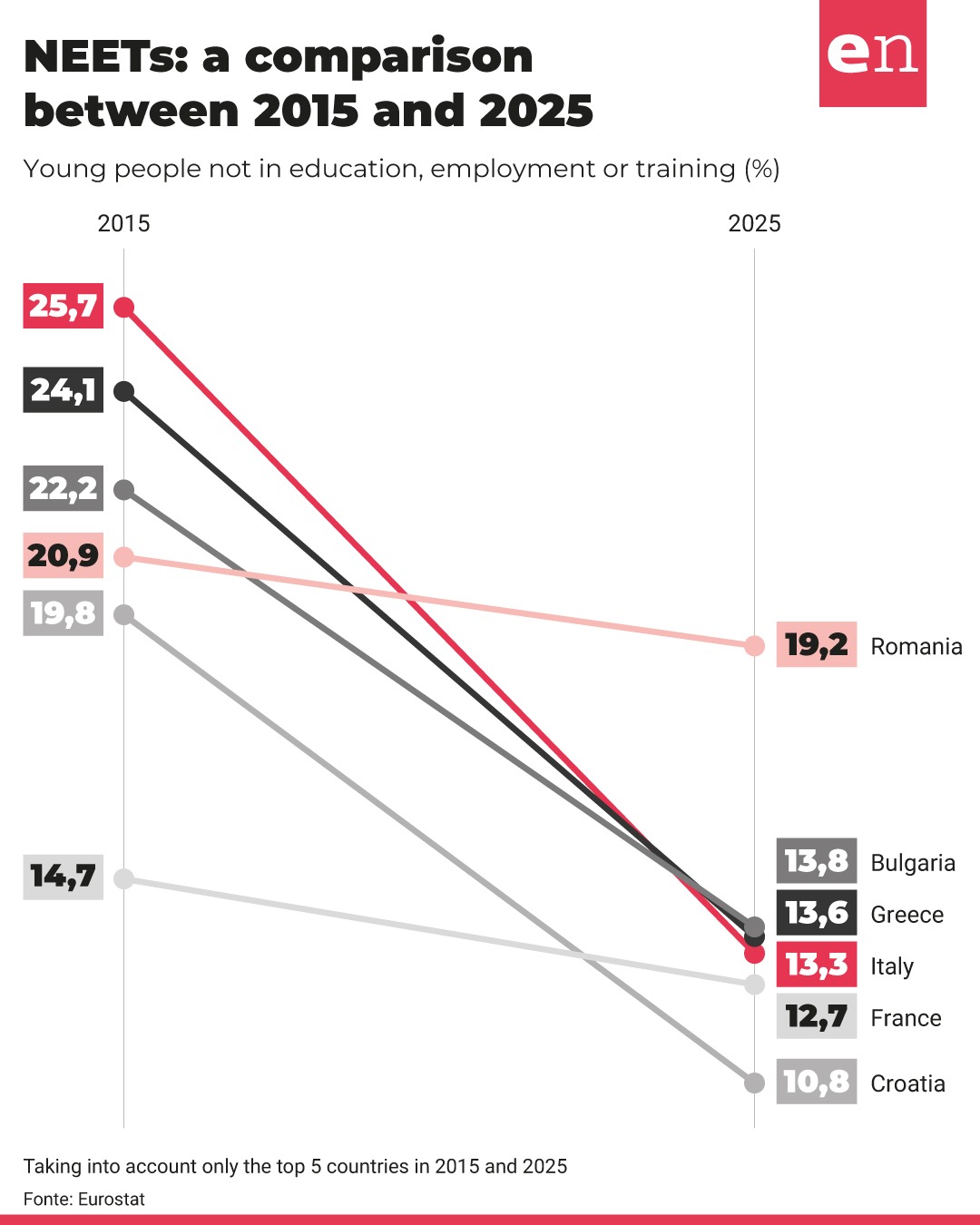
Eurostat highlights that the lowest NEET rates were recorded in the Netherlands (5.3 per cent), Sweden (5.9 per cent), and Slovenia (7.6 per cent), while the highest were in Romania (19.2 per cent), Bulgaria (13.8 per cent), and Greece (13.6 per cent). According to estimates, the overall share of NEETs decreased by 4.2 percentage points in the EU between 2015 and 2025, with similar declines in 22 of the 27 countries. The most significant declines were recorded in Italy (13.3 per cent), which in 2025 saw a reduction of 12.4 percentage points compared to 25.7 per cent in 2015. Next came Greece (-10.5 percentage points), falling from 24.1 per cent to 13.6 per cent, and Croatia (-9.0 percentage points), where the NEET rate fell from 19.8 per cent to 10.8 per cent. There are three countries where the NEET rate has risen since 2015: Germany (+1.0 percentage point), Luxembourg (+1.2 percentage points), and Austria (+1.6 percentage points). A comparison of the two countries with the highest and lowest NEET rates in 2025 shows that Romania’s rate was almost 4 times higher than the Netherlands’.
The data highlights a gender gap: in 2025, 12 per cent of young women aged between 15-29 in the EU were classified as NEETs, whilst the corresponding figure for young men was 2.1 percentage points lower, standing at 9.9 per cent (in Italy, 11.8 per cent of men compared to 14.9 per cent of women). The NEET survey began in 2015, the year of the sovereign debt crisis, and the percentage fell steadily until 2019 before peaking (13.8 per cent) in 2020, the year of the COVID-19 pandemic. For the 15–29 age group, the EU has set a target to reduce the proportion of young NEETs to 9 per cent by 2030.