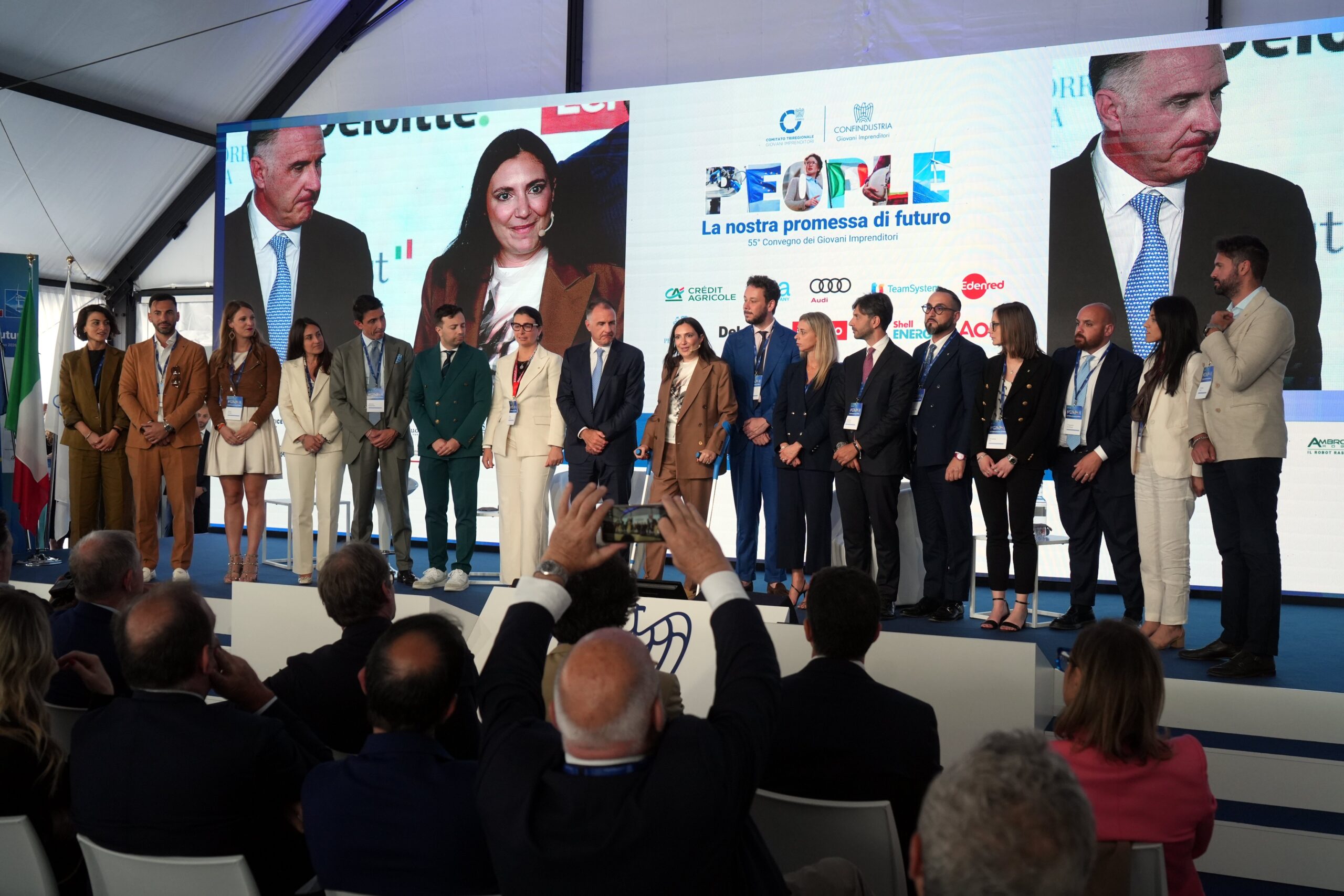
Porto Carlo Riva, at Rapallo, is one of those places where the Tigullio lines up its boats as if they were arguments: 253 of them, to be exact, up to sixty metres overall, in a marina conceived more than fifty years ago and boldly rebuilt eight years ago after a vicious storm. On the 5th and 6th of June, under an early summer light that Liguria knows how to make almost solemn, the moored yachts served as a backdrop, imagined more than seen from inside the marquee set up for the meeting, to an audience of entrepreneurs under forty, ministers, bankers and party leaders in search of a stage. On the platform, in front of the microphone that David Parenzo kept alive for two days, Maria Anghileri opened the fifty-fifth National Convention of Confindustria’s Young Entrepreneurs with a word that carries more weight than it seems: promise. “People. Our promise of the future”, ran the claim. And a promise, she said herself without circling around it, has cracked in Italy.
The diagnosis that came from that platform is unambiguous. The country is not growing. The young are angry and stuck. We are the most indebted nation in Europe, and this despite a prudence over the public accounts that Anghileri herself acknowledged in the government. Firms and workers, she added, remain the seam from which eighty per cent of the tax take is extracted, and she called that unjustifiable. Behind the figures sits a phenomenon that ought to worry more than any badly drafted budget: the export of entrepreneurs, the young who leave and take their company with them, discouraged by regulatory uncertainty, by the cost of energy, by a bureaucracy that in Italy now has the consistency of an unchanging climate.
All true. All documented. And yet the most interesting part of Rapallo does not lie in the diagnosis, which has been known for years and which anyone close to business knows by heart. It lies in the posture. The way a business association chooses to pronounce those truths says far more than the figures it quotes.
For much of the twentieth century business representation built its identity, as the phrase goes, by subtraction; defining itself against something: the trade union counterpart, the interlocutor with whom to bargain the price of labour; the social partner summoned to the table when the sacrifices had to be shared out.
An entrepreneur friend, certainly no longer in the first flush of youth yet still a presence on the Calata Andrea Doria, the tie and the padded jacket long gone, puts it this way: “It was a grammar, at times almost folkloric, the grammar of the trenches; suited to a national, nationalistic and certainly Fordist economy, where the distributive conflict sat at the centre of the stage. That grammar is no longer enough today. Not because the conflict has vanished, but because the perimeter has changed. The stake is no longer the division of a domestic product that is growing, it is the very survival of Europe’s productive base in a world that has turned, all at once, almost solely geopolitical.” Lucid, sharp, merciless. No excuses left.
Without going far, this is the lesson Mario Draghi handed to the Union in his report on competitiveness, and which he has repeated ever since with a pedagogical insistence, to the point of taking the measure of the recalcitrant infantilism of the audience the message was aimed at. The growth gap with the United States that keeps widening, the share of sectors in which China competes head on with Europe risen to two fifths, energy that stays dearer than the American kind, artificial intelligence where the continent has produced a handful of foundational models against the dozens from across the ocean. He said it with his banker’s understatement: inaction threatens not only competitiveness, it threatens sovereignty. It is a language business associations ought to make their own, because it redraws their trade. From guardians of a sectional interest to custodians of a collective fundamental that becomes a common good.
Here lies the step that at Rapallo was glimpsed without ever being completed. The association of the future is not a social partner that makes demands, it is a stakeholder that takes part. The difference is not semantic. Whoever thinks of themselves as a social partner asks, and measures success by the concession obtained. Whoever thinks as a stakeholder takes on a share of responsibility for the result, and measures that result by the growth produced. The first position is comfortable, because it always offloads the blame elsewhere. The second is uncomfortable, because it forces you to put your signature next to that of politics.
From this follows a demanding requirement of those who lead such associations. Entrepreneurial maturity shown, not proclaimed: leaders who are, before anything else, credible entrepreneurs, “present in the present” of the economy and society with the authority of those who every morning sign wage slips and orders and payments, and not with the standing borrowed from their office. A dominant presence in the real, made of their own numbers before the numbers of others. It is the minimum condition for the voice of representation to count at a table where governments sit handling budgets of hundreds of billions.
This becomes clearer when you widen the gaze, because the generation that spoke Italian at Rapallo is facing the same questions across the continent, with answers that draw an instructive map.
In France the Centre des Jeunes Dirigeants has shifted the centre of gravity onto performance globale. The idea, that is, by which the result of a business is no longer only economic but social and environmental too: leaders who are resilient yet uneasy, who in the face of political chaos choose to insulate the company and tend to its internal culture. A defensive posture, in the end. In Germany Die Jungen Unternehmer have the opposite reflex: civic activism, explicit lobbying pressure, a defence of the market economy that demands less state and reads in subsidies a distortion of competition. They want drastic tax simplification and deregulation, and they bet on recovering technological competitiveness in deep tech and on digitalising a public administration left behind. It is the voice of those who feel themselves heirs to a model, the German one, and discover that the model is no longer invincible.
In Spain the Confederación Española de Asociaciones de Jóvenes Empresarios has the pragmatist’s understatement: maximise European funds, organise into strong regional hubs between Madrid, Barcelona and Malaga, win the right to open a company in forty-eight hours and with one hundred euros. Further north the question changes in nature. In the Nordic countries enterprise is driven by values before margins: in Sweden and Finland many young people will only consider it if it offers work that carries meaning, aligned to an ethic; sustainability is built in from the first day, hierarchies are flat, and they prefer to take over an existing company rather than found one. In Norway the enemy has a precise name, the comfort trap: a granite welfare state and a fossil rent make secure employment more attractive than risk, and when the decision to start a business is made it is made to dominate the blue economy, aquaculture, offshore wind, the capture of carbon dioxide.
Portugal, with the Associação Nacional de Jovens Empresários, has a natively international DNA: lacking a large home market, companies are designed export ready from the moment they are founded, mingled with the community of digital nomads, with the obsession of turning the flight of brains into their return. Greece is leaving the mentality of survival and entering the mentality of growth, betting on the digitalisation of commercial shipping and on renewables. The United Kingdom, outside the single market, is forced to look beyond Europe, towards the United States and Asia, sustained by the most powerful venture capital ecosystem on the continent and by the ambition of becoming a superpower of artificial intelligence and fintech. Ireland, the only English-language bridge left in the Union, tries to wean itself off its dependence on the American multinationals to build indigenous firms, while the housing crisis paralyses its hiring.
Set these postures side by side and one thing alone becomes visible, and it lights up the Italian case. Where youth representation has stopped thinking of itself as a counterpart and begun to think of itself as a stakeholder, the conversation has moved from grievance to strategy: energy, computing power, markets, value chains, the placing of one’s own productive system within the global contest. Where the twentieth century “grammar” survives instead, you stay nailed to the request for concessions, however legitimate those may be.
The Italy of the young entrepreneurs, at Rapallo, showed both faces. The call for a structural wage increase, up to one thousand euros net more a month in the first year of work for the under thirty-fives through a tapering income tax exemption, is a serious proposal, and Emanuele Orsini spelled out what needed saying: that firms, on their own, cannot pay those wages without a systemic intervention. But it was the president of Confindustria himself who pointed, almost en passant, to the right trajectory. In the five hundred days left before the end of the legislature, he said, Confindustria will do its job by talking to every party and staying independent, because it falls to the parties to bring courage and to entrepreneurs to bring responsibility and trust. On Europe, which he called fundamental, he added that it is getting its policies to support business wrong, and that one must have the courage to tell it so.
Responsibility and trust. These are the two words on which everything is staked. Responsibility is what separates the stakeholder from the social partner; trust is the currency of an operational partnership with politics. Not the partnership of concertation, that weary ritual of tables and protocols, but a relationship that enters the substance of the economic and financial fundamentals: European common debt for defence, artificial intelligence and the transition, a single energy market with nuclear and renewables together, the adoption of artificial intelligence as a lever and not as a bogeyman. They were, as it happens, the requests that came out of Rapallo. The very ones Draghi delivers to Brussels.
What remains is the hardest part, the part that at Rapallo was only brushed against. The engagement with the future. A mature business association does not confine itself to asking politics to mend the present, it brings as its dowry a reading of the geopolitical and geoeconomic future: the trade flows that are reorienting, the supply chains coming back closer, the regions from Asia to Africa to the Middle East from which capital, talent and markets will arrive. It is work for a ruling class, not for a pressure group. It asks you to stop reacting and to start designing. It asks for leaders able to talk about technological sovereignty and supply chains with the same ease with which the national labour contract was once discussed.
Better to return to Porto Carlo Riva, on the last evening, when the speakers have gone and only the boats remain. Those moored yachts are an image all too exact of the Italian ambivalence: capital at a standstill, ready to set sail, waiting for a wind and a course. The promise Maria Anghileri spoke of will not be kept on love of country. She admitted herself that it is not enough to pay the mortgage. It will be kept if the “employer class of today” (the definition belongs to a trade union observer of yesteryear) that called itself at Rapallo the “despite everything” generation finds the courage to change its name: no longer entrepreneurs who hold out despite the country, but actors of the real economy willing to answer for the country, just as in a company one answers to the shareholders for having invested their money well. That too was a phrase from Rapallo. Perhaps the most important. Almost no one picked it up.
English version by the Translation Service of Withub