
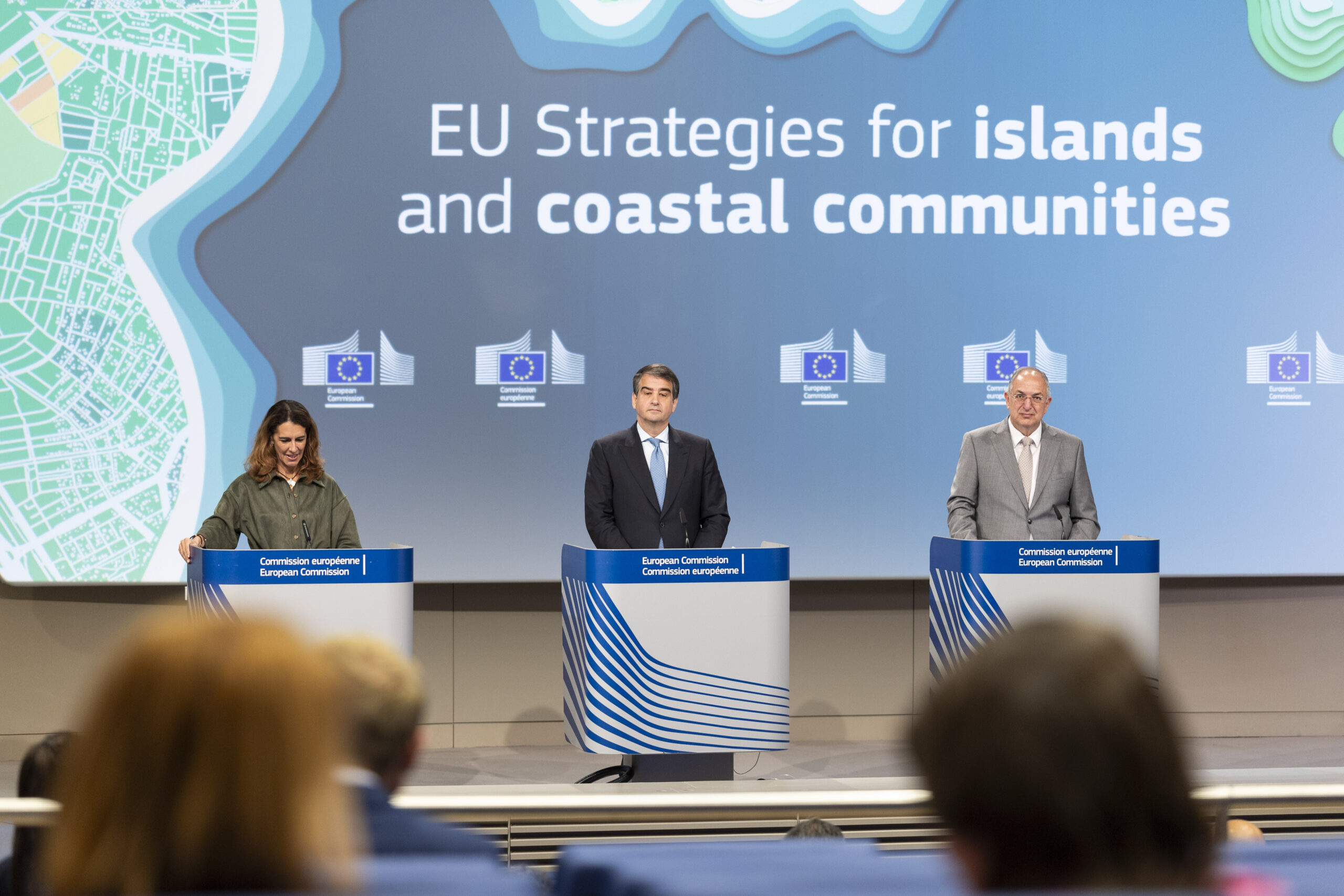
Brussels – “For the first time, the European Union has adopted
specific strategic frameworks for its island and coastal regions.” This was announced today (10 June) by the Executive Vice-President for Cohesion and Reforms, Raffaele Fitto, on the occasion of the adoption of the EU’s first strategies for islands and coastal communities. Fitto explained that the two plans have been introduced because the European Union comprises three coastal Member States (Cyprus, Ireland and Malta) and 4,000 islands, where, according to Commission estimates, 17 million people live.
“The islands face challenges similar to those of other European territories, yet the impact is often exacerbated by a specific condition: insularity,” the Vice-President pointed out, emphasising that the issue is not merely “a geographical fact,” but a real economic cost. “The cost of insularity,” explained Fitto, is a figure “that millions of EU citizens and businesses pay every day simply because of where they live and operate, with a consequent long-term structural negative effect on their income and competitiveness.” According to the data presented by the Commission, compared to the mainland, transport costs on islands can be 300 per cent higher, public spending 30–50 per cent higher, and house prices 75–130 per cent higher. Most European islands have a GDP of 70 per cent of the EU average. In Italy, it is estimated that insularity can reduce GDP in Sicily by 7 per cent and in Sardinia by up to 36 per cent. As for employment rates, the average for the islands is 59 per cent of the EU average.
The strategy for the islands is therefore structured around four key pillars: economic development, connectivity, competitiveness, and innovation; energy security, environmental protection, and climate resilience; community and demography; security and crisis preparedness. On this point, Fitto reiterated that “the scope of this strategy has not been defined in Brussels” and that the strategies are “the result of an in-depth and ongoing dialogue with local areas and communities” after the executive had, in recent months, “organised meetings, missions, and discussions across Europe and in Brussels and issued a formal call for contributions, in which 358 stakeholders from 18 Member States took part.”
In presenting the strategy for island communities, the European Commissioner for Fisheries and Oceans, Costas Kadis, noted that “Europe’s coasts are home to around 95 million people and stretch for 70,000 kilometres across 22 coastal states,” generating “around €265 billion in gross value added annually and supporting millions of jobs.” The strategy will be structured around three strategic objectives: prosperity, resilience, and liveability, and will be supported by 13 key actions. It also recognises “the high diversity of coastal territories, ranging from small fishing villages to large port cities” because, as Kadis himself emphasised, “it requires tailored and specific solutions for each territory, rather than a standardised approach.”
The two strategies align with the European Pact for the Oceans, launched in 2025, and complement the EU’s broader policies on climate action, cohesion, and sustainable development. The EU’s outermost regions, however, are not covered by these proposals, as they are the subject of a separate specific strategy to be presented by the end of the year.
English version by the Translation Service of Withub
![Gli eurodeputati del Movimento 5 stelle Palmisano, Della Valle e il deputato Carotenuto hanno presentato il film "The sea" con la giornalista Giulia Innocenzi al Parlamento europeo di Bruxelles. [Foto: Eunews]](https://www.eunews.it/wp-content/uploads/2026/06/2-350x250.jpeg)
![[Foto: Unsplash]](https://www.eunews.it/wp-content/uploads/2026/06/daniel-schludi-e1RI3wRelqM-unsplash-350x250.jpg)