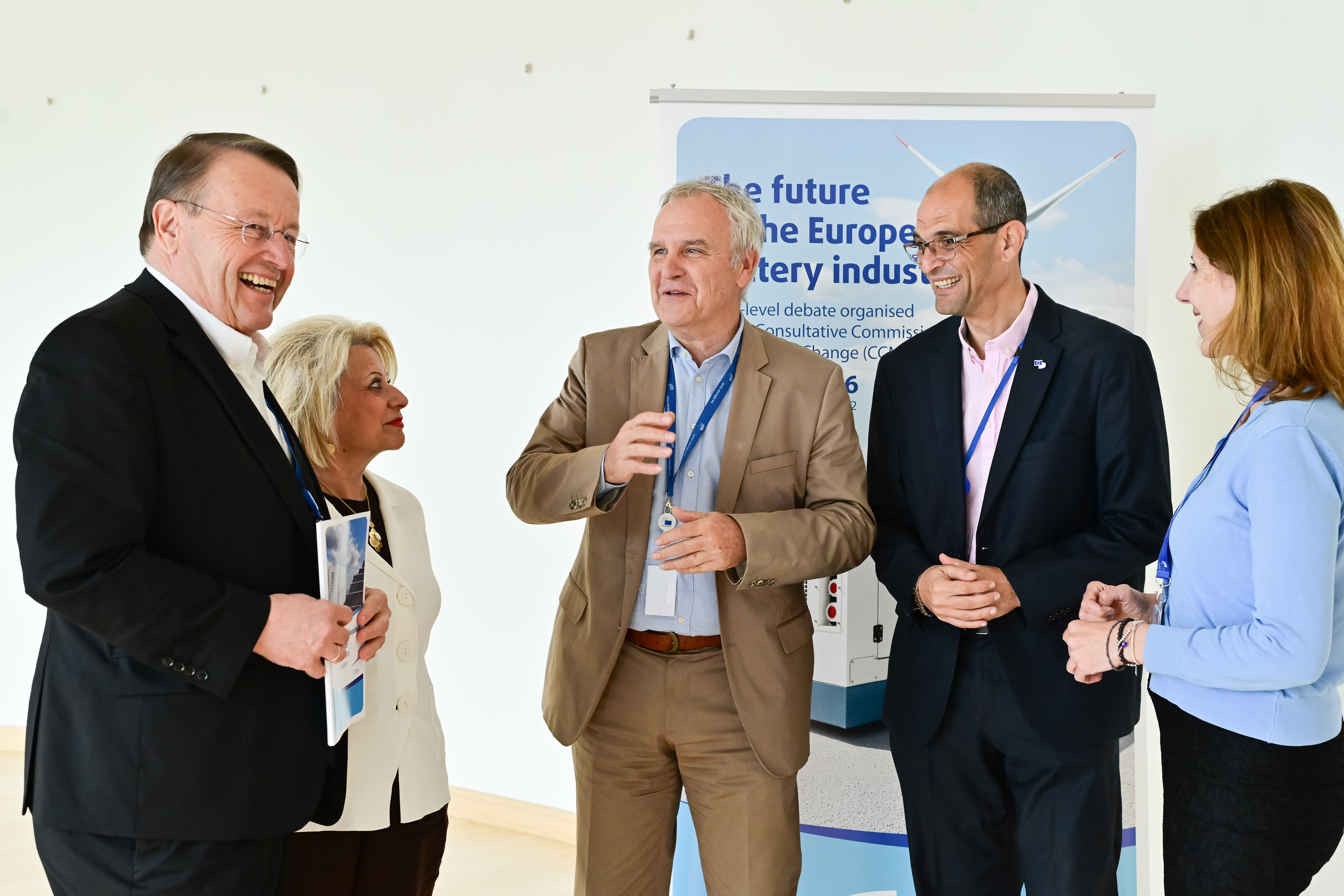
Brussels – The aim of the high-level debate on the future of the European battery industry held yesterday (11 June) by the Consultative Commission on Industrial Change (CCMI) of the European Economic and Social Committee (EESC) was to promote political debate on strengthening the European battery manufacturing industry, with a particular focus on the strategic potential of sodium batteries.
Alain Coheur, President of the CCMI, stressed that “the European battery industry faces significant challenges, including intense global competition, high production costs, supply chain vulnerabilities, and growing technological rivalry. Yet batteries are not merely an industrial product.” They are a key technology for industrial transformation, whether in terms of decarbonisation, energy security or industrial leadership. Therefore, Europe must simultaneously reduce its dependence on imported raw materials, compete with heavily subsidised global markets, ensure access to affordable energy for manufacturing, maintain high sustainability standards, and safeguard quality industrial jobs.
According to MEP Thomas Pellerin Carlin, “to ensure the emergence of a value-added battery supply chain in the EU, a comprehensive and stable regulatory framework is needed. Thanks to the CRMA, the NZIA and the Battery Booster, the EU has the policy in place to supply batteries. But—he added—these batteries require predictable demand, and this is where regulating CO2 standards for cars becomes crucial. If, as the far right suggests, we were to dismantle such regulation, offering zero predictability to battery manufacturers, we will see the death of this emerging strategic sector.”
Joanna Drake, Deputy Director-General of the European Commission’s Directorate-General for Research and Innovation (DG RTD), spoke about the rapidly changing geopolitical and economic landscape facing Europe. “Tensions in the Middle East and the resulting volatility in energy markets are just a reminder that energy security, industrial competitiveness and strategic autonomy are not just buzzwords; they are deeply interconnected and deeply disconcerting. In this context, batteries are much more than a technology. They are a strategic industrial asset for Europe’s strategic economy.”
The central theme of the CCMI debate was sodium-ion batteries, a topic addressed by the EESC in its February opinion “Strengthening the EU’s strategic autonomy and developing a greener and bluer economy: the potential of the sodium-ion battery manufacturing sector”. Sodium batteries are establishing themselves as an alternative to traditional lithium-ion systems in several strategic sectors. They are crucial to the EU’s energy independence and its competitiveness in the global market. As well as being a more environmentally friendly option, sodium-ion batteries offer Europe the opportunity to create an ecosystem that integrates research, industry, and workforce development. However, participants in the CCMI debate cautioned against viewing sodium-ion batteries as the immediate solution to Europe’s battery needs, emphasising that their large-scale deployment is still a long way off. Nevertheless, these batteries offer significant long-term potential within the European battery ecosystem, thanks to gradual expansion.
Although China is currently far ahead of its competitors, accounting for almost 99 per cent of global production capacity, the speakers argued that the race is far from over. This is because the technology underpinning sodium batteries is still in the early stages of development and the foundations for future industrial leadership have not yet been established. This offers Europe a rare opportunity. Unlike the lithium-ion sector, where Asian manufacturers secured a dominant position from the outset, the sodium-ion industry has not yet identified a clear long-term winner. Several participants, therefore, argued that Europe is capable of carving out a leadership role if it acts decisively. However, achieving this EU ambition on sodium batteries will depend on more than just technological progress. Speakers emphasised the need for long-term political support, targeted public and private investment, stable regulatory conditions, and a coordinated economic and political effort in order to establish competitive production capacity.
During the CCMI debate, participants placed great emphasis on developing a coherent European roadmap for batteries. This will translate the objectives set out in the European Commission’s battery strategy—which the EESC discussed in an opinion adopted in March—into concrete measures across the entire value chain, from innovation and production to recycling and skills development.
The speakers also strongly emphasised the need for a credible long-term funding plan for this strategy, with greater support from both the Commission and the Member States, including through the next multiannual financial framework. Furthermore, the “Made in Europe” label should be synonymous with high-quality products, robust social and environmental standards, and industrial competitiveness.
Finally, the EESC advocates an ecosystem-based approach that supports SMEs, suppliers, recycling companies, and large manufacturers. Public funding should be conditional on the creation of quality jobs, full compliance with EU legislation, and adherence to the principles of the European Pillar of Social Rights. At the same time, state aid schemes, public procurement, and grant programmes should be designed to encourage technology transfer and local content, helping to develop strategic skills and industrial know-how within the EU.
English version by the Translation Service of Withub