- Europe, like you've never read before -
Tuesday, 11 August 2026
No Result
View All Result
  • it ITA
  • en ENG
Eunews
  • Politics
  • World
  • Business
  • News
  • Defence
  • Health
  • Agrifood
  • Other sections
    • Culture
    • Rights
    • Energy
    • Green Economy
    • Finance & Insurance
    • Industry & Markets
    • Media
    • Mobility & Logistics
    • Net & Tech
    • Sports
  • Newsletter
  • European 2024
    Eunews
    • Politics
    • World
    • Business
    • News
    • Defence
    • Health
    • Agrifood
    • Other sections
      • Culture
      • Rights
      • Energy
      • Green Economy
      • Finance & Insurance
      • Industry & Markets
      • Media
      • Mobility & Logistics
      • Net & Tech
      • Sports
    No Result
    View All Result
    Eunews
    No Result
    View All Result

    Home » General News » How many “Dublin-case” migrants are there in Europe (evading, in particular, the Italian authorities)?

    How many “Dublin-case” migrants are there in Europe (evading, in particular, the Italian authorities)?

    Germany and France, as can be seen from the chart produced by Withub, are the main final destinations for migrants seeking asylum

    Cosimo Firenzani by Cosimo Firenzani
    11 August 2026
    in General News
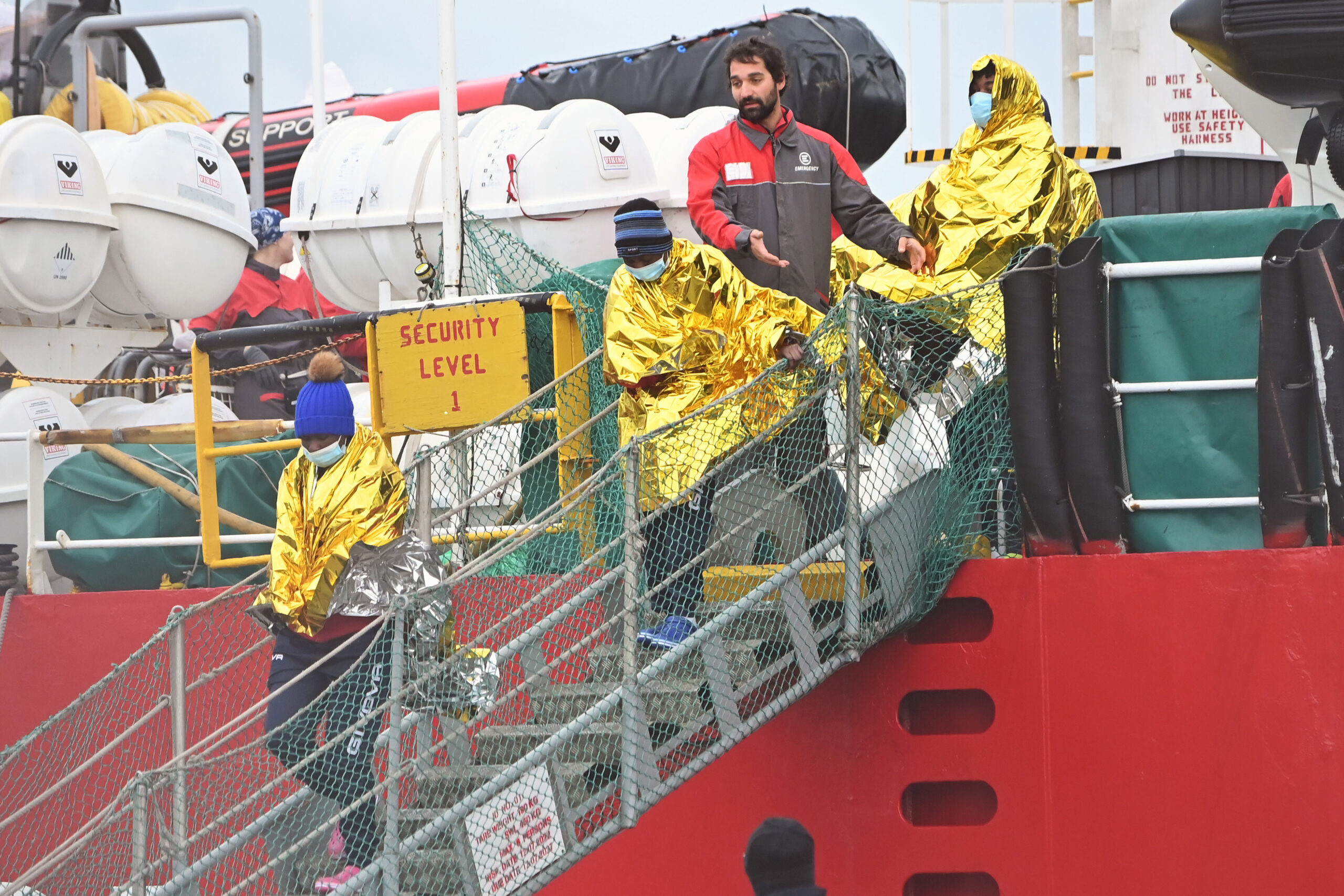
    PORTO  NAVE  LIFE  SUPPORT  EMERGENCY    ATTRACCA  A  BARI CON 120  MIGRANTI    EQUIPAGGIO   SBARCO   MIGRANTI. IMMIGRAZIONE UE. Source: Imagoeconomica

    PORTO NAVE LIFE SUPPORT EMERGENCY ATTRACCA A BARI CON 120 MIGRANTI EQUIPAGGIO SBARCO MIGRANTE MIGRANTI

    Milan – The crisis in Ceuta has put the issue of immigration back on the European agenda. For Italy, the situation is becoming more complicated: following the diplomatic crisis with Spain, a new front has now opened up with Germany. At the heart of the clash between Giorgia Meloni and Friedrich Merz lies the issue of the so-called “Dublin cases”: asylum seekers who have landed on Italian shores but, instead of remaining on the peninsula, have crossed the Alps to reach Germany. The phenomenon of “secondary movements” (the
    term used to describe the transfer of migrants who originally arrived in one EU
    country to another, known as “Dublin cases” under the 2003 Dublin Regulation) has for years been a key issue for the German centre-right. Under the Dublin Regulation, in fact, an asylum application must be examined by the country of first arrival, and more recent agreements have also confirmed this approach.
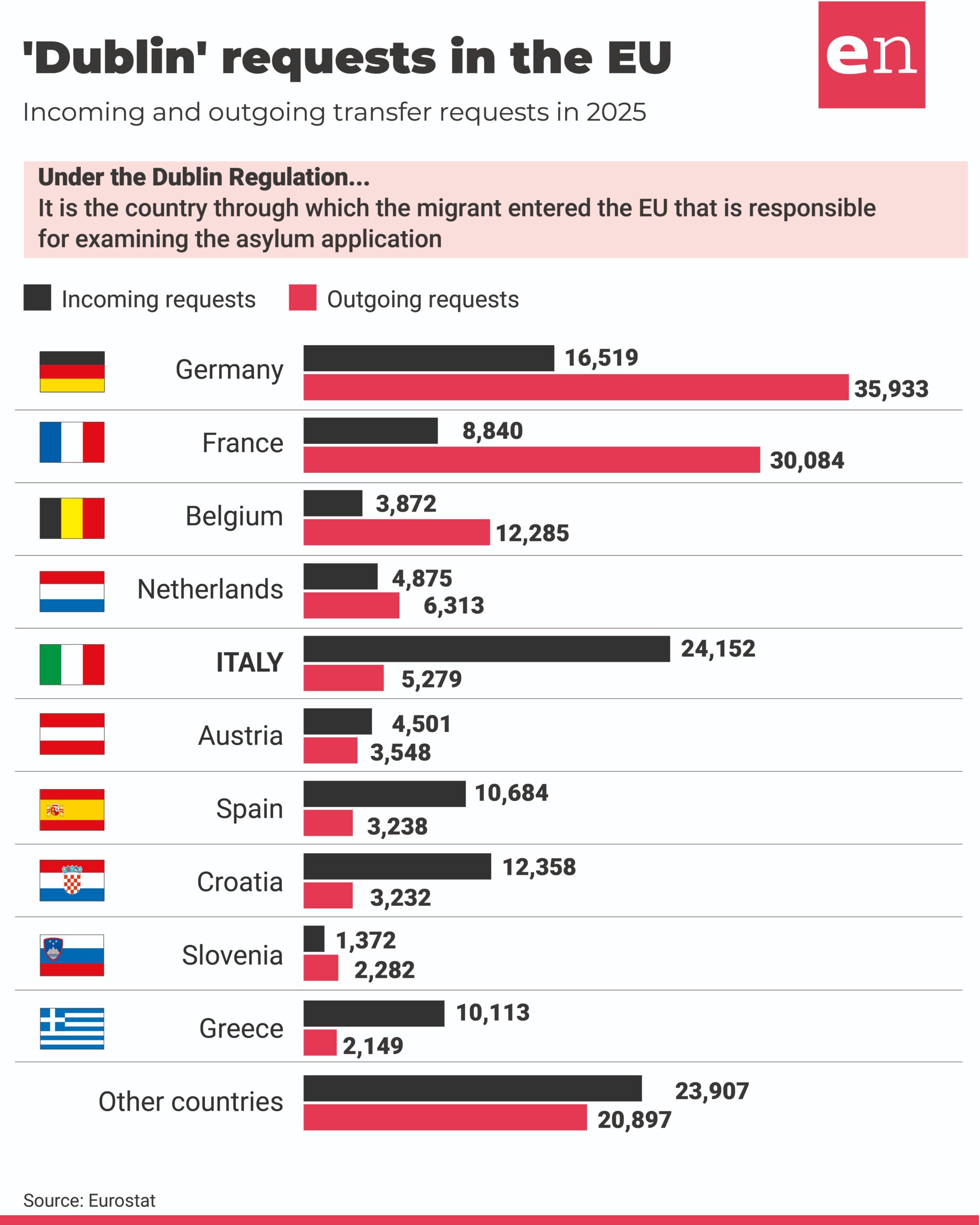
    Essentially, when the authorities of one country consider that jurisdiction lies with another country, they send a transfer request: for the sender, it is an “outgoing” request; for the recipient, it is an “incoming” one. The same figure, viewed from two opposite perspectives. This is the mechanism that enables us to obtain Eurostat data: incoming and outgoing transfer requests, as well as actual transfers, are counted.

    As can be seen from the graph, Germany and France are the main final destinations for migrants seeking asylum: in 2025, Germany processed 35,933 outbound applications and France 30,084. The actual transfers numbered just over 5,000 in the former case and just under 4,000 in the latter.
    In 2025, Italy was by far the country that received the most asylum applications within the EU, 24,152, ahead of Germany (16,519) and Croatia (12,358). As it is often the first country of arrival, Italy is designated as the responsible Member State when an asylum seeker continues their journey to another Member State and lodges an application there. The gap between incoming and outgoing requests tells the same story: Italy sent just 5,279 requests, a fifth of those received. The opposite is true of Germany, which in 2025 submitted 35,933 requests compared with 16,519 received—making it the country that submits the most requests to other Member States.
    At European level, in 2025, nineteen countries received more requests than they sent, while eight, including Germany and France, sent more than they received. Twelve Member States received fewer than 1,000 requests, with Estonia (88) and Ireland (133) on the fringes of the system. Not all transfer requests are the same: of the 115,625 received in total by the EU, 39.4 per cent are “take-charge requests”—where one country considers that another should deal with the application from scratch—while 60.6 per cent are “take-back requests”, i.e. cases where the person has already applied elsewhere.
    English version by the Translation Service of Withub

    Tags: dublinantimigrants

    Related Posts

    Meloni - immigrazione - Ceuta
    General News

    Ceuta widens the rift, Meloni hardens her stance: Europe grows increasingly divided over immigration

    10 August 2026
    rimpatri migranti
    Politics

    EU countries agree to tighten reception and repatriation; set migrant solidarity contributions

    9 December 2025
    map visualization
    PORTO  NAVE  LIFE  SUPPORT  EMERGENCY    ATTRACCA  A  BARI CON 120  MIGRANTI    EQUIPAGGIO   SBARCO   MIGRANTI. IMMIGRAZIONE UE. Source: Imagoeconomica

    How many “Dublin-case” migrants are there in Europe (evading, in particular, the Italian authorities)?

    by Cosimo Firenzani
    11 August 2026

    Germany and France, as can be seen from the chart produced by Withub, are the main final destinations for migrants...

    META e TIKTOK post CEUTA

    The EU is mobilising Meta and TikTok to combat “false promises” made to migrants: crisis protocols have been activated for Ceuta

    by Annachiara Magenta annacmag
    11 August 2026

    Executive Vice-President Henna Virkkunen held talks with the Spanish Minister for Digital Transformation, Óscar López, during which the importance of...

    Pena di morte in Libano - Kaja Kallas

    Lebanon abolishes the death penalty. Kallas: “A powerful example for the Middle East”

    by Annachiara Magenta annacmag
    11 August 2026

    While Lebanon has abolished the death penalty and become the first country in the Middle East to adopt a law...

    SEALED AIR SSE AZIENDA INDUSTRIA IMBALLAGGI IMBALLAGGIO PACKAGING ALIMENTARE FABBRICA STABILIMENTO

    EU Packaging Regulation: new requirements from 12 August

    by Iolanda Cuomo
    11 August 2026

    Strict limits will be introduced on polyfluoroalkyl substances (PFAS) in packaging that comes into contact with food

    • Director’s Point of View
    • Opinions
    • About us
    • Contacts
    • Privacy Policy
    • Cookie policy

    Eunews is a registered newspaper
    Press Register of the Court of Turin n° 27


    Copyright © 2025 - WITHUB S.p.a., Via Rubens 19 - 20148 Milan
    VAT number: 10067080969 - ROC registration number n.30628
    Fully paid-up share capital 50.000,00€


    No Result
    View All Result
    • it ITA
    • en ENG
    • Politics
    • Newsletter
    • World politics
    • Business
    • General News
    • Defence & Security
    • Health
    • Agrifood
    • Altre sezioni
      • Culture
      • Rights
      • Energy
      • Green Economy
      • Gallery
      • Finance & Insurance
      • Industry & Markets
      • Media
      • Mobility & Logistics
      • Net & Tech
      • News
      • Opinions
      • Sports
    • Director’s Point of View
    • Draghi Report
    • Eunews Newsletter

    No Result
    View All Result
    • it ITA
    • en ENG
    • Politics
    • Newsletter
    • World politics
    • Business
    • General News
    • Defence & Security
    • Health
    • Agrifood
    • Altre sezioni
      • Culture
      • Rights
      • Energy
      • Green Economy
      • Gallery
      • Finance & Insurance
      • Industry & Markets
      • Media
      • Mobility & Logistics
      • Net & Tech
      • News
      • Opinions
      • Sports
    • Director’s Point of View
    • Draghi Report
    • Eunews Newsletter

    Attention