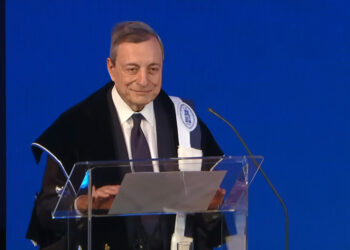
The first remark, caustic and searing, reaches me from the Berlaymont: “He has freed the orator who slept inside the banker.” When Mario Draghi publishes a book, the media system, not just in Italy, enters a state of reverence that resembles devotion more than journalism. It happens on 16 June; here in Brussels, we are already discussing it with that peculiar veneration which only continental newspapers reserve for a man who saved a currency by saying whatever it takes. La Stampa in Turin publishes an extract, as they say in newsrooms, prominently. Other commentators unleash enthusiastic previews. The machinery of draghism sets itself back in motion, punctual and oiled like a precision Swiss timepiece. The book is titled: “Compete or Disappear. For a New European Landscape.” Published by Rizzoli. It gathers speeches delivered from 2023 to 2026, a period during which Draghi held no official position yet seemed to continue governing from outside, from the lectern of the public speaker whom bourgeois Italy has always listened to as if he were an economic confessor.
Here lies the knot. Here begins the real problem, not the one La Stampa and others perceive. Draghi, having left Palazzo Chigi, PM headquarters, in October 2022 with that halfway defeat still reeking of the unfinished, has transformed the absence of formal power into a form of informal power so pervasive that perhaps he has become what Italy does not know it possesses: an organic intellectual of its own absent ruling class. In concrete terms: someone who articulates the thought circulating in the salons of Milan, Rome, Brussels and Frankfurt without answering to anyone. The timing of the book is not accidental. There lies ahead one year, sixteen months at most, then the political elections will arrive. The Quirinal, with Mattarella’s term already scheduled to end in 2029, remains in the background as the final prize of a game that now has no definitive losers.
Draghi already missed the palace once, in 2022, for a piece of media foolishness that nonetheless reveals everything: his wife Serenella, speaking to the barista in Città della Pieve, had confessed (with a downcast air) that her husband would “certainly” go to the Quirinal. That innocent remark became the headline in newspapers. Mattarella remained; his historic second term protected him from any external attempt. This time the context differs. This time the book arrives at a moment when consensus around Draghi amongst major Italian commentators is virtually unanimous, rarely seen; when the European centre-right gains ground (Austria, Portugal, the Netherlands, Germany with the AfD wind at its back, France with the moves by Le Pen, Bardella and an exhausted Macron). When Europe recognises Draghi pragmatism as compass, the Financial Times and Wall Street Journal cite him as “one of the strongest voices among European leaders” on sanctions and Atlantic strategy, whilst Italian newspapers acclaim him without reservation. The preface belongs to Martin Wolf, the principal economic commentator at the Financial Times. And in his prologue Wolf describes Draghi’s words as “the most lucid analysis of the new, turbulent world in which we live, and an appeal to defend, in the name of the values upon which Europe rests, our very freedom.”
Yet a contrast emerges here as well. Each time Draghi pontificates from the public pulpit, Italian papers celebrate him; European ones give him lower-profile coverage; the Financial Times itself only the odd modest column. Given this premise, the book is not merely a collection of speeches; it is, as Wolf grasps it, a manifesto of a vision: pragmatic European federalism, accelerated monetary integration, shared investment in defence and technology. The title Compete or Disappear crystallises the crossroads at which Europe stands and Draghi admits no middle ground, does not believe in narrative compromises. Either Europe competes as a sovereign bloc, with unified budgeting and decision-making, or it vanishes, absorbed by the Usa-China vice. In his prologue he stresses that the European union exists to guarantee democracy, liberty, peace, equity and prosperity; if Europe can no longer guarantee these to its citizens, “it will have lost its reason for being.”
The recipes are not new (he had already proposed them in the September 2024 report, commissioned by Ursula von der Leyen), yet urgency has grown month by month. The world contracts. Tensions in the Gulf (the Hormuz effect that will persist beyond any form of trumpeted peace) have shown how fragile European dependence on maritime trade remains. American and Chinese technological drive admits no delay. War has not disappeared from Europe’s borders. And here, in this context of contraction and fear, Draghi arrives with his ultimatum message: immediate action, federalism without illusions, abandon the language of “social partnership” and confront the true problem, which is not economic policy but regime security. “They will end up asking him to put his proposals into practice, you will see,” says my source standing before the monument in four languages honouring Schuman positioned at the Berlaymont entrance, always requesting anonymity, not from affectation.
What does this mean for the Quirinal? Everything and nothing. Draghi is not an official candidate for anything. But the book functions as a posture, a declaration of principle that says to Italian political actors (and European ones too): here is what I think necessary, here is how true statesmen should move. It is not self-promotion; it is something more insidious: the definition of what it would mean to govern “properly” from 2027 onwards. Whoever wins the 2027 elections, as Italian papers stress, will “hold the cards” for the election of the next head of state in 2029. And whether the Italian centre-right orients itself increasingly towards the populist right of Vannacci (already flirting with sovereigntist and remigration positions), or towards a moderate axis of Meloni with Tajani, or whatever other solution emerges in the months ahead, demands a figure to remind Europe that Italy has not entirely become Hungary. Draghi serves this purpose, though residual, though not a candidate. He serves to say: there is still a higher path.
Yet the risk is that this becomes mere institutional rhetoric whilst things happen elsewhere. The consensus on Draghi in Italy is unanimous amongst bourgeois commentators, true; the Financial Times cites him with respect, true. But what weight does this carry in a Europe where the axis shifts every day further rightward? Where France already looks ahead to the post-Macron moment with anxiety, Germany navigates between CDU and AfD, and even the “moderate” PPE escapes rightward to avoid being overtaken? And if Italy, in less than two years, discovers that the vote does not move where the Roman ruling class would prefer?
Draghi knows all this. Perhaps for this reason the book is not a desperate appeal; it is the summary of a process towards lucid diagnosis of a terminal condition requiring emergency treatment. Compete or Disappear. There is no middle ground, no gradual adaptation, not even a hint of a more cautious five-year plan. Either Europe refashions itself as an economic and military federation in the shortest timeframe, or as he has repeated many times, it disappears. And if Italy does not grasp (or does not accept) this ultimatum, then Italy disappears first, reduced to a satellite of those who made the right choices when time remained.
Perhaps this is the true message. Not so much Draghi at the Quirinal, but Draghi reminding our politicians, in the sixteen months left, that history grants narrow windows of opportunity, and that 2027 might be the last moment to choose how to pass into the second quarter of a new century without excessive damage. And in 2029 come the European elections too, with a new Parliament and new Commission. At the Berlaymont, they have already arranged for an informal translation of the book and the comments that have accompanied it so far.
English version by the Translation Service of Withub![Piccole e medie imprese [Fonte: unsplash]](https://www.eunews.it/wp-content/uploads/2026/06/pierre-chatel-innocenti-LGblf4EH4yk-unsplash-350x250.jpg)

![Da sinistra: il presidente del Consiglio europeo, Antonio Costa; il presidente dell'Ucraina, Volodymir Zelensky: la presidente della Commissione europea, Ursula von der Leyen [Bruxelles, 18 giugno 2024. Foto: European Council]](https://www.eunews.it/wp-content/uploads/2026/06/euco_ua260618-120x86.jpg)
![[foto: Saverio De Giglio/imagoeconomica]](https://www.eunews.it/wp-content/uploads/2026/10/cpt-120x86.png)