
Brussels – Steel will enter a new regime on 1 July as the EU rolls out tighter import quotas and higher tariffs on exporters that exceed the established thresholds. Following the inter-institutional agreement in mid-April between the Parliament and the Council, the European Commission today (30 June) is presenting the implementing regulation that brings the new Steel Regulation, as the European Union’s response to persistent global overcapacity in the steel sector, which remains a serious global problem and continues to distort international markets.
The European Commission currently records over 620 million tonnes of steel entering the global market, and it is estimated that this volume could reach 721 million tonnes – more than five times the EU’s annual steel consumption. These figures have justified the regulation, which comes into force tomorrow.
Steel: the new EU regime
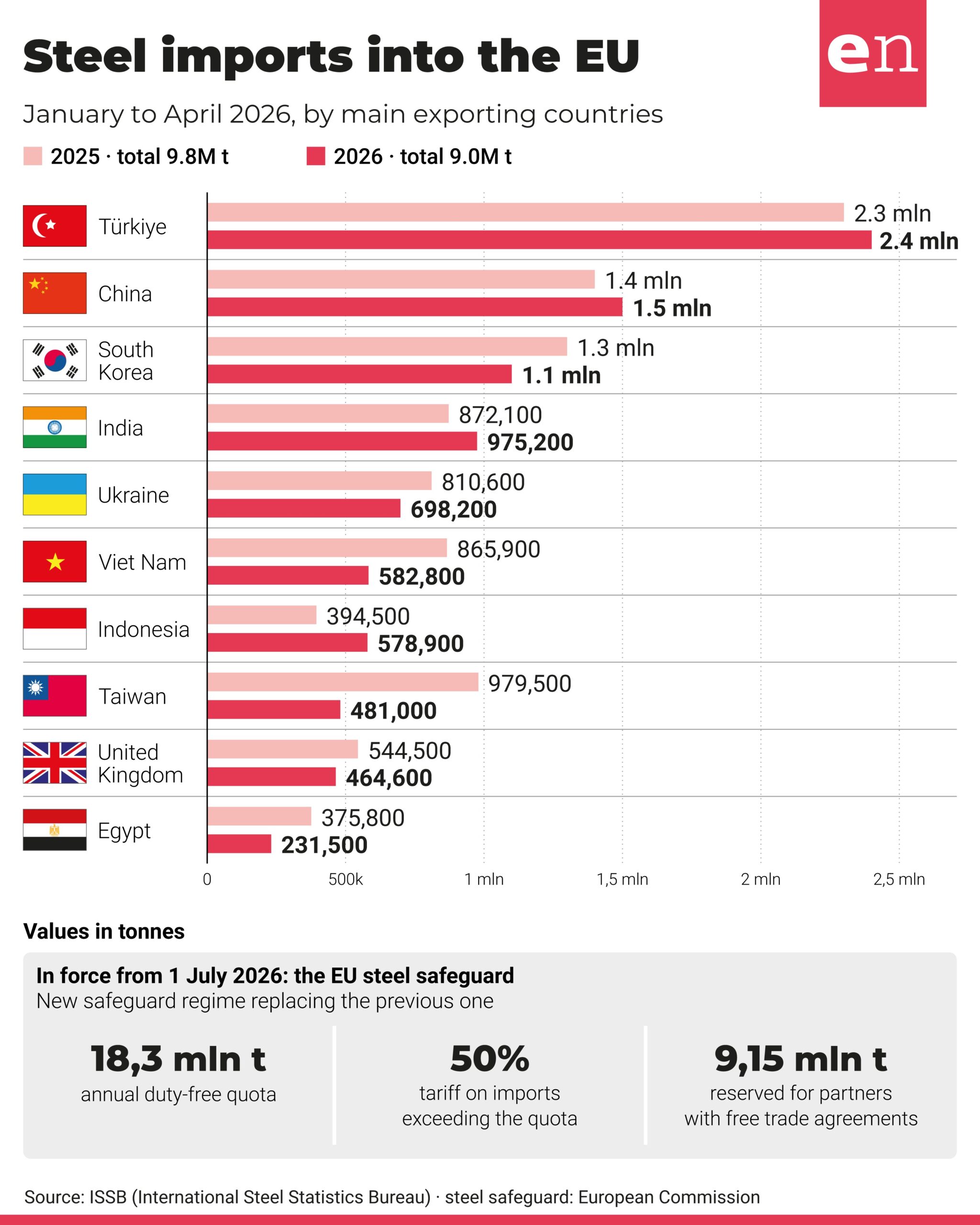
The new rules on steel imports into the European single market provide, first and foremost, for a total quota of 18.3 million tonnes at zero duty. Imports exceeding this quota will be subject to a 50 per cent duty on the selling price. Half of the EU’s annual import quota – 9.15 million tonnes – is reserved exclusively for trading partners with whom the EU has concluded free trade agreements. The other half of the quota is allocated to all other third countries. Countries with which the EU has free trade agreements in force may draw on the second half of the total quota, in competition with third countries. Consequently, the EU’s partner countries with which free trade agreements have been concluded will retain a significantly larger share of access to the EU market than others.
Of the quota available exclusively to partners with whom the EU has existing free trade agreements, the largest part consists of country-specific allocations. These are allocated to countries that have historically accounted for at least 5 per cent of import volumes (based on an average share of imports in the years 2022–2024). The remaining volumes are available for export from all free trade agreement partners on a competitive basis.
The countries of the European Economic Area (Iceland, Liechtenstein, and Norway) are not subject to tariff quotas or customs duties under the steel measure. This differentiated approach is justified by their very high and unique level of integration into the EU’s internal market, despite not being Member States of the European Union.
“With today’s implementing regulation, the Commission is putting in place the practical arrangements needed to ensure that the EU’s steel measure operates effectively from day one,” Trade Commissioner Maroš Šefčovič said. Through the new rules, he adds, “we are providing market participants with predictability through clear and transparent quota distribution rules, while applying a fair and objective methodology.”
English version by the Translation Service of Withub
![ferrosilicio [foto: FocalPoint/Wikipedia Commons]](https://www.eunews.it/wp-content/uploads/2026/03/ferrosilicio-350x250.jpg)