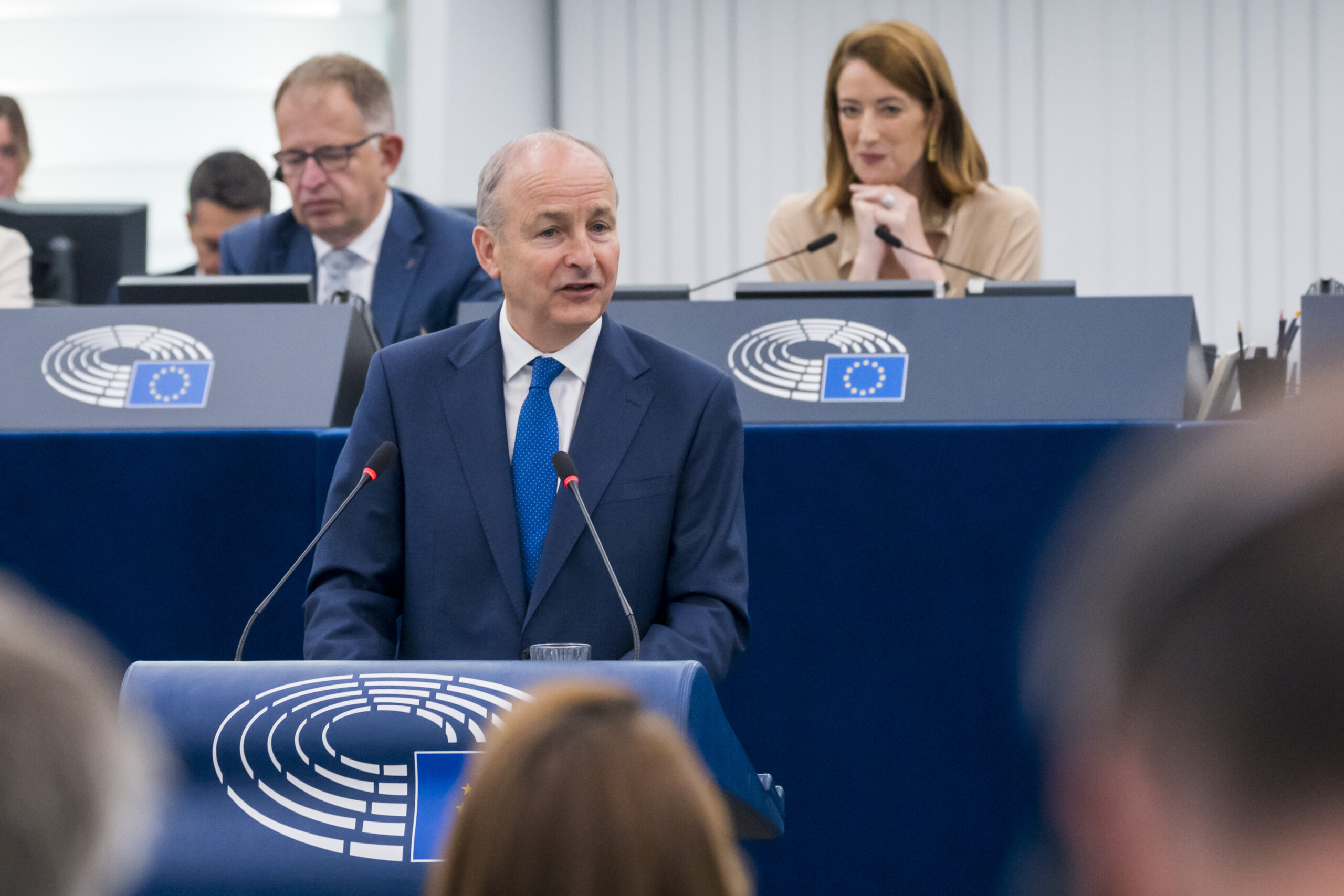
Brussels – “Tús maith leath na hoibre” – “A good start is half the work.” With these words, Irish Prime Minister Micheál Martin has set out the course for the next six months. Competitiveness, values and security are the three pillars around which Ireland is building its six-month presidency of the Council of the European Union, which began on 1 July. Presenting the programme to the European Parliament in Strasbourg, the Taoiseach stressed the political objective set to dominate the agenda: reaching an agreement on the next Multiannual Financial Framework (MFF) for 2028–2034.
“Throughout our term of office, we will work to make the Union more prosperous and safer, and to defend our shared fundamental values,” Martin assured. This challenge is intertwined with the negotiations on the European multiannual budget, one of the most complex issues facing the EU-27. European leaders have already tasked Dublin with reaching a compromise by the end of 2026, reconciling national priorities and interests that are often at odds.
On competitiveness, the Irish Prime Minister stressed the need to speed up Europe’s economic recovery. “We share the assessment that Europe urgently needs to improve its competitiveness and productivity,” he said, adding that “competitiveness is a dry word, but it couldn’t be more important to the lives of the people whom we serve.” According to Martin, “we need to be economically competitive in order to sustain the European way of life,” because stronger growth alone can fund welfare, employment, healthcare, the green transition, and security.
The Irish Presidency therefore aims to implement the “One Europe, One Market” roadmap by reducing administrative burdens, completing the single market, and fostering business growth, including through the “EU Inc.” project. Other priorities include completing the European Networks Package, strengthening energy security, reducing energy costs, and advancing a European agenda on artificial intelligence, which will be the focus of the summit scheduled for Dublin on 14 October. There is also a focus on innovation in healthcare, with legislative initiatives on biotechnology and medical devices considered strategic for European competitiveness.
The second priority is security, encompassing geopolitical, economic, and energy dimensions. “We will continue to offer unwavering support to Ukraine,” Martin reiterated, emphasising that political, financial and military support must be accompanied by “ever-increasing pressure on Russia” through more effective sanctions. At the same time, he argued that “Europe must also invest in all dimensions of its own security and rapidly develop its defence capabilities” by closing strategic gaps and strengthening resilience, cybersecurity, and protection against hybrid threats.
The overarching theme of the six-month term remains the negotiations on the multiannual budget. “To achieve these goals, we need a budget that can match our ambitions,” Martin said, criticising the fact that the EU has “too often” addressed new priorities by diverting resources from existing programmes. Whilst acknowledging that the negotiations “won’t be easy,” the Prime Minister said he was convinced that “an agreement in the Council can be reached by the end of this year.” He assured that the Irish Presidency will act “as an honest broker” to bridge the gaps between Member States and build the necessary consensus on the future European budget for the period 2028–2034.
English version by the Translation Service of Withub


![Da sinistra: il presidente del Consiglio europeo, Antonio Costa; il presidente dell'Ucraina, Volodymir Zelensky: la presidente della Commissione europea, Ursula von der Leyen [Bruxelles, 18 giugno 2024. Foto: European Council]](https://www.eunews.it/wp-content/uploads/2026/06/euco_ua260618-120x86.jpg)
![[foto: Saverio De Giglio/imagoeconomica]](https://www.eunews.it/wp-content/uploads/2026/10/cpt-120x86.png)