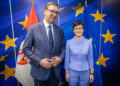
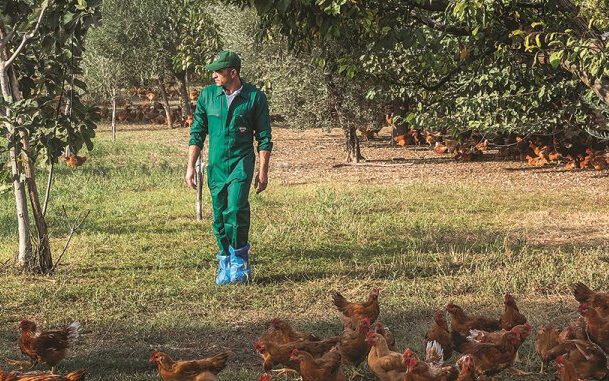
Brussels – “This strategy covers agriculture and rural development, animal welfare, and cohesion.” This is how the Executive Vice-President for Cohesion and Reforms, Raffaele Fitto, presented the Livestock Farming Strategy adopted today (7 July) by the European Commission.
Fitto explained that the document addresses the many challenges facing the sector, including “global competition, the need to remain profitable, and society’s expectations regarding animal welfare and sustainability.” The text is accompanied by a Protein Action Plan, an initiative aimed at increasing protein supply and production within the Union.
During a joint press conference with Fitto, the European Commissioner for Agriculture and Food, Christophe Hansen, pointed out that the European livestock sector is a European success story, as it employs around 7 million people and generates an annual turnover of around €400 billion, as well as a trade surplus of €37 billion. However, “this success is at risk due to rising production costs, extreme weather events, animal diseases, and low profitability,” a situation that has led to a 10 per cent reduction in livestock numbers over the last ten years.
Accordingly, the Strategy sets out five priorities for action. The first is the development of a resilient and crisis-ready livestock sector. This means working with the European Investment Bank to develop climate-related insurance schemes and to support animal disease risk management.
In second place is competitiveness: to ensure the sector’s prosperity, the plan encourages technological innovation and promotes new income opportunities for farmers through the circular economy, renewable energy and the production of organic products.
The third is sustainability. With a view to reducing emissions and protecting the environment, the strategy aims to use policy instruments, research and innovation to further reduce environmental externalities. Taking into account Europe’s diverse circumstances, it also promotes a tailored approach.
Next comes territorial balance: the Commission intends to tackle depopulation and land abandonment in vulnerable rural areas, particularly along its eastern borders. At this stage, support from an EU Observatory on Territorial and Demographic Policies is envisaged.
Finally, excellence. The EU intends to reward farmers who adhere to high standards for animal welfare and carbon emissions reduction. This also includes a proposal to phase out the use of cages for certain livestock and to ensure that imported products meet EU standards. The aim is to develop “a European system of excellence” and a “Buy European” campaign.
Finally, with regard to the Protein Plan, the Commission aims to increase the share of protein crops produced in the EU (soya and pulses) for animal feed, raising it from the current 25 per cent to 35 per cent by 2035. Hansen concluded the press conference by stating that, according to the FAO, the EU’s livestock sector is already the most efficient in the world, but that this success story is now at risk. “We must move beyond polarising debates and focus on practical solutions,” he concluded.
English version by the Translation Service of Withub![Fertilizzanti [foto: imagoeconomica, via Fomet spa]](https://www.eunews.it/wp-content/uploads/2026/05/Imagoeconomica_2404695-350x250.jpg)


![Da sinistra: il presidente del Consiglio europeo, Antonio Costa; il presidente dell'Ucraina, Volodymir Zelensky: la presidente della Commissione europea, Ursula von der Leyen [Bruxelles, 18 giugno 2024. Foto: European Council]](https://www.eunews.it/wp-content/uploads/2026/06/euco_ua260618-120x86.jpg)
![[foto: Saverio De Giglio/imagoeconomica]](https://www.eunews.it/wp-content/uploads/2026/10/cpt-120x86.png)