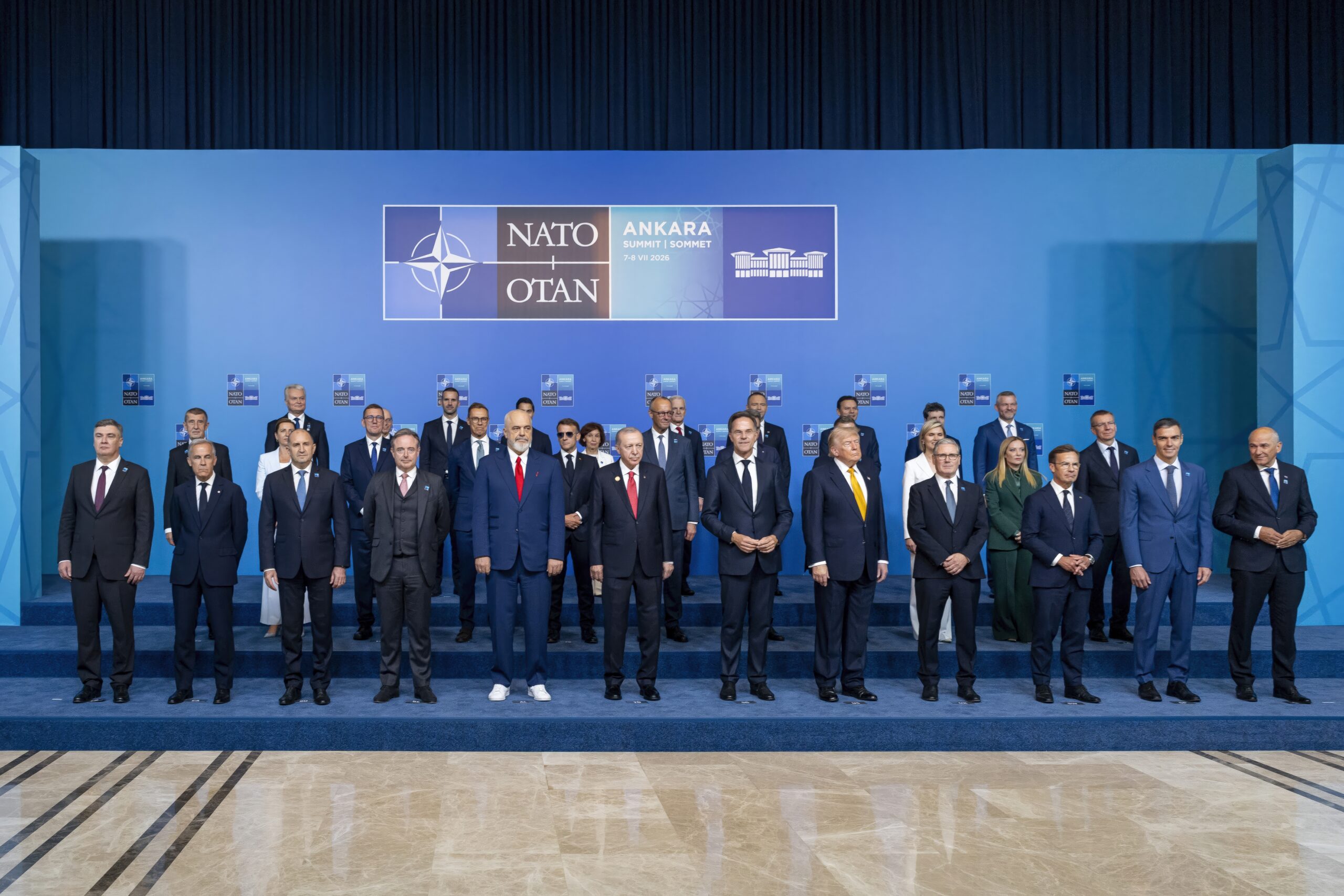
Brussels – From the “unwavering” commitment under Article 5 of the North Atlantic Treaty to the 140 billion to be allocated to Ukraine for 2026 and 2027. From 50 billion in defence contracts, to Russia being described as a long-term threat. From Iran, which must never be allowed to possess nuclear weapons, to the recognition of the increased spending commitments by European allies and Canada. The Ankara NATO summit declaration is trying to hold together all the pieces of an Alliance that is on edge and fractured from within. A “huge success,” characterised by a “palpable sense of unity,” where “allies have enthusiastically welcomed President Trump’s leadership, which is transforming this Alliance and making it stronger,” the Secretary-General reassured at a press conference, Mark Rutte, who exulted: “The Alliance is stronger than ever.” A strength, however, where the issue is not “spending more, but maintaining the security of a billion people,” Rutte stated. In other words, “modernising our Alliance means a stronger Europe within a stronger Alliance.” In fact, the central issue remains that of spending, and a spending that favours Washington: “All contracts awarded will benefit American industry, creating more jobs. Because we are the best and the fastest at manufacturing,” the US President, Donald Trump, would comment later that day at his press conference.
Perhaps this is also why the White House tenant describes the summit as “a great success,” adding that “there was extraordinary unity in that room” and “love,” where “each of the leaders spoke very well” and they are “very intelligent people, who have so much good in their hearts—not evil, but good—and are doing a brilliant job for their country.”
The day, however, had not begun on such a positive note for Trump, and the Secretary-General once again had to play the role of “fire-extinguisher” in the face of the tycoon’s discontent towards the allies he had brought with him to Turkey. Spain is “a terrible partner” with whom “we no longer want to do business”; “the UK did not allow us to use the island for two weeks”; “Italy has been dreadful when it comes to its bases,” along with “a few other” allies. It was already well known that the US president was “very unhappy with NATO.” The main reason lies in what he brands as a lack of support for Washington in its war against “the main state sponsor of terrorism,” Iran. “When we asked them to join us, they all said no,” while the US has spent “over a thousand billion dollars.” An imbalance typical of the usual spoilt Europe, in his eyes: “We protect them, but they aren’t there for us.”
But another source of tension has also resurfaced at the meeting in Turkey: Greenland. “Greenland is very important to the United States, but not to Denmark. When Denmark was invaded by the Nazis, Hitler defeated them in less than a day and took control within a day. They asked us to take charge of Greenland. In fact, we took Greenland and then, foolishly, gave it back. We shouldn’t have given it back, because we are the ones who need it. We need it for the protection of the world, not just the United States,” he said.
Then there is Iran, with the ceasefire coming to an end and reports of possible US attacks as early as tonight. The leaders in Tehran are “liars,” “scum,” “sick people” who “make a deal and then say it was never discussed. As far as I’m concerned, it’s over,” Trump said. And he warned: “Yesterday we struck Iran hard and we’re likely to do it tonight as well. This is a warning I’m issuing.” Last night’s attack received Rutte’s endorsement. “I think it was absolutely necessary,” he commented this morning ahead of the summit, “because when there is a ceasefire, and Iran violates it, I think it is absolutely essential that the United States responds forcefully.”
The White House tenant, however, has high regard for the Turkish President, Recep Tayyip Erdogan: “A great leader, he has been extraordinary. He is a friend of mine, and has been for a long time. He is a strong person with a very strong personality, and that is why he governs such an efficient and well-organised country; I would say it is truly a great country from a military point of view,” he said at a press conference. And Chinese President Xi Jinping: “China has treated us well,” “I told President Xi that I hoped he would not get involved in the conflict” against Iran. “It receives over 50 per cent of its oil from the Strait of Hormuz and has not gone to war. It has not supplied equipment to Iran. It has been exceptional. I am a great admirer of President Xi,” he stated this morning.
Against this backdrop, Rutte first confirmed that Trump “is fully committed to NATO,” although “there is an expectation” that “Europeans and Canada will bring their spending in line with that of the US.” He then summed up that “we argue in order to become stronger.” He emphasised “the good news” that is “today’s great victory, and it is a defeat for Putin and a victory for President Trump, and Europeans and Canadians are doing exactly that.” A point the tycoon acknowledged at the press conference. “All the leaders understand perfectly well that the United States remains by far the largest contributor to NATO in economic terms, and perhaps in other areas too, and the strongest military power in the world,” and “now everyone is moving towards spending 5 per cent,” he said.
As for Iran, “I know you’re disappointed, but 5,000 aircraft have taken off from European airports in support of Operation Epic Fury,” Rutte argued this morning. “Europe has served as a major platform for projecting American power, assisting the United States in the operation,” he added.
The Italian Prime Minister, Giorgia Meloni, emphasised the need to meet the targets set by the Alliance. “Wherever I have the means to strengthen defence and security, I will do so as far as I can. Today we are at 2.8 per cent of gross domestic product; next year we will make every effort to increase this further, to improve still more, and we will honour our commitments. But the commitments we have undertaken to honour seem to me to be the appropriate ones at this time, I would not go beyond them,” she stated at a press conference following the Summit. The Peninsula, she noted, “is a credible ally” and “this is demonstrated by the nearly 3,000 Italian military personnel deployed in the Alliance’s main theatres of operation: we are the NATO nation that contributes the greatest number of men and women to the missions in which NATO is engaged, by far.”
Consequently, the call for unity is the first point set out in the Summit’s final declaration. “We, the Heads of State and Government of the North Atlantic Alliance, have gathered in Ankara to reaffirm our ironclad commitment to collective defence under Article 5 of the Washington Treaty and to the transatlantic bond. An attack on one is an attack on all,” it states. “To counter the long-term threat that Russia poses to Euro-Atlantic security and stability and the persistent threat of terrorism,
Allies are delivering on The Hague defence commitment,” the text continues. It notes that, by 2025, the European Allies and Canada had increased their investment in essential defence requirements by over 139 billion dollars, “providing the capabilities we need, while strengthening our industrial base and resilience.” Meanwhile, “today in Ankara, we are announcing over 50 billion dollars in new contracts and committing to expanding our collective production capacity and working with industry to accelerate innovation.”
The declaration also mentions Iran—the 32 allies reiterate that “it must never possess a nuclear weapon”—while Ukraine and Western support for Kyiv remain central. “The European Allies and Canada now fund the vast majority of security assistance to Ukraine through bilateral and multilateral channels. The Allies emphasise that such support must be equitable, predictable and sustainable in the long term. For 2026, the Allies commit to providing Ukraine with 70 billion euros in military equipment, assistance and training, and reaffirm their sovereign commitment to maintaining at least equivalent levels in 2027”, the declaration states.
On the eastern front, Rutte emphasised that Moscow “is in trouble” and that “the economy is in a serious state,” while “Ukraine is making deep inroads into Russia, in terms of energy and defence infrastructure.” For the Ukrainian president, Volodymyr Zelensky, too, “Russia’s conditions for peace are changing” because “it is no longer just about the number of soldiers, but the main issue is also military technology, and I believe we have a certain advantage,” added Zelensky.
English version by the Translation Service of Withub


![Da sinistra: il presidente del Consiglio europeo, Antonio Costa; il presidente dell'Ucraina, Volodymir Zelensky: la presidente della Commissione europea, Ursula von der Leyen [Bruxelles, 18 giugno 2024. Foto: European Council]](https://www.eunews.it/wp-content/uploads/2026/06/euco_ua260618-120x86.jpg)
![[foto: Saverio De Giglio/imagoeconomica]](https://www.eunews.it/wp-content/uploads/2026/10/cpt-120x86.png)