Brussels – A new mechanism for shared debt of €850 billion a year, to support investment and revitalise the EU economy on a grand scale. Spain is reshaping the European political debate with a plan aimed at strengthening the single market, “contributing to Enrico Letta’s agenda in terms of reducing barriers” to growth and competitiveness. Carlos Cuerpo, the Spanish Finance Minister, arrives in Brussels for the Eurogroup meeting with a plan that directly involves Italy, France, Germany, and the Netherlands, given that, as he explains, “to achieve sufficient scale” for the plan’s success, it is necessary for “the major issuers” in the eurozone to participate.
Under the Spanish proposal, the aim is to achieve savings of up to €25 billion a year by funding EU integration and growth through bonds issued by the Commission, which would be guaranteed by the EU budget as a last resort, resulting in the centralisation of shared debt that national governments would be required to honour in the first instance. “It is not debt mutualisation; it is greater efficiency in debt issuance,” insists Cuerpo. Underpinning this plan, worth €850 billion euros a year, remains “voluntary participation”, for a coalition of the willing that, however, does not exist.
Germany has always been opposed to the idea of Eurobonds, and Berlin has already said “nein” even when it comes to defence, a central theme of the new twelve-point political agenda. The Dutch Finance Minister, Eelco Heinen, nips any discussion on the subject in the bud: “There’s a debate about Eurobonds every day. It probably won’t be the last, but the answer is always the same: no!”
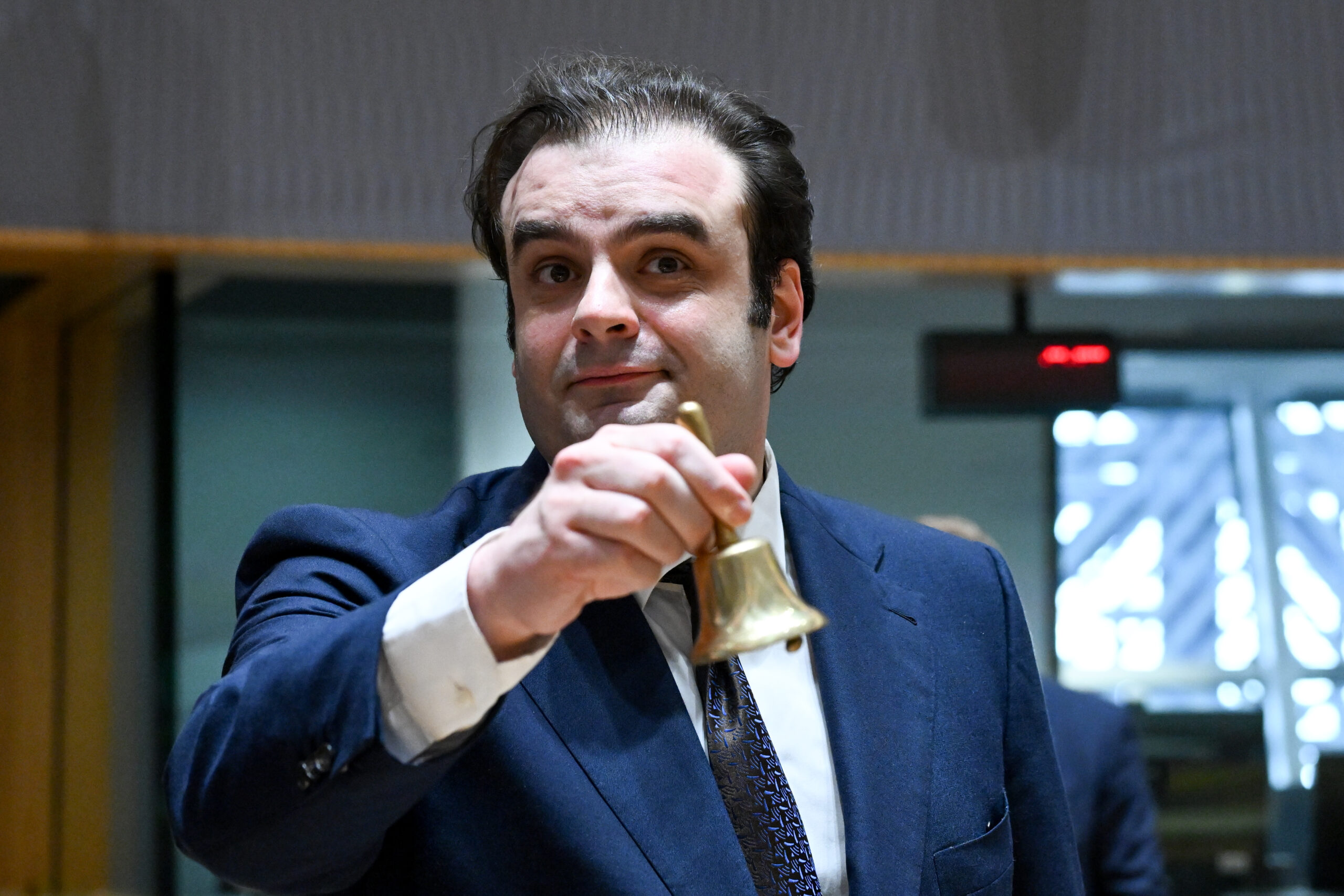
Finland, too, strongly rejects Spain’s proposal: “No to new shared debt,” declares Helsinki’s Finance Minister, Riikka Purra. Shared debt, she insists, “is not the solution, and it is not an option for Finland.” Meanwhile, Simon Harris, Ireland’s Finance Minister, points out that the the rotating presidency held by his country “aims to reach an agreement on the multiannual financial framework” (MFF 2028–2034), which will require a significant amount of work. A veiled way of saying that Ireland does not intend to push the issue. Not least because, as the President of the Eurogroup, Kyriakos Pierrakakis, admits, “there is currently no consensus on this.”
While waiting and seeking an agreement on new joint debt programmes—which is proving an uphill struggle—the agenda remains the same for everyone: “Reforms, reforms, reforms”, emphasises the President of the Eurogroup. Given an uncertain and unpredictable international context, he explains, “we cannot make any predictions at this stage, and so we must keep our own house in order.”
English version by the Translation Service of Withub![Il castello di Alden Biesen, in Belgio, dove si riuniranno i leader dell'UE per il vertice informale dedicato a mercato unico e competitività [foto: European Council]](https://www.eunews.it/wp-content/uploads/2026/02/aldenbiesen-350x250.jpg)


![Da sinistra: il presidente del Consiglio europeo, Antonio Costa; il presidente dell'Ucraina, Volodymir Zelensky: la presidente della Commissione europea, Ursula von der Leyen [Bruxelles, 18 giugno 2024. Foto: European Council]](https://www.eunews.it/wp-content/uploads/2026/06/euco_ua260618-120x86.jpg)
![[foto: Saverio De Giglio/imagoeconomica]](https://www.eunews.it/wp-content/uploads/2026/10/cpt-120x86.png)