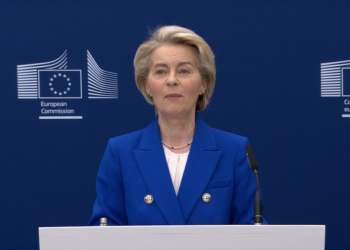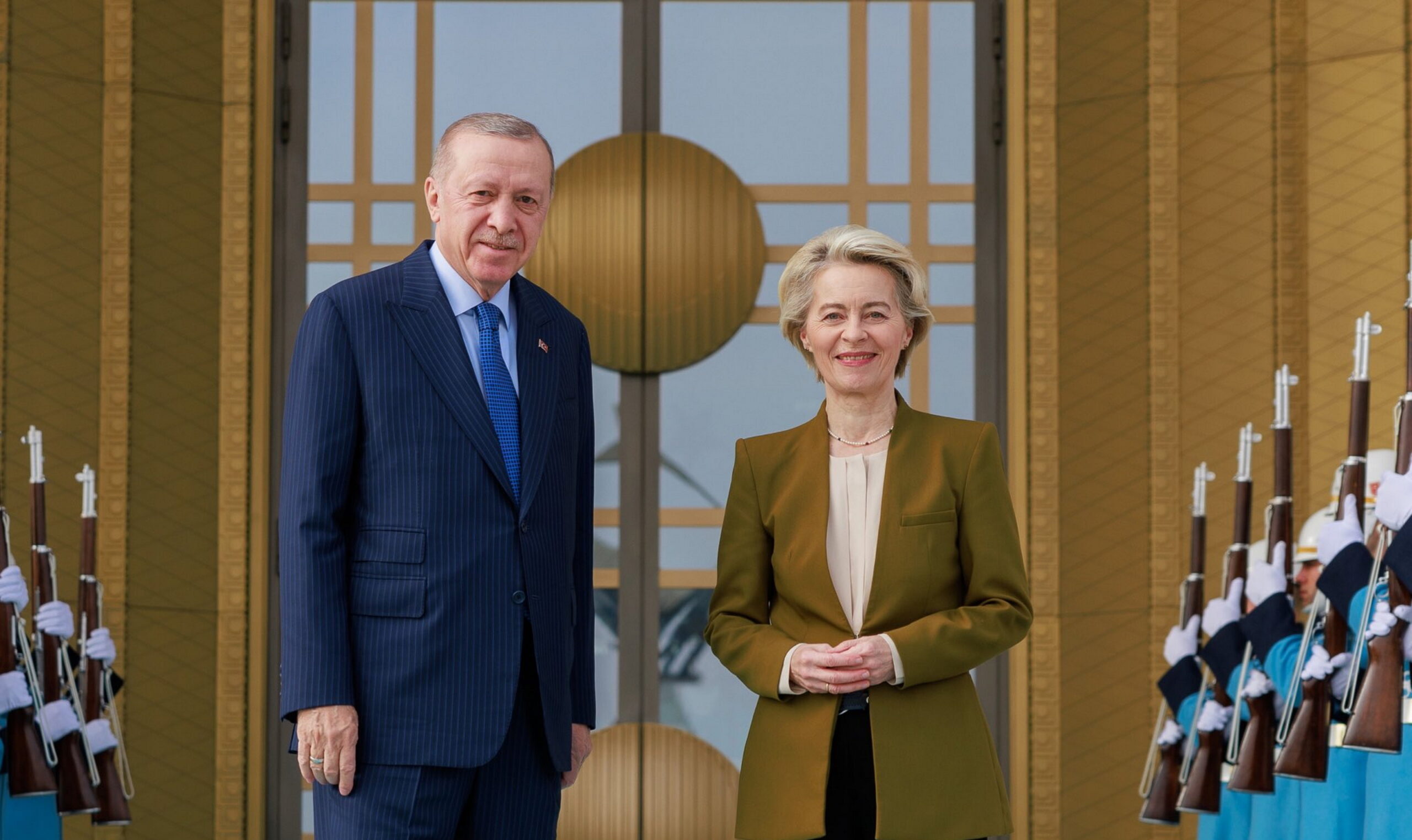
Ursula von der Leyen ‘thanked’ Turkish President Recep Tayyip Erdoğan for giving her a revolver — as he did with all the other leaders — at the end of the NATO summit in Ankara. Not an antique revolver that might recall the struggle for independence, still a weapon, an inherently troubling object, but one that may carry centuries of history and thus becomes something that symbolises a story.
No, it’s a Turkish-made pistol from the 1990s, a Gumusay 357 Magnum (complete with bullets, so ready for use), very similar to the one Inspector Callaghan uses in the second film of the series about the tough cop played by Clint Eastwood, a “tough guy with a heart of gold.” In short, a very aggressive, heavy‑caliber revolver — designed to kill by inflicting massive damage on the victim’s body, not conceived for any theoretical “self‑defence” purpose.
A spokesperson for the European Commission — not a particularly sharp one — explained that von der Leyen felt the need to express her thanks for receiving such an object. Sometimes it’s better to say nothing. But not everyone is born to be a political spokesperson.
Now, for heaven’s sake, we’re talking about a gun — specifically a very aggressive one. Leaving aside the sheer bad taste of the item itself as a gift, and the fact that – let’s not be hypocritical – NATO was meeting to discuss governments’ acquisition of weapons far more lethal than a revolver, but honestly — the president of the European Commission, who is supposed to be a champion of peace, who should abhor violence — can she really “be grateful” to someone (and not just anyone: someone widely seen as coarse, and whose system of government borders on dictatorship) for giving her an object designed to tear apart a victim’s body?
From what I’ve been able to find, that ‘brilliant’ Commission spokesperson Olof Gill is the only one who expressed the “recipient’s” view on the gift received. Had he even a bit of professional instinct — just a little — he would have kept quiet, or at least avoided mentioning the word “gratitude,” as the other spokespersons did. The story came to light because the British Prime Minister, Keir Starmer, told journalists about the incident on the flight back to London, without mentioning any thanks but emphasising that he had left the gun there in Turkey, at the embassy – as, it later transpired, other leaders had also done. An explicit gesture of dissent. Giorgia Meloni, without comment, took it to Rome without even touching it, entrusting it to her security detail before consigning it to the “gift collection” at Palazzo Chigi, where it will probably remain gathering dust, as such a gift deserves.
Not Von der Leyen, though – she liked the gift; she liked it so much that she’s going to donate it to a military museum in Belgium (perhaps the War Museum, which is just a few metres from her office, so she can pop in from time to time to admire the object on which her name is engraved). In other words, according to the President of the European Commission – who, in theory, is a champion of world peace – a Turkish revolver from the 1990s is so important an artefact that it deserves a place in a museum. Perhaps because it has gained value simply by having been given to her personally.
In short, Erdoğan is the unpleasant – indeed, detestable – man that he is, but NATO leaders have to deal with him. That does not, however, mean we should sympathise with him or appease him, particularly when he tramples on the values of the European Union.
English version by the Translation Service of Withub