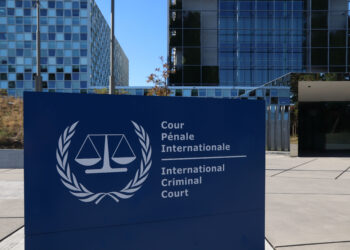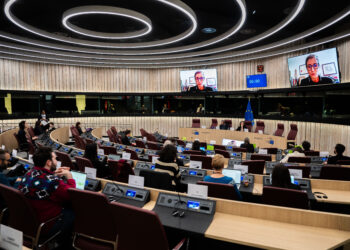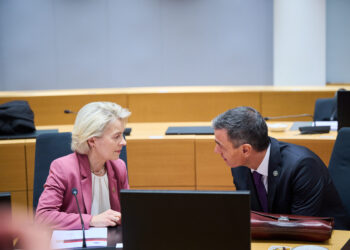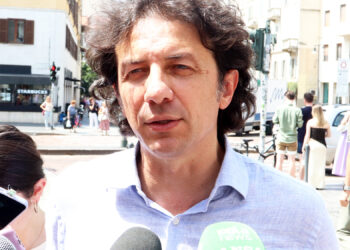
For several months, an essential debate has been taking place across Europe: do we still want to live in a world governed by law, or do we accept the return of the rule of the strongest? This question is crystallising today around the International Criminal Court.
Created by the Rome Statute adopted on 17 July 1998, the ICC was founded on a simple conviction: some crimes are so serious that they concern humanity as a whole. Genocide, crimes against humanity, war crimes, the crime of aggression: no political, military, or economic leader should be able to rely indefinitely on their power to escape justice.
It is precisely this principle that is now being seriously challenged.
The United States and Russia openly contest certain decisions of the Court. Moscow reacted to the arrest warrants related to the war in Ukraine by initiating criminal proceedings against ICC judges, with effects essentially limited to Russian territory. Washington, under Donald Trump’s presidency, has chosen a different path: that of extraterritorial economic sanctions against the Court, its judges, and its staff.
These measures are far from symbolic. They can prevent targeted individuals from accessing banking services, payment instruments, digital platforms, and IT tools that are essential to everyday life and to the work of an international institution. Indirectly, these sanctions also heavily affect victims’ associations that provide assistance to judicial investigations. The message is clear: enforcing international law can now expose judges to economic retaliation, as well as associations and individuals working in connection with ICC activities.
Let us not be mistaken! This is not merely a legal disagreement, but a genuine attempt at political deterrence. If international judges can be sanctioned for taking decisions that displease a major power, then the very independence of international justice is placed at risk.
Faced with this situation, Europe cannot limit itself to declarations of principle. It has a concrete instrument at its disposal: the Blocking Statute, whose activation has already been requested through a resolution of the European Parliament, would make it possible to neutralise the effects of US extraterritorial sanctions within European territory. In practice, this would mean that companies operating in the European Union would have to continue providing services to individuals and institutions targeted by such sanctions.
The question addressed to the European Commission and its President, Ursula von der Leyen, is therefore fundamentally political: does the European Union want to protect a court of justice that is based in Europe and represents one of the greatest achievements of contemporary international law?
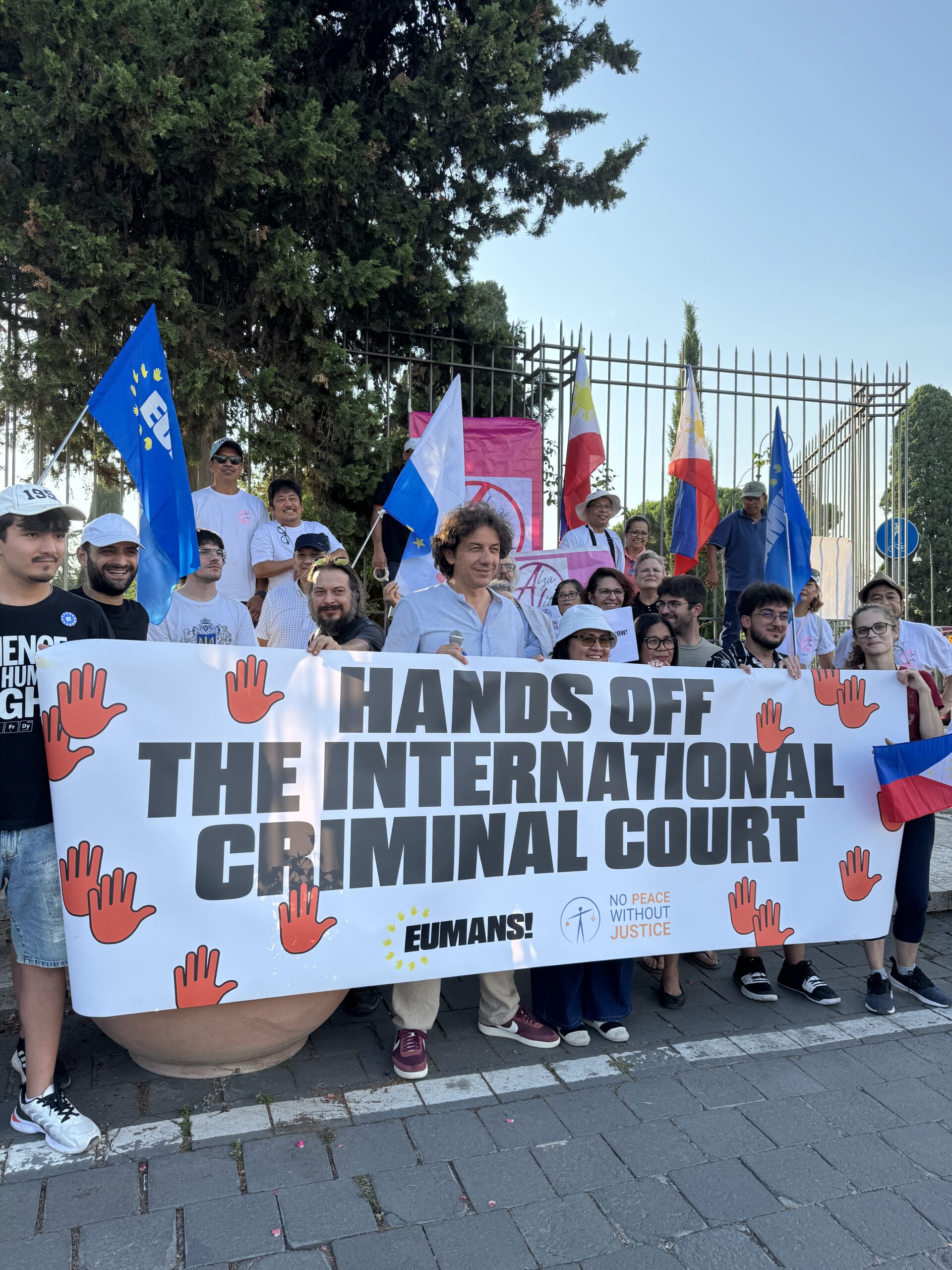
In response to this campaign, promoted by Eumans, a pan-European movement for popular initiatives, and No Peace Without Justice, an NGO specialised in defending human rights, citizen initiatives have multiplied. Since mid-April, activists have demonstrated in front of European institutions in Brussels, with the participation, among others, of Members of the European Parliament Brando Benifei and Chloé Ridel, as well as in several European cities, including Barcelona, Madrid, Berlin, Rome, Milan, Naples, and Bologna. At the same time, a relay hunger strike involved more than 260 participants across Europe.
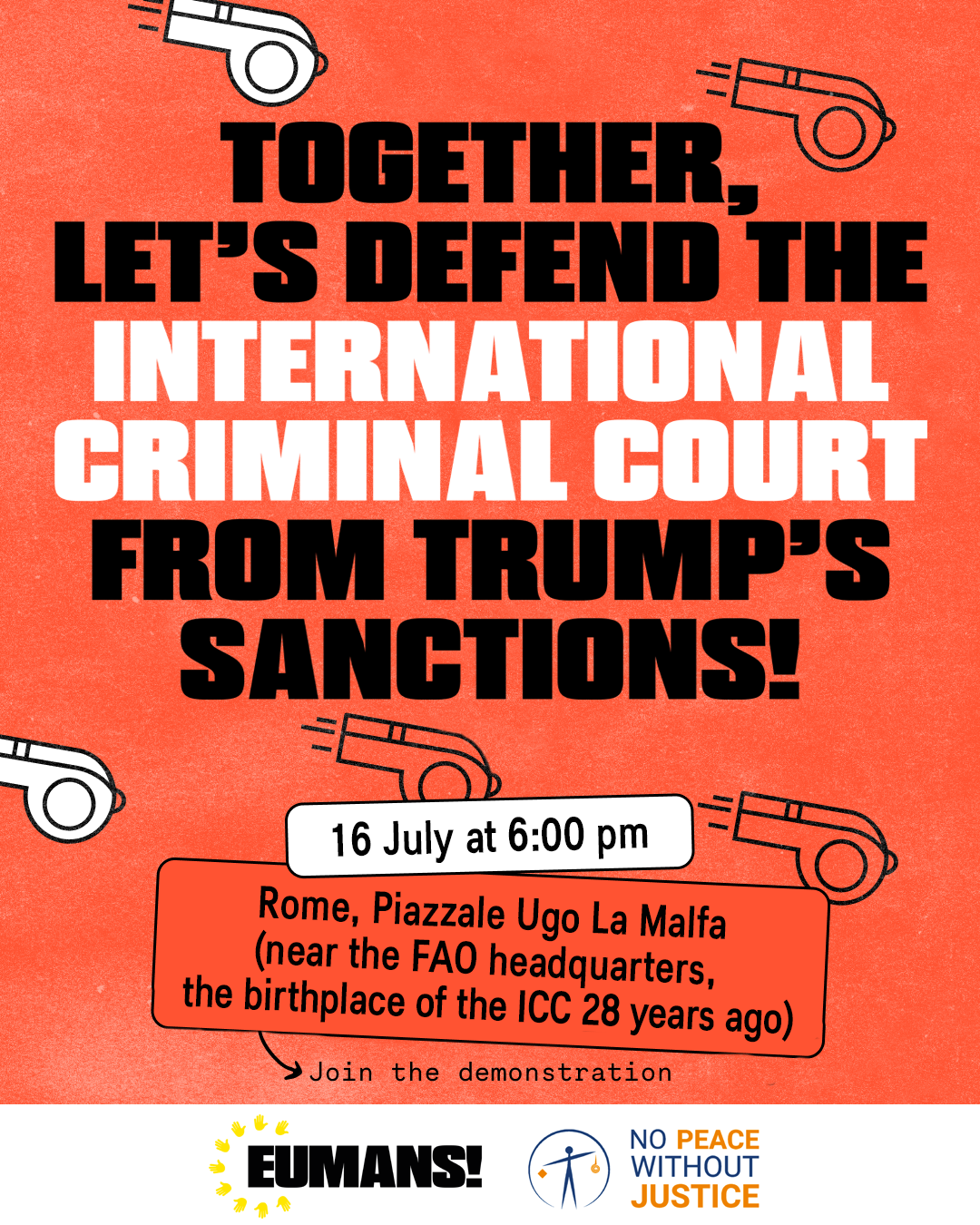 On 16 July, on the eve of World Day for International Justice, a new step will be taken. Eumans and No Peace Without Justice will organise a demonstration in Rome at 6 p.m., next to the FAO headquarters. This location was not chosen by chance: it was precisely here, in 1998, that the Rome Statute establishing the International Criminal Court was adopted. From this symbolic place, we will renew our appeal to the European Commission to activate the Blocking Statute and concretely protect the ICC, its judges, and its staff.
The following day, 17 July, the more than 260 participants in the relay hunger strike will exceptionally carry out a collective one-day hunger strike, sending an even stronger message to Ursula von der Leyen: Europe must stop accepting US extraterritorial sanctions and defend its legal sovereignty by activating the Blocking Statute.
This campaign has received the support of more than 3,900 European citizens and five Nobel laureates: Geoffrey Hinton (Physics, 2024), Oleksandra Matviichuk (Nobel Peace Prize 2022, on behalf of the Center for Civil Liberties), Giorgio Parisi (Physics, 2021), the Tunisian National Dialogue Quartet (Nobel Peace Prize 2015), and Richard J. Roberts (Physiology or Medicine, 1993).
The campaign also puts forward a broader proposal: awarding the 2026 Nobel Peace Prize to the International Criminal Court, in recognition of its enduring contribution to international peace and security through the fight against impunity for the world’s most serious crimes.
While the President of the United States, despite pursuing an international approach based on power relations, publicly claims this recognition for himself, awarding it to an institution that genuinely works for peace and respect for human rights would carry a highly symbolic value. It would mean recognising the role of the International Criminal Court — precisely the institution that Donald Trump is currently seeking to weaken and circumvent.
The stakes go far beyond the ICC. If Europe accepts that a foreign power can punish international judges for their decisions, it sends a dangerous message to the world: common rules only apply as long as they do not inconvenience the most powerful.
On the contrary, protecting the Court today does not mean choosing a geopolitical side. It means affirming that no State, no leader, and no army should stand above the law.
On 17 July 1998, Europe contributed to the creation of the International Criminal Court. Twenty-seven years later, it must decide whether this legacy is still worth defending.
Signatories:
Marco Cappato — Co-President of Eumans
Djémila Boulasha — Co-President of Eumans
Lorenzo Mineo — Treasurer of Eumans
Niccolò Figà Talamanca – Secretary General of No Peace Without Justice