
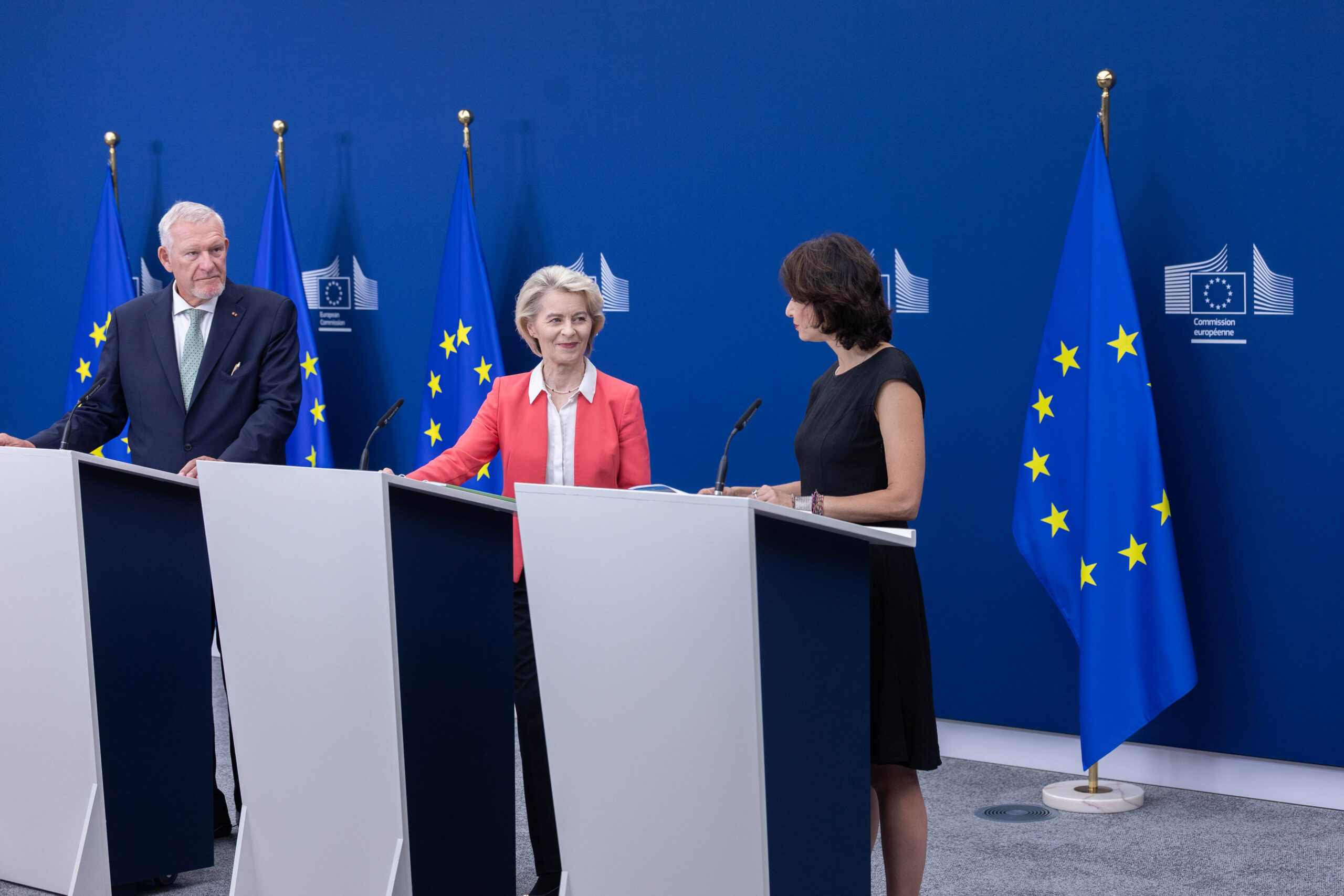
Brussels – Protecting “our children online” and “establishing a new normal in the digital world of the future.” These are the priorities of the new report “Protecting and empowering minors in a digital world”, presented today (13 July) by the Special panel on child safety online, a group of experts set up by the European Commission with the aim of protecting children in the digital world, examining age limits for social media and drawing up new rules for online platforms. In part based on this document, the European Commission will present a proposal after the summer to restrict minors’ access to social media. The announcement was made by the President of the European Commission, Ursula von der Leyen, during the press conference to present the report. “We brought the expert group together precisely to gather evidence on the best approach to tackling the risks and harms. We will now carefully read the report and discuss it within the College, before presenting a proposal after the summer,” she explained. Meanwhile, the Irish Presidency of the Council of the EU emphasised that “strengthening online safety is a priority” for its work and that Dublin will host “a conference on online safety for children and young people in September,” so as to “rapidly advance work on the protection of children online.”
The tenant at the Berlaymont Building has reiterated that “social media is not a toy” and that it is therefore “up to parents to decide when their children will get their first smartphone.” However, within the EU there is already “consensus on the need to set a starting age for children’s access to social media” as the current status quo—that is, “a world in which we continue to allow big tech companies unlimited access to our children, will only serve to condemn yet another generation to further mental harm, addiction, and unhappiness,” she noted. Von der Leyen also cited some figures: “Across Europe, young people spend four to six hours a day in front of a screen,” which amounts to “20 years of their lives,” and “almost 60 per cent of children have experienced emotional and psychosocial problems online,” including “insomnia, depression, anxiety, cyberbullying, and exposure to harmful content.”
The president therefore raised three points. The first is that “platforms were the architects of these systems” and it is now up to them “to prove that their services do not cause harm.” In the EU, “anyone who develops a product is responsible for its safety,” she added. “Car manufacturers must make their vehicles safe,” and the same principle “must apply to big tech companies,” she emphasised. Certainly, we do not “expect children to design their own seatbelts” or parents to “install airbags at home.” The second point is the “need for age-appropriate restrictions on platforms.” Just as “we do not give our children the car keys before they have a driving licence, nor do we allow them to buy alcohol until they are of legal age, we must set a minimum age for legal access to social media,” she explained.
According to the director of the French National Institute of Health and Medical Research, and co-chair of the Panel, Maria Melchior, the the issue of online safety “must be accompanied by the development of digital literacy among young people, their parents, and their teachers,” as, above all, “parents must be prepared to supervise and guide young people’s access to digital services across different age groups,” she noted at a press conference.
This brings us to the third point raised by von der Leyen. “Research shows that timing is crucial“, explained the President of the Berlaymont building. “We know that young children should not be exposed to screens and digital platforms, so no screens before the age of 3,” she said, adding that “children should only use social media under the supervision of parents, guardians or teachers, and for a limited time.” For this reason, “I believe we need to consider a gradual approach to access for different age groups,” because “childhood doesn’t wait, and once it’s gone, we can never get it back,” she added.
In this regard, Professor Jörg Fegert, Medical Director of the Clinic for Child and Adolescent Psychiatry at Ulm University Hospital (Germany), has recommended that children be “online only when accompanied by parents or teachers and for a limited period of time.” Furthermore, “we should also support real-life activities for children and keep an eye on what images and videos children are viewing on social media.” In addition, “The development of independence and autonomy is very important for teenagers, which is why, between the ages of 13 and 18, we want them to have increasingly independent access to what “social media plus” has to offer,” he said.
In line with the trends outlined by von der Leyen, a new Eurobarometer survey was also published today, showing that Europeans are extremely concerned about the risks children face on social media. In particular, cyberbullying and harassment were cited by 71 per cent of respondents, closely followed by fears of online grooming and sexual exploitation (70 per cent), exposure to harmful content such as violence, self-harm or extremism (69 per cent), and the misuse of children’s personal data (69 per cent). Furthermore, the vast majority of Europeans would like the EU to do more to protect children from online risks: almost two in three Europeans (63 per cent) want EU rules to restrict children’s access to social media based on their age, either through a complete ban below a certain age threshold (36 per cent) or delayed access (27 per cent).
English version by the Translation Service of Withub