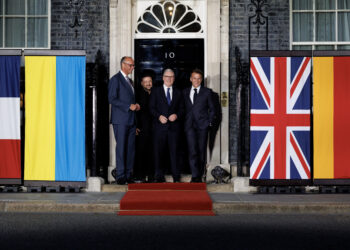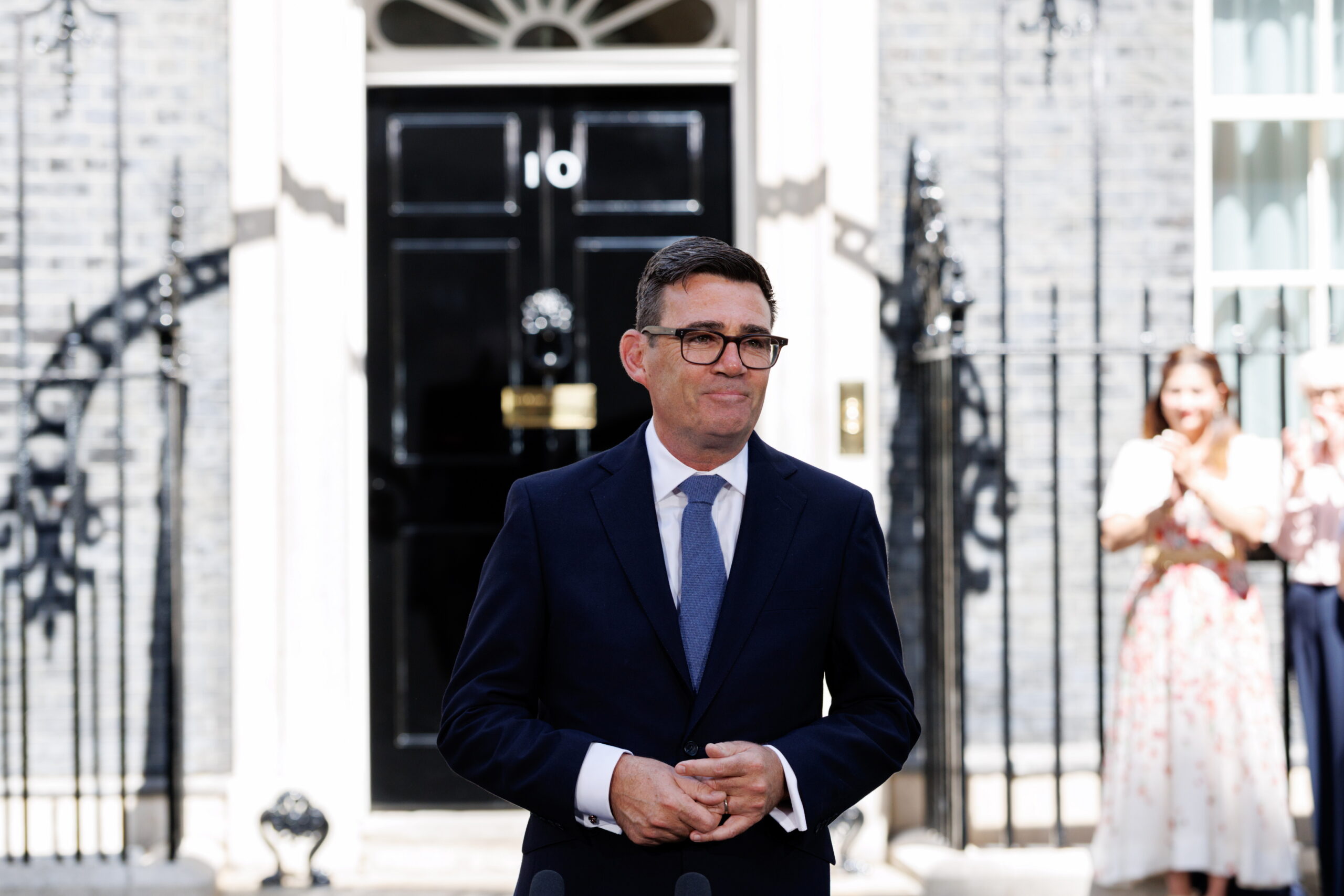
Brussels – As of today (20 July), Downing Street No. 10 has a new occupant. Following Keir Starmer’s resignation on 22 June, Andy Burnham stepped through the doors of the British Prime Minister’s official residence. Aged 56, a Catholic and a former minister and mayor of Manchester from 2017 to 2026, the new leader of the Labour Party inherits a United Kingdom marked by years of political instability in the wake of Brexit. For this reason, he has promised to restore “hope” to the British people, as well as “unity and stability.”
“Britain is stronger and fairer than it was two years ago. Our economy is more robust,” said the now former British leader Starmer in his final statement outside 10 Downing Street. “I leave with a sense of calm, I leave with a smile, and I leave proud of everything we have achieved.” A final farewell before the handover. Following the formalisation of Starmer’s resignation at Buckingham Palace in the presence of King Charles III, Burnham was summoned immediately afterwards by the royal family to be tasked with forming the new government, in accordance with traditional British constitutional procedure.
Burnham was elected last Friday (17 July) as leader of the Labour Party, securing overwhelming support from the parliamentary group and the trade unions affiliated to Labour. In the absence of any other candidates, a vote by party members was not required: his appointment took place automatically, enabling him to succeed the 63-year-old Starmer as leader of both the party and the government at the end of a leadership change anticipated for weeks.
Burnham is the eleventh of the last nineteen British prime ministers to take up office at Downing Street without having won a general election, a possibility provided for under the UK’s parliamentary system. And, since London’s exit from the EU, over the last ten years, the United Kingdom has had seven prime ministers, a high turnover of leaders that has eroded public confidence in the institutions.
Last Friday (17 July), in his speech upon taking office as Labour leader, Burnham said he was “ready to govern” and to promote a policy of “change” in the UK, following “40 years of neoliberalism that have not been kind” to large sections of the population. “This is our last chance to bring about change,” he said, insisting that he did not wish to follow the agenda of the rising right or of Reform UK, Nigel Farage’s party. He also called on Labour to unite against “factionalism,” recalling that he had supported “all the party leaders” throughout his political career.
The new Prime Minister’s priorities include support for British citizens struggling with “the cost of living” and the adoption of measures capable of producing “tangible” results quickly. In general, Burnham aims to restore “confidence in politics,” while acknowledging that he is “acutely aware” of taking the helm of the government as the seventh prime minister in ten years, in a country where political stability now seems a thing of the past.
Today (20 July), in his first speech outside 10 Downing Street, the former mayor of Manchester outlined his government’s priorities: “Britain must show the world that it can regain its stability: that is the challenge before us.” The new Prime Minister assured that there is “a long-term plan” to improve the country over the next “10 years.” He also ruled out the possibility of a snap election, as advocated by Farage: “We live in a parliamentary democracy” and whoever “can secure a majority of MPs in the House of Commons obviously has the legitimacy to lead the country.”
There was no shortage of congratulatory messages from European leaders. “Congratulations, dear Andy Burnham, on your appointment as Prime Minister. I look forward to working with you to strengthen the EU-UK partnership. For the security of our shared continent. And for the prosperity of the people on both sides of the Channel,” writes on X the President of the European Commission, Ursula von der Leyen. The President of the European Council Antonio Costa, expressed his hope to “continue to strengthen further our cooperation for the benefit of our citizens and our businesses. The UK and the European Union are stronger together.” Congratulations and best wishes for success also from the Italian Prime Minister, Giorgia Meloni. “Italy and the United Kingdom are bound by a deep friendship and a partnership that, over the years, has grown ever stronger, thanks in part to our joint work on issues of fundamental importance to our nations,” she pointed out. “I am certain that we will continue along this path, strengthening our strategic partnership in the interests of our nations and our citizens,” she added, extending “sincere thanks” to her predecessor Keir Starmer “for the work he has done and for the commitment with which he has helped to make the relationship between Italy and the United Kingdom even stronger”.
English version by the Translation Service of Withub![Proteste per la brexit [Foto: Unsplash]](https://www.eunews.it/wp-content/uploads/2026/06/alexander-andrews-qDni9uoarQ-unsplash-350x250.jpg)