Brussels – In the second quarter of 2026, the European Union imported goods worth 701.8 billion euros from non-EU countries, while exports totalled 680 billion euros, according to data published by Eurostat, the European Union’s statistical office. The result is a trade deficit of 21.8 billion euros, the first recorded by the EU since the second quarter of 2023, as shown in the data published yesterday by the European institute. Energy is the main factor weighing on the EU’s trade balance, with the deficit rising from 71.3 billion euros in the first quarter to 101.1 billion euros in the second. Deficits for raw materials and other manufactured goods also increased, whilst the surplus for machinery and vehicles fell.
Compared with the previous quarter, imports rose by 9.9 per cent, whilst exports recorded more modest growth of 5.4 per cent. By contrast, imports increased by 11.7 per cent and exports by 4.5 per cent in the second quarter of 2025.
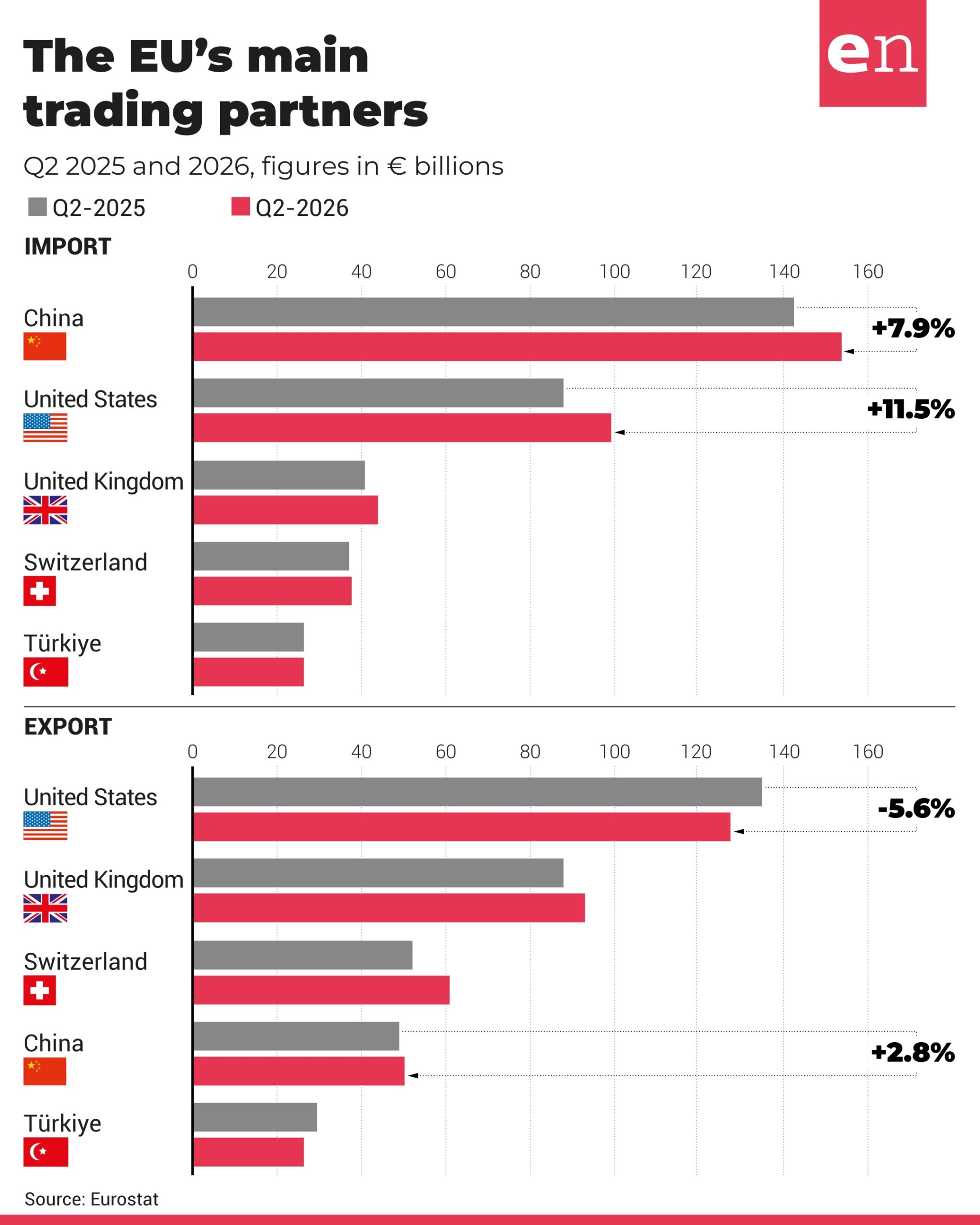
China remains the EU’s main supplier. In the second quarter, Beijing accounted for 21.9 per cent of European imports, worth 153.6 billion euros. The United States follows with 98.7 billion (14.1 per cent), the United Kingdom with 43.4 billion (6.2 per cent), Switzerland with 36.9 billion (5.3 per cent), and Turkey with 25.5 billion (3.6 per cent). Compared with the same period in 2025, the EU increased its imports from the United States (+11.5 per cent), the United Kingdom (+8.8 per cent), China (+7.9 per cent), and Switzerland (+2.1 per cent). Imports from Turkey, however, fell slightly by 0.6 per cent.
On the export front, the United States remains the main market for European products. In the second quarter, the EU exported goods worth 127.7 billion euros to the US, accounting for 18.8 per cent of the total. Next came the United Kingdom with 92.7 billion (13.6 per cent), Switzerland with 60.5 billion (8.9 per cent), China with 50.3 billion (7.4 per cent) and Turkey with 27.3 billion (4 per cent).
In the year-on-year comparison, the growth in exports to Switzerland stands out, having risen by 16.1 per cent. Exports to the United Kingdom (+5.6 per cent) and China (+2.8 per cent) also increased. By contrast, European exports to the United States fell by 5.6 per cent, whilst those to Turkey fell by 4.9 per cent.
English version by the Translation Service of Withub