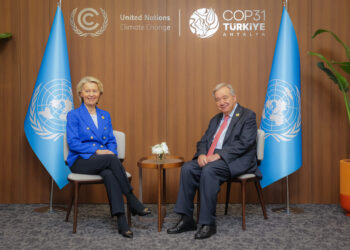
Brussels – To increase the share of electricity in global final energy consumption to 35 per cent by 2035: This is the objective of the 35×35 electrification pledge, which the European Union signed up to at the COP31 in Antalya, Turkey. The initiative, launched by the Turkish presidency of the United Nations Climate Change Conference in the wake of the Electrify Now campaign, aims to accelerate the transition from fossil fuels to electricity.
This endorsement fits perfectly with the objectives set out by Brussels,before and during the conference. The European Commissioner for Climate Action, Wopke Hoekstra, and the Irish Minister for Transport, Darragh O’Brien, reiterated today (17 November) the need to focus on implementing the climate commitments already agreed, rather than introducing new rules. This position is supported by the President of the European Commission, Ursula von der Leyen, who, in her speech in Antalya, emphasised that the world has now entered the age of electricity. The EU is calling for the COP31 negotiations to remain anchored to the targets already set, starting with the agreement reached at COP28 in Dubai.
With Dubai‘s Global Stocktake, the collective “inventory” designed to assess whether the efforts of the various countries are sufficient to achieve the objectives of the Paris Agreement – namely, to keep global warming well below 2°C, with the aim of limiting it to 1.5°C – countries had committed to tripling global renewable energy capacity, doubling the average annual rate of improvement in energy efficiency by 2030, and initiating a transition away from fossil fuels in a just, orderly, and equitable manner. Electrification should help to realise these objectives, reducing emissions and bringing the world closer to the goal of limiting global warming to 1.5 degrees above pre-industrial levels.
For the EU, the main challenge is to increase the use of electricity across the various economic sectors. While around 70 per cent of Europe’s electricity already comes from locally produced clean sources, this still accounts for only 23 per cent of final energy consumption. Brussels aims to increase this share to 46 per cent by 2040, according to the indicative targets set out in the European Action Plan for Electrification. Achieving this target could reduce the EU’s expenditure on fossil fuel imports by €260 billion a year.
As well as contributing to climate targets, the transition serves as a means of strengthening Europe’s energy security and competitiveness by reducing its dependence on international fossil fuel markets.
The European Commission was already taking steps in this direction. From July 2026, the European Commission has committed to making Europe “the first fully electrified continent.” And it intends to do so by replacing the direct consumption of fossil fuels with electricity generated from renewable sources. Electric cars instead of combustion engines, heat pumps instead of gas boilers, and industrial processes powered by electricity rather than coal or oil. According to the Berlaymont Building, the benefits are already tangible: “Driving an electric car can reduce costs by up to 78 per cent, while switching to a heat pump can cut your heating bill by up to 60 per cent.”
English version by the Translation Service of Withub