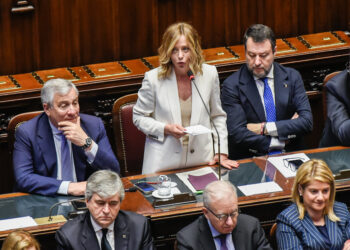
Brussels – “Hybrid warfare does not stop at national borders.” With these words, the President of the European Parliament, Roberta Metsola, commented on today’s vote on the European Democracy Shield (EUDS), which was approved by the plenary session in Strasbourg with 420 votes in favour, 220 against and 26 abstentions. The report sets out a series of recommendations addressed to the European Commission to counter threats to the EU’s democratic institutions and processes. The groups that voted against the text tabled by the People’s Party’s Tomas Tobé were the European Conservatives and Reformists (ECR), Patriots for Europe (PfE), the sovereigntists of Europe of Sovereign Nations (ESN) and The Left.
“At a time when many are seeking to sow mistrust and destabilise us, this House’s response today is loud and clear,” said Metsola, emphasising that the EU must not allow itself to be “intimidated or divided”. The President also called for stricter sanctions against those who promote disinformation, citing Russia and other hostile actors in particular, and for better enforcement of existing legislation. “Press freedom, transparency and digital literacy are not optional, but absolute necessities for strengthening our societies,” she added.
Bots, disinformation, sabotage and foreign interference: the European Parliament calls for strengthening European democracy’s defences. The EUDS Special Committee, established in December 2024, already approved its text in June to assess threats to European democracy and the Union’s responses to them. Among the key proposals is the creation of an EU Centre for Democratic Resilience, which would coordinate initiatives to counter manipulation and foreign interference, with its own mandate, budget, and capacity to act.
The Centre, as European Commissioner Michael McGrath pointed out in his address to the plenary session, has “been operational since February and all Member States have already joined.” Soon, “EU candidate and potential candidate countries will also be involved,” McGrath added. The body coordinates initiatives ranging from training civil servants to establishing common methodologies and standards for identifying and countering information manipulation and disinformation. “An equally ambitious budget should match our ambition to strengthen democracies,” McGrath stressed.
The report identifies Russia as the main threat to European democratic integrity, citing cyber-attacks, sabotage, espionage and other forms of hybrid warfare. Belarus, China, Iran and North Korea are also in the firing line. MEPs are calling for sanctions to be extended to those who facilitate disinformation and for the protection of critical infrastructure to be strengthened.
On the digital front, Parliament is calling for stricter enforcement of existing rules, such as the Digital Services Act and the rules on artificial intelligence, and urges platforms to combat electoral interference via bots more effectively. To protect elections, it also proposes classifying electoral infrastructure as critical infrastructure and introducing measures against deepfakes and illicit political funding.
The rapporteur for the report, Tomas Tobé (EPP, Sweden), rejected the idea that the proposed measures could result in a restriction on freedom of expression: “This report is not about regulating political opinions. It is about protecting our democracy from foreign interference. Russian bots are not freedom of expression. Foreign interference is not freedom of expression. And manipulating our elections is certainly not freedom of expression.”
English version by the Translation Service of Withub