Brussels – Inflation is on the rise again in Europe. According to figures published by Eurostat, the European Union’s statistical office, in August 2026, the annual inflation rate in the eurozone rose to 3.2 per cent, up from 2.9 per cent in July. A year earlier, in August 2025, the rate stood at 2.0 per cent. A similar trend is also evident across the European Union as a whole, with annual inflation reaching 3.2 per cent in August 2026, up from 3.0 per cent in July and 2.4 per cent a year earlier.
In this context, Italy is perfectly in line with the Eurozone average. In August 2026, the annual inflation rate in Italy stood at 3.2 per cent, up from 2.9 per cent in July. This represents a significant rise compared with the same month of the previous year, when inflation in Italy stood at 1.6 per cent. It increased by 0.1 per cent from the previous month.
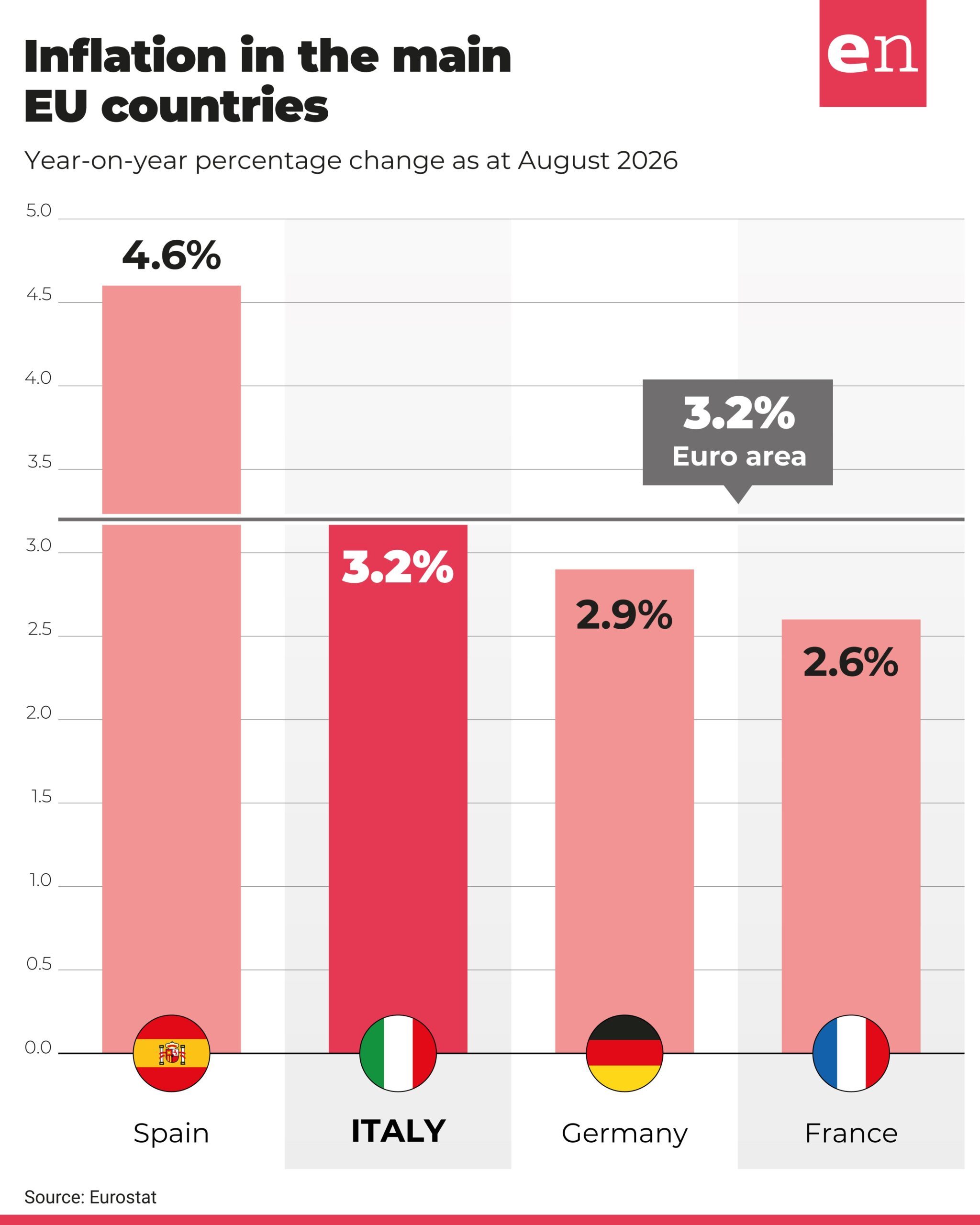
However, the situation across Member States remains varied. The lowest annual rates in August 2026 were recorded in Sweden (0.3 per cent), Estonia (1.3 per cent) and the Czech Republic (1.5 per cent). Conversely, the sharpest rises were seen in Romania (6.3 per cent), Lithuania (5.6 per cent) and Cyprus (5.2 per cent). Compared with July 2026, annual inflation fell in six Member States, remained stable in one and rose in twenty.
To understand these figures, it is necessary to distinguish between the percentage change in prices within a single sector and its actual impact on overall inflation. In August 2026, energy recorded the sharpest rise in prices, with the annual inflation rate jumping to 14.3 per cent (up from 10.3 per cent in July and 8.5 per cent in June). In the same month, the annual inflation rate for services was, by contrast, much more moderate, standing at 3.0 per cent (a slight fall from the 3.3 per cent recorded in July).
Although the percentage rise in energy prices was significantly higher, services made the largest contribution to overall inflation in the eurozone, at +1.43 percentage points, compared with +1.29 percentage points for energy. This is because services account for a vastly larger share of the expenditure basket, at 468.2 thousandths compared with just 90.3 thousandths for energy. Consequently, even a moderate rise in service prices has a greater overall impact on the general index than a sharp rise in energy prices.
English version by the Translation Service of Withub![[Berlino, 10 settembre 2026. Foto: Lorena Deidda/ECB. Copyright: (c) 2026 European Central Bank www.ecb.europa.eu]](https://www.eunews.it/wp-content/uploads/2026/09/lagarde-vucic-260910-350x250.jpg)