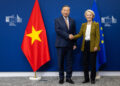
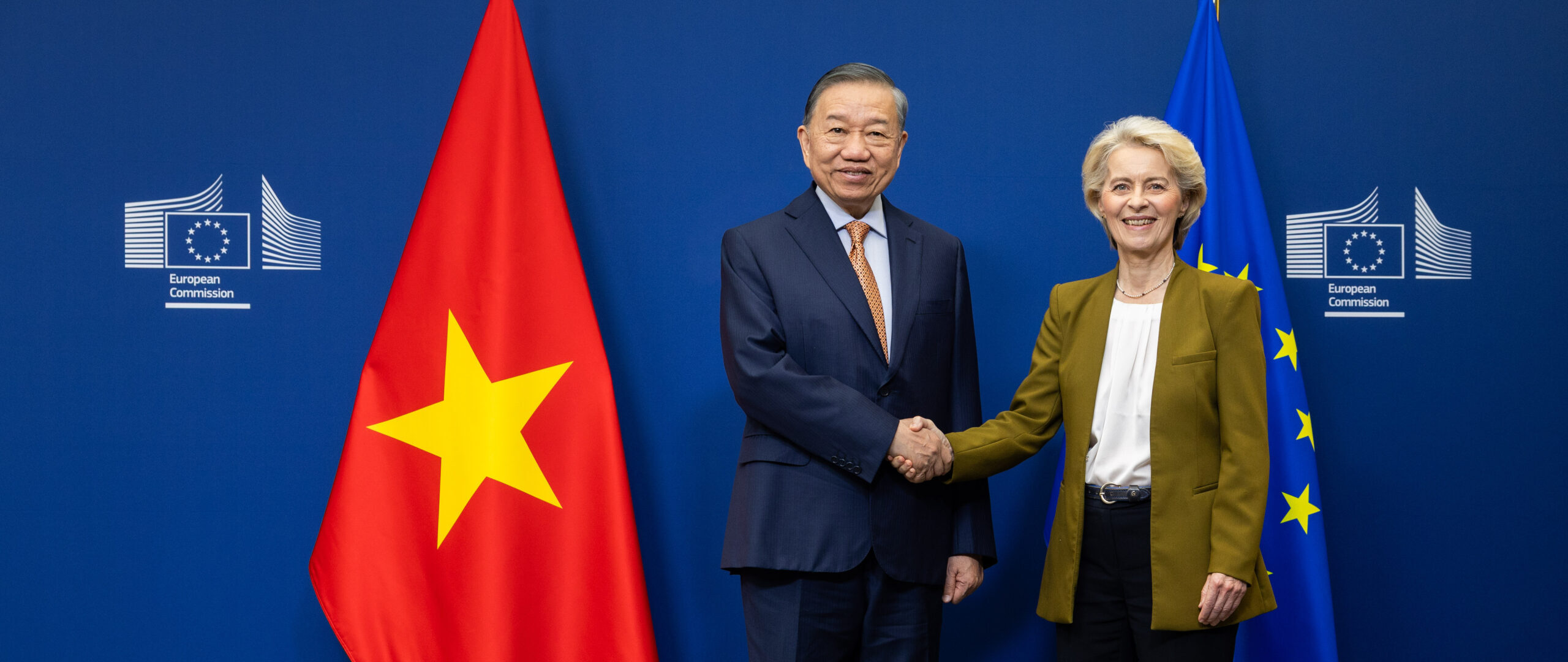
Brussels – Strengthening “bilateral cooperation, regional security, and global challenges.” This is the central theme of the joint statement signed today (22 October) in Brussels by the President of the European Commission, Ursula von der Leyen, the President of the European Council, António Costa, and the General Secretary of the Central Committee of the Communist Party of Vietnam and President of the Socialist Republic of Vietnam, Tô Lâm.
In the document, the EU and Vietnam recognised “the importance of strengthening resilience, diversifying partnerships and promoting stability and prosperity in the Indo-Pacific, including through the EU Strategy for Cooperation in the Indo-Pacific” – the action plan launched in September 2021 to strengthen the EU’s presence and its political, economic, and security role in the region stretching from the east coast of Africa to the Pacific islands. Accordingly, the two parties “welcomed” a new impetus in their relations after having already decided in January 2026 to upgrade their bilateral ties to a “Global Strategic Partnership”.
In addition to their political alignment, the leaders reaffirmed their commitment to further strengthening their partnership through investments under the “Global Gateway” – the European Union’s official strategy, launched in December 2021 by the European Commission to promote investment in sustainable, high-quality infrastructure worldwide – and the “Partnership for a Just Energy Transition” – the multilateral climate finance platform established to help major emerging and developing economies gradually reduce their use of fossil fuels. For President von der Leyen, these represent “new opportunities.”
Against this backdrop, therefore, the two sides called for the full implementation of the EU–Vietnam Free Trade Agreement and the swift ratification of the investment protection agreement. On her social media channels, von der Leyen also pointed out that the agreement would lead to “a 53 per cent increase in trade.”
Other areas in which the two sides intend to cooperate include “raw materials, technology and innovation, education and training, the green transition, strategic infrastructure, the circular economy, and the blue economy.” Both sides also recognised the potential for cooperation in the fields of defence and security, expressing appreciation for the role of the “Dialogue on defence and security between the EU and Vietnam” – an official mechanism for annual strategic consultation established to strengthen geopolitical and military cooperation between the European Union and Vietnam – and for the existing cooperation frameworks.
Finally, the importance of effective multilateralism and a rules-based international order was emphasised. Von der Leyen and Costa also praised the constructive role played by Vietnam within ASEAN – an acronym for the Association of Southeast Asian Nations. The two stated that they were looking forward to the EU-ASEAN commemorative summit in 2027, which will mark the 50th anniversary of relations between the two sides.
Also today, the Vietnamese Minister of Education, Hoang Minh Son, and the Executive Vice-President of the European Commission for Education, Culture, Labour and Social Rights, Roxana Mînzatu, signed a formal letter of intent on cooperation in education and training. The agreement aims to expand global academic exchanges and student training, to strengthen joint research initiatives based on mutual respect and equality, and to enhance established programmes, such as Erasmus+, which support links within higher education.
Outside the walls of the Berlaymont Building, Lâm’s visit was not greeted with jubilation. Protesters of Vietnamese origin staged a demonstration, thereby drawing attention to the intensification of internal political repression in Vietnam. Among the many reasons cited, the activists denounced alleged actions by the Vietnamese authorities against critical voices living abroad.
English version by the Translation Service of Withub