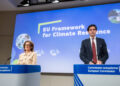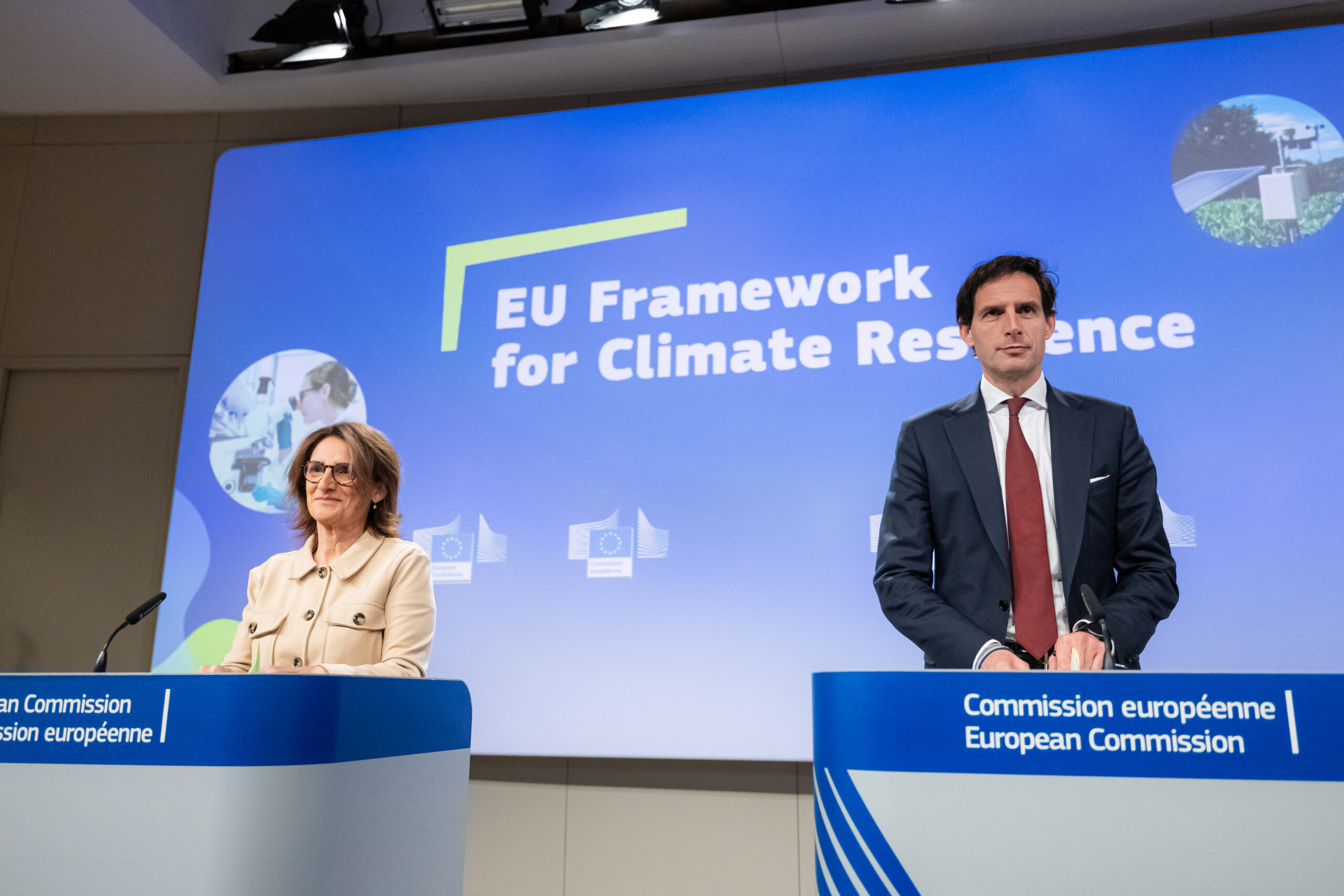
Brussels – Building on a common scientific basis to assess climate risks and clarify the responsibilities of individual Member States. This is the direction set out in the new European Framework for Climate Resilience, adopted today (27 October) by the College of Commissioners and presented by the Executive Vice-President for a Clean, Fair and Competitive Transition, Teresa Ribera, alongside the European Commissioner for Climate Action, Wopke Hoekstra. The aim is to strengthen the EU-27’s ability to anticipate and manage the impacts of global warming by integrating climate resilience into key national and European policies.
“Last summer was the summer of truth”, Hoekstra said at a press conference, recalling the destruction and loss of life caused by extreme weather events between June and September. “Climate change is not a hoax. It is not only real. It is also a powerful killer, and it kills people: just think of the 30,000–50,000 premature deaths that occurred this summer in Europe,” Ribera explained. In this context, however, the Vice-President noted that “having the tools does not mean being prepared.” This is why the Commission intends to define a common reference trajectory, based on scientific evidence, to help Member States assess risks and plan the necessary measures.
Projections indicate that global warming could reach 1.5 degrees above pre-industrial levels by 2030, 2 degrees by 2050 and 3 degrees by 2100. This scenario calls for greater preparedness at the European level. In her State of the Union address, Commission President Ursula von der Leyen had already signalled a common response to extreme weather events, noting that “Europe is warming at twice the global rate.”
According to Ribera, the priority remains tackling the causes of climate change, but also preparing for the impacts that are now inevitable: “Europe is ill-prepared, and it is our responsibility to minimise the costs and suffering that this entails.” The Vice-President also drew attention to inequalities in the distribution of risks, which particularly affect the most vulnerable communities.
Climate resilience is also a matter of competitiveness. The economic losses from climate-related damage between 2022 and 2025 are estimated at around 200 billion euros, equivalent to 50 billion per year. “If the five hottest years on record in each country between 2014 and 2024 were replayed in the period 2026–2030, cumulative GDP losses could reach between 5 per cent and 7 per cent for the most exposed economies: Countries such as France, Italy, Germany or Spain could suffer losses of between 120 and 240 billion dollars,” Ribera said. “The impact is structural in nature, with a sharp decline – averaging 8 per cent – in gross fixed capital formation,” she continued. Furthermore, “there has been a disproportionate contraction in tax revenues, to the extent that many EU Member States risk breaching budgetary benchmarks due to heat stress. In fact, Europe cannot be competitive unless it is resilient,” she added.
Adapting infrastructure and the economy to new climatic conditions will require investment of around 70 billion euros per year. According to the Commission, however, “every euro invested in adaptation can generate benefits more than ten times its value,” thanks to avoided losses and damage. Added to this is the economic potential of adaptation technologies: the global market for climate resilience solutions could reach 3,500 billion euros by 2050. This represents an opportunity for European businesses, which are called upon to innovate and strengthen their technological position. “Europe’s future competitiveness depends on our ability to anticipate and prepare for climate change,” warned Hoekstra. “Every euro invested today in resilience helps to protect jobs, businesses and livelihoods tomorrow.”
The framework also aims to simplify national planning through a single strategic plan and more regular and comparable climate risk assessments. At an operational level, the European Climate Resilience Platform will provide tools to visualise projected risks, identify available resources and explore tried-and-tested adaptation solutions.
Among these, the Commission is rolling out the European Climate Viewer, developed by the European Centre for Medium-Range Weather Forecasts (ECMWF), which will provide an interactive map of projected climate risks across the continent, or the Navigator of Climate Resilience Tools, developed by the European Environment Agency (EEA), which helps users find relevant tools for climate resilience based on their location, sector and the specific risks they face. Or, the Solutions Explorer, which presents practical adaptation solutions developed and tested through the EU’s Climate Change Adaptation Mission.
“The Framework will strengthen preparedness, clarify responsibilities and equip public authorities, businesses and communities with practical tools to act,” concluded Ribera. “Climate resilience is a shared obligation,” she assured, and the Commission is ready to play its part in building a more resilient and fairer Europe.
English version by the Translation Service of Withub