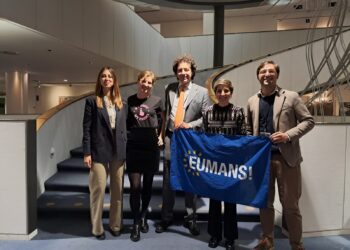
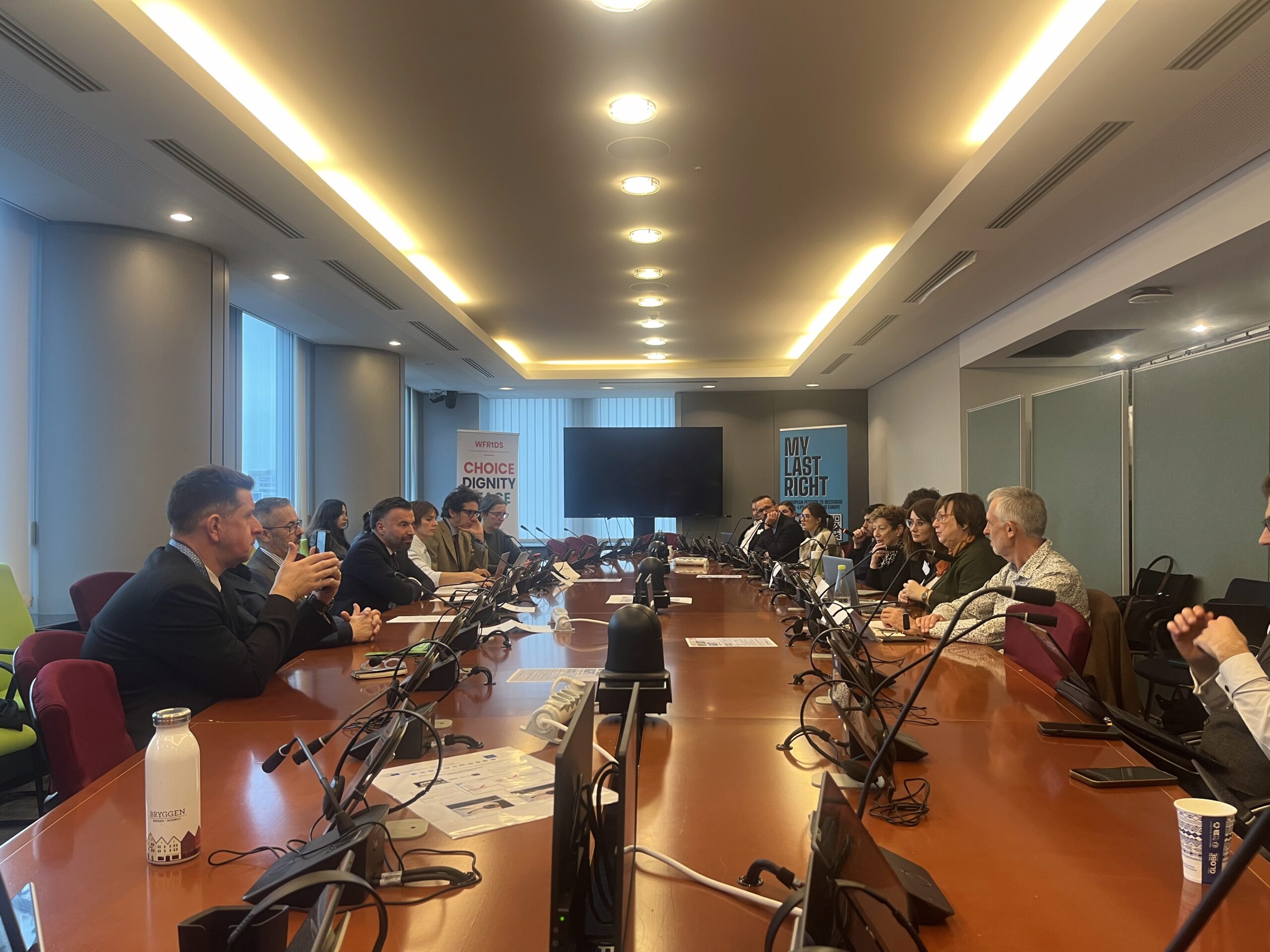
Brussels – A petition calling for the recognition of self-determination at the end of life – in line with the provisions of Article 1 of the Charter of Fundamental Rights of the European Union – and for European legislation to give effect to “the right of the individual to decide by what means and at what point their life will end,” and the recognition of living wills in other EU countries as well. This is the petition promoted by the pan-European political movement for popular and non-violent initiatives, Eumans, by the World Federation of Associations for the Right to Die (WFRtDS) and the European coalition “My Last Right”, which today (4 November), together with the PD (S&D) MEP, Alessandro Zan, organised a roundtable on the subject at the European Parliament. For Zan, the debate on living wills is not “an abstract debate” because behind “every law, every petition, and every parliamentary debate there are real people, whose voices must be heard.” Therefore, “the right to choose regarding end-of-life matters must be recognised and protected throughout Europe.” And it is “for this reason that today, at the European Parliament, we launched the ‘My Last Right’ petition, which calls on the European Union to recognise the right to self-determination in decisions regarding end-of-life care and living wills,, he added.
The former MEP and current treasurer of the Luca Coscioni Association, Marco Cappato, has clarified that the petition does not call on “the EU to regulate end-of-life decisions through EU-wide legislation.” Instead, “we are proposing mutual recognition amongst those countries that recognise this right, so that information and data can be shared when a citizen is in another Member State.”
As decisions regarding end-of-life care and patient autonomy are still governed by a patchwork of national laws within the European Union, a person’s wishes may not be respected in another country. Member of the Executive Board of Eumans and a member of the executive committee of the Luca Coscioni Association, Alice Spaccini explained that “situations relating to the end of life vary considerably: in countries such as Belgium, the Netherlands, Luxembourg, and Spain, euthanasia is legal under certain conditions. In others, such as Italy, Germany, and Austria, assisted suicide is permitted, while in most other EU countries, such practices remain restricted.”
According to the executive director of the WFRtDS, Peter Warren, “what is lacking today is, for every individual, the opportunity to draw up a living will in which they can specify what they wish – or do not wish – to happen as they approach the end of their life, or in the event that, following a tragic incident, they are no longer able to express their wishes personally.” A study presented by Spaccini and conducted by the lawyer and president of the Dániel Karsai foundation, Evelyn Frank, who was also present at the event, reveals “that 20 of the 27 Member States of the European Union already have some form of legislation governing living wills.” This “shows that most EU countries already recognise the right of citizens to express their medical wishes in advance; an issue which, going far beyond euthanasia or assisted suicide, affects millions of people,” added Spaccini.
During the round-table discussion, national experiences, legal perspectives, and the views of civil society were compared, with the aim of identifying common challenges and generating the political momentum needed for concrete EU action.
Among the testimonies and accounts of activism is that of the Hungarian Dániel Kartsai, who is the co-founder of a foundation dedicated to his brother, Péter Kartsai: a Hungarian lawyer who decided to publicly campaign against the total ban on active euthanasia and assisted suicide laid down in Hungarian law, by bringing his case before the European Court of Human Rights. “Dániel died two years ago, and when he spoke out in public about his suffering, we would never have thought that in 2026 we would be here discussing this issue in the European Parliament,” he recalled, while Frank pointed out that even today in the country “many people are unaware of living wills, and often not even doctors are informed about them.”
The president of the French association The Choice – Citizens for a Chosen Death, Keith Lund, has reported on new developments in France, where “the right to assisted dying was recently introduced following an intensive legislative process lasting over a year, culminating in the Parliament’s final vote on 15 July.” The president of the association End of Life Ireland, Janie Lazar, explained that hers is “a grassroots voluntary organisation that gives a voice to patients and those who have directly experienced these situations” in a country where “76 per cent of the Irish population supports legislation on assisted dying.”
Finally, the situation in countries where these are now established rights. “Hearing the testimonies from Hungary, Ireland, and France makes it clear just how fortunate we are in Belgium and the Netherlands, where euthanasia laws were passed almost 25 years ago, in 2002,” commented the president of the Association for the Right to Die with Dignity, Jacqueline Herremans.
At a press briefing held on the sidelines of the round-table discussion, Zan observed that “the Meloni government continues to approach this issue from an ideological standpoint.” Despite “repeated calls from the Constitutional Court, there is still no national law,” and while “some regions have tried to fill this legislative void with their own laws, the government has even challenged them, demonstrating its utter cruelty towards those people who are enduring excruciating suffering.” Instead, “when it comes to end-of-life issues, we do not need further delays or ideological battles: we need a law, and we need respect for the freedom, self-determination, and dignity of every person,” concluded the MEP.
English version by the Translation Service of Withub