Brussels – Things were better when they were worse. The Green Deal is becoming increasingly unpopular—even the EPP, led by its creator, Ursula von der Leyen, as head of the Commission, has begun dismantling it—and it now requires new and additional efforts. In this context, however, it becomes clear that research in the key sectors for the twin green and digital transition – the automotive and technology sectors – was better funded when the Green Deal did not exist. Strange yet true: the European Central Bank, in a special publication on industrial policy in the EU, highlights the loss of momentum in research and development precisely when greater commitment was needed.
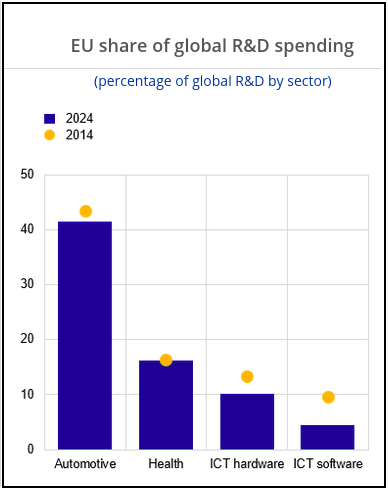
A summary chart stands out in the analysis, clearly illustrating how and to what extent support has dwindled for research and development in the automotive industry, operational programmes relating to data collection and management, digital communications (ICT software) and next-generation infrastructure for data collection, transmission and communication (ICT hardware). Overall EU expenditure in 2024 is lower than in 2014, confirming a decline in funding for new industrial solutions.
The Central Bank’s experts have ultimately exposed the great paradox of the EU and its agenda: it is not merely about sustainability but also about fostering renewed competitiveness through the two transitions enshrined in the European Green Deal. Overall, “the sectoral composition of R&D in the EU is concentrated in established industrial sectors, with high-technology sectors receiving lower allocations”.
This is no minor paradox, given that the sectoral breakdown of research and development expenditure “matters for productivity, as high-tech sectors generate stronger spillovers and account for a significant share of the EU-US productivity gap“. In short, the EU is not competitive because it has chosen not to be, through a use of resources that remains stuck in the old industrial paradigm and not steered towards the new model dictated instead by the first von der Leyen Commission.
The problem is primarily political. National governments are dragging their feet, while the business world remains stuck in “business as usual” – that is, an approach rooted in outdated models. As the ECB’s analysis explains, “Europe’s institutional and financial architecture defines its position relative to the global technological frontier.” From this perspective, “R&D expenditure relative to GDP is lower in the EU than in the United States, reflecting weaker business sector investment.“
English version by the Translation Service of Withub