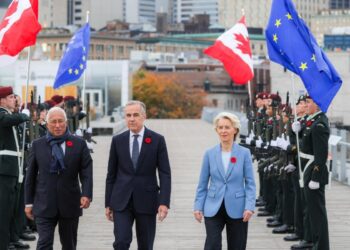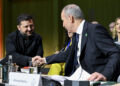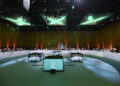
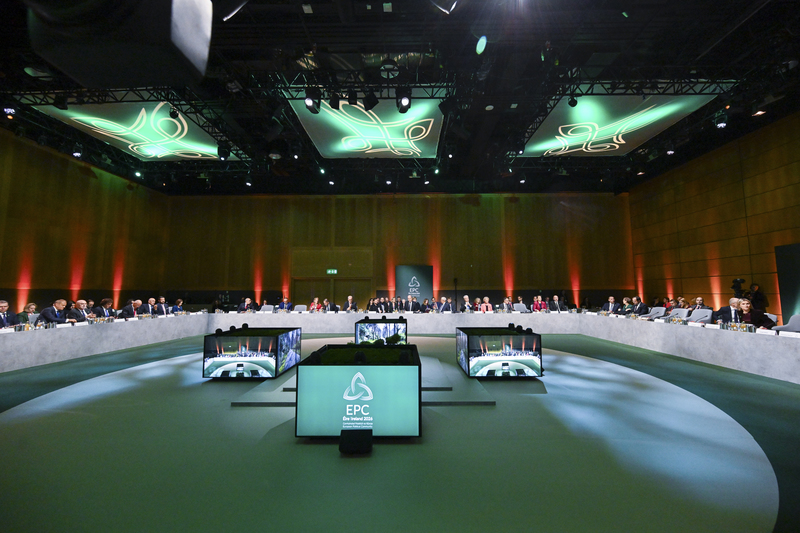
Brussels – Common security, to be understood as “the security of our continent is inseparable from the security of Ukraine,” and the need to navigate the turbulent waters of today’s world. The President of the European Council, António Costa, sets out the tone of the European Political Community meeting in Dublin, which comes at a time when, perhaps for the first time with renewed resolve, Russia and Ukraine begin discussions on the possibility of ending the conflict with US mediation. The EU-27 and their partners are attempting to send clear and decisive messages: easy enough in statements, but somewhat less so in the practical need to find shared solutions.
Among the non-EU countries invited to the talks, the Prime Minister of Albania, Edi Rama, calls for grievances and animosities to be set aside in favour of a pragmatic approach: “Whether we like it or not, Russia is not going to disappear; it will remain.” This means, he emphasises, “that while continuing to support Ukraine fully, we must keep the dialogue open.” We need to talk to the Kremlin and its lord, Vladimir Putin. If others are mediating today, the fault lies with a European Union that lacks a genuine foreign policy and has little vision in its capitals: “I believe it was a colossal mistake to leave diplomacy to others and focus exclusively on military support for Ukraine.”
A similar line of reasoning must also have been followed in Helsinki, because the Finnish Prime Minister, Petteri Orpo, makes no secret of his concerns regarding a role that has so far been characterised more by subordination than by leadership – a situation that needs to be rectified: “Europe needs a seat at the table. No one can negotiate on our behalf.” This, then, is the issue that the European political community must resolve.
In Dublin, however, the EU is continuing its efforts to shift its political and economic centre of gravity eastwards. Georgia, Armenia, Azerbaijan: Europe is reaching out to countries that have historically and traditionally been close to Moscow’s sphere of influence. Armenia is still a member of the Collective Security Treaty Organisation (CSTO), the military alliance established in 1992 as a post-Soviet reorganisation led by Russia, and the government in Yerevan is also a member of the Eurasian Economic Union (EAEU), a customs and trade union also led by Russia. “The era of spheres of influence in Europe is long gone,” emphasises Costa, who throws down a new gauntlet to Putin (while glossing over the actions of other players – the US and Israel – in other parts of the world).
While EU leaders, on several occasions and in varying degrees of detail, have repeatedly emphasised the importance of continuing to support Ukraine, messages from Canada go a step further, using the Dublin summit as an opportunity to strike a blow against the US administration. For Ottawa, participation in the summit “is part of the process that brings us closer to the European Union,” a process that can “bring more opportunities for our businesses, more choice, greater affordability, and greater security”, emphasises the Canadian Prime Minister, Mark Carney.
The Irish Prime Minister and host, Micheál Martin, steers the debate back to the main topic: the Russia-Ukraine conflict and the Europeans’ stance towards Putin: “We do not believe in war. We are democrats; we believe in democracy,” he emphasised, immediately distancing himself from Russia and, more implicitly, from Trump’s USA.
Whatever happens, “we will support Ukraine, both in times of war and in times of peace,” clarifies the President of the European Commission, Ursula von der Leyen, who announces the preparation of the twenty-second package of sanctions against Moscow and work on new financial loans for Kyiv: “We will present the sanctions package and the proposal regarding financial requirements before the next European Council.”
English version by the Translation Service of Withub