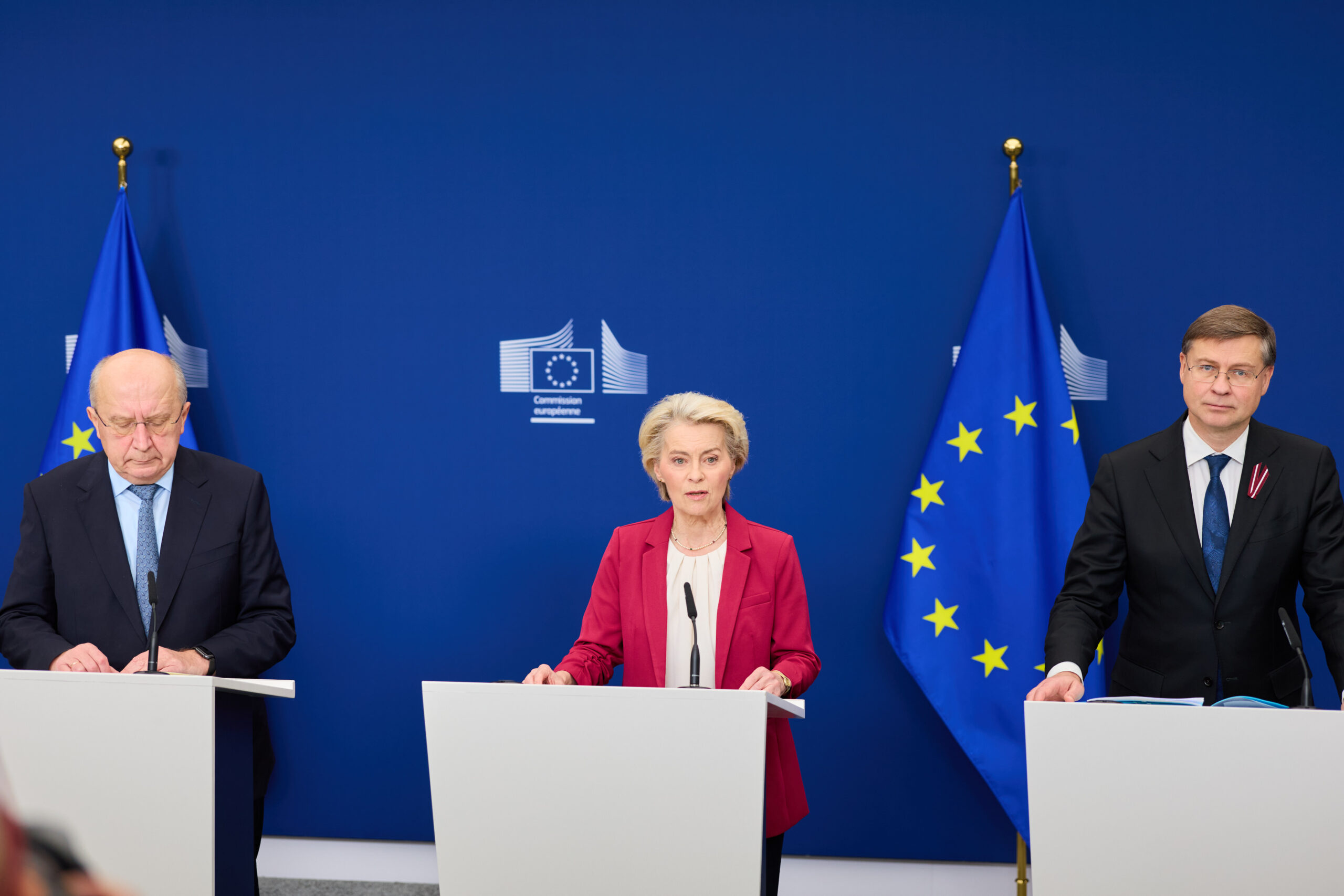
Brussels – Ukraine’s financial requirements for next year “amount to 70 billion” in total, and the European Commission is ready to help the country under attack from Moscow. Today (18 November), the Berlaymont Building presented a legislative package to provide its support of €45 billion for 2027. This is the amount already provided under the aid package totalling 90 billion for 2026 and 2027. The support will be financed through the issuance of debt securities by the Union on the capital markets, guaranteed by the EU budget’s room for manoeuvre. In this way, Brussels will be able to cover two-thirds of the funding requirement, while appealing to international partners for the remaining 25 billion.
The announcement was made by the President of the European Commission, Ursula von der Leyen, following the weekly meeting of the College of Commissioners. The proposal comprises three initiatives: the Coordinated Support Facility for Ukraine; a proposal to amend the current Multiannual Financial Framework regulation, to enable the EU budget to guarantee the new loan; and new “incentives for international partners to provide further financial support” to Kyiv. The Coordinated Support Facility for Ukraine will make €45 billion available for 2027, which “Ukraine will only be required to repay once Russia has paid for the damage caused in the country,” the President clarified. The measure “consists of two components: €20 billion for budgetary support and €25 billion for military needs.” The head of the Berlaymont building emphasised that, after “covering Ukraine’s financial needs in 2026”, the facility represents “the best way to give Ukraine a strong hand at the negotiating table.”
The Coordinated Support Facility for Ukraine
Von der Leyen explained that while the 20 billion from the new instrument will make it possible “to keep essential public services running, ensuring that schools and hospitals remain open,” the 25 billion earmarked for defence will provide the government in Kyiv with “the means necessary to defend itself.” According to what was outlined by the Commissioner for the Economy, Valdis Dombrovskis, the funds allocated to the budget “will be divided equally between macro-financial assistance and the Ukraine Facility” – the €50 billion EU financial mechanism established on 1 March 2024 to provide the country under attack by Moscow with stable, predictable, and flexible economic support for the period 2024–2027. Furthermore, disbursements will be tied to Ukraine continuing its reforms, notably on the rule of law, on the fight against corruption, and the public finance management.”
The European Commissioner for Defence, Andrius Kubilius, welcomed the new proposal, stating that “this is a decision of great significance,
both from material and from a political point of view,” and that “it sends a strong signal, including to Mr Putin: the EU continues to stand with Ukraine.” According to the Commissioner, this year’s loan “
It proved successful in providing quick and predictable deliveries at scale for Ukraine,” and “by the end of the year, the full amount earmarked for 2026 – €28.3 billion – will have been disbursed”. Now, “we are preparing for 2027 to spend the remaining Ukraine support loan funds, €31.7 billion for Ukrainian defence.” Furthermore, “we have begun drawing up the first supply programmes relating to this loan for 2027: €14.4 billion will be allocated to drones and ammunition, with the aim of commencing disbursements as early as January 2027, thereby avoiding any kind of gap,” he announced. In this context, “Ukraine’s requirement for weapons by monetary value is shifting more and more towards drones. At the beginning of 2026, it was 31%. In 2027, the prediction is that it will be 62%.” According to estimates, “this year the Russians will deploy around 10 million drones, next year around 20 million drones,” and “Ukraine with EU assistance needs to match and will match,” he emphasised, reiterating the need to “increase the production of weapons for Ukraine, also on the EU side.”
Amendments to the Multiannual Financial Framework
As for how the support will be financed, “the Commission will borrow on the financial markets
backed by the headroom in the EU budget,” Dombrovskis pointed out, adding that this is “the same approach as under previous union loans.” On the one hand, “interest will be paid by Ukraine, but the EU
may provide a borrowing cost subsidy as we are doing it now.” In practical terms, the Berlaymont building aims to draw on the so-called “headroom”, i.e. the EU budget’s room for manoeuvre. A European official clarified that the Commission must adjust it “in such a way as to cover the potential liabilities of this new loan,” by providing “a financial guarantee, as has been the case for other loans since 2023.” According to forecasts from EU sources who have worked on the dossier, “the cost of this new loan will begin to accrue or become a reality from 2028,” and “it will depend on market conditions, but also on the pace at which this new tranche is disbursed.” However, “we must be transparent about this: it will take a long time before the very first loans are repaid, and subsequently the proceeds could be used for new loans.” It is not an issue “for the immediate future,” he added. The Commissioner clarified at the press briefing that “interest payments relating to this coordinated support instrument will only begin in 2028.” Therefore, “they will not fall within the current Multiannual Financial Framework (MFF), but within the next one. We therefore expect this issue to be debated when the next European budget is drawn up,” he added.
The role of the other partners
As regards the shortfall in Kyiv’s funding needs not covered by EU support, “we will continue to urge other external partners to step up their efforts” and “cover the remaining third”, warned von der Leyen. In order to facilitate further contributions from third countries, the Commission is therefore proposing two further amendments to the instrument presented today. Firstly, it has been suggested that the use of “future windfall profits” from frozen Russian assets could be expanded. This would be made possible by “an amendment to the Cooperation Mechanism for Loans to Ukraine”, i.e. the ad hoc financial instrument created by the EU to support Kyiv using the extraordinary revenues generated by frozen Russian sovereign assets. According to the Berlaymont Building, this solution could be utilised once the repayment of previous loans – disbursed both under this instrument and those guaranteed by G7 countries – has been completed. This “would allow such proceeds to contribute to the repayment of new eligible loans granted by the EU and G7 partners.” An EU official familiar with the matter pointed out that the Mechanism forms part of the so-called “Extraordinary Revenue Acceleration” (ERA) loans promoted by the G7 countries. Thanks to this, “we collect the revenue accruing on fixed assets and distribute it to G7 partners in a fixed proportion towards the repayment of loans granted to Ukraine,” he explained. Underpinning the measure, once again, is the principle that “Ukraine will only be required to repay the principal once it receives reparations from Russia”.
The second solution involves mobilising up to €5 billion in additional loans through the Ukraine Facility, thanks to financial support from third countries with an AAA/Aaa rating, which is the rating assigned to countries considered to be extremely sound from a financial perspective. This solution would enable international partners to support Ukraine by drawing on “the EU’s robust borrowing capacity and its disbursement programmes, while ensuring strong safeguards for the Union’s budget,” the European Commission states in a press release.
The proposal’s progress, however, is still in its early stages. The head of the European Commission is now “looking forward with interest to next week’s European Council”, where von der Leyen will present the proposal. However, the proposal will be discussed as early as tomorrow (19 November) in Berlin at the meeting of the Coalition of the Willing: “We will also take stock of the latest peace efforts, with a view to possible multilateral negotiations,” von der Leyen said, reiterating that the 22nd package of sanctions against Moscow will be introduced next week. The President has no doubts regarding the Member States’ support for the proposal: “All twenty-seven Member States have stated very clearly that they wish to support Ukraine.”
On the other side of the European continent, the President of Ukraine, Volodymyr Zelensky, thanked the European Commission on his social media channels for the proposal. “This will complement the EU’s existing commitments under the support loan to Ukraine and cover a significant portion of next year’s budgetary and defence requirements,” he emphasised, calling for “a swift adoption of this decision by the European Parliament and the Council.” The President also expressed his gratitude to von der Leyen for “her initiative to secure assistance from our other partners through new mechanisms to facilitate and coordinate further support,” including “the United Kingdom, Canada, Japan, and Norway.” Like the head of the European Commission, Zelensky is also looking forward to tomorrow’s debate “to get everything on track as soon as possible.”
English version by the Translation Service of Withub