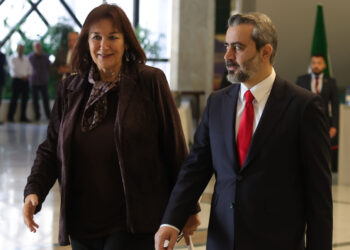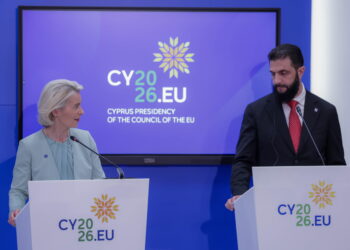
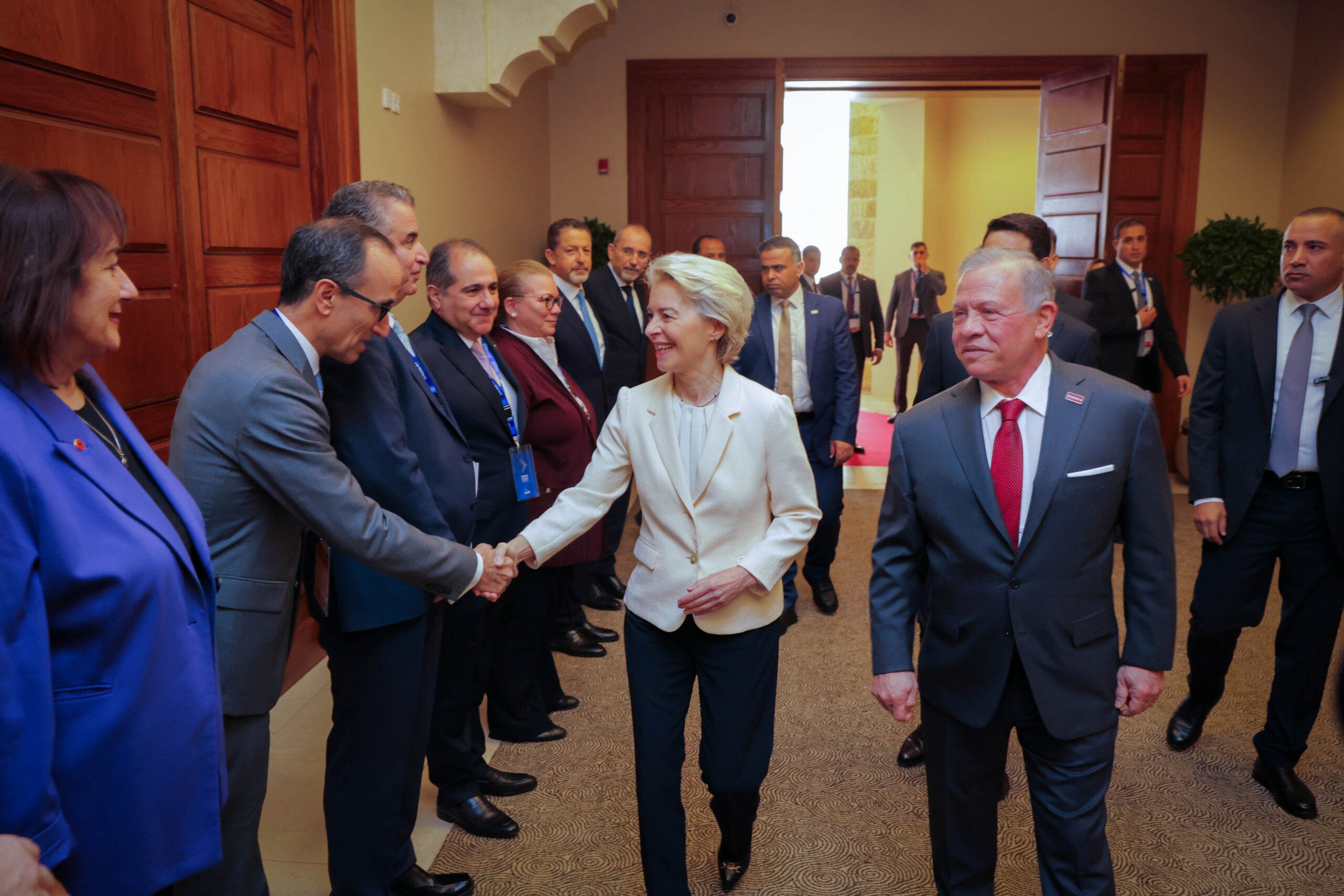
Brussels – “Jordan is a smart investment. Our partnership is already bringing results – in transport, energy, digital connectivity, and more. And now, together, we are building the foundations for greater investment and growth,” said the President of the European Commission, Ursula von der Leyen, today (19 November) in Amman, Jordan. She spoke at a press conference on the sidelines of the EU-Jordan Investment Conference at the Dead Sea, where she is with the Commissioner for the Mediterranean, Dubravka Šuica. On this occasion, the President and the King of Jordan, Abdullah II bin Al-Hussein, signed several agreements to support the country’s modernisation and economic resilience. According to von der Leyen, “as the geopolitical situation became more uncertain, few thought this conference would be possible. Yet here we are. Bright and early, I might add. Because we are ready to get to work.” The event was attended by around a thousand people, including policy-makers, business leaders and representatives of international financial institutions. To mark the occasion, European and Jordanian companies explored investment opportunities and new partnerships in “high value-added” sectors such as the digital economy, water security, the energy transition and connectivity.
The conference was organised as part of the EU-Jordan Strategic and Comprehensive Partnership, which was launched in January 2025. The EU supports it with a €3 billion package for 2025–2027. Today’s agreements also aim to support the objectives of the Mediterranean Pact – the strategic framework through which the European Union aims to strengthen economic, energy, cultural and security cooperation with its partners in the Southern Mediterranean – by helping mobilise private investment and create jobs in Jordan. The President noted that “for Europe, this means two things”. Firstly, “investing in Jordan makes sense politically” as it is “a practical way to support a voice of wisdom in regional affairs,” but also “economically”, as “even amidst regional turmoil, Jordan remains a strong and resilient economic partner for Europe.”
Increased macro-financial assistance
Among the commitments made today, a Memorandum of Understanding (MoU) was signed to provide EU macro-financial assistance (MFA) totalling 500 million euros, to be disbursed between 2027 and 2028. This is the fifth operation of this kind, bringing the total support to 1 billion euros. The loans will help cover part of the country’s financing needs, support its economic stability, and advance its reform programme in key sectors such as public finances, the fight against corruption and much more. Other priorities include the resilience of the water sector, the green transition and the business environment. The disbursement of the funds will depend on the satisfactory implementation of the measures agreed in the Memorandum of Understanding and on a proven and satisfactory implementation of the International Monetary Fund’s programme for Jordan. The disbursement of funds will also require a positive assessment of what the Berlaymont building calls “the political precondition”. This means that the country must respect “effective democratic mechanisms, including a multi-party parliamentary system, and the rule of law, and guarantee respect for human rights.”
Investing in the water sector
Yesterday (18 November), Šuica attended, alongside the Prince of Jordan, Faisal bin Al Hussein, the opening ceremony of the National Water Transport Project (NCP). This flagship project of Team Europe – the joint approach by the European Union and its Member States to make external action and international cooperation more effective – will desalinate seawater and supply drinking water to Aqaba and Amman, meeting around 40 per cent of Jordan’s water needs. Team Europe is also mobilising 1.6 billion euros to strengthen long-term water security through the National Water Management Project (NCP). The financing involves the European Investment Bank (EIB), the European Bank for Reconstruction and Development (EBRD), Proparco, the Dutch Enterprise Development Bank (FMO) and the German Investment and Development Corporation (DEG). The EIB will invest a further 250 million euros to support infrastructure for the transport and distribution of desalinated water. On the same day, the Commissioner also visited the Aqaba Digital Centre, where it was announced that the Medusa submarine cable – a fibre-optic telecommunications infrastructure laid in the Mediterranean Sea to connect Europe, North Africa and the Middle East – will be extended to Jordan thanks to 11.3 million euros in funding provided through the EIB. The same institution has also allocated a 7.5 million euro Green and Digital Transition Facility within the EIB.
Competitiveness and trade
As part of the Mediterranean Pact, the EU is expanding access to finance and trade opportunities in the region through an 80 million euro regional social impact fund, co-financed by the EU and Germany, and through EBRD partnerships with the Jordan Kuwait Bank, focusing on green finance and trade. A further 5 million euro EU grant will support the JOUD programme, which aims to improve the competitiveness of businesses in the agri-food sector.
The two parties have also signed a multi-sectoral budget support agreement worth 110 million euros, the first of its kind in the region. The initiative aims to implement the reforms set out in the King’s programme, entitled Economic Modernisation Vision. A further 63 million-euro financing agreement, under the EU’s 2025–2027 multiannual action programme, will support economic resilience, trade and investment, and promote reforms in the water sector and public administration.
In a press release, the European Commission explained that the conference forms part of a promotional initiative led by Jordan in various European cities. Launched in January 2026, the initiative involved a series of meetings with European companies to identify investment opportunities. “It has been nearly two years since you, Your Majesty, travelled to Brussels to open a new chapter in our relations. And since then, we have worked together to deliver,” concluded the head of the European Commission.
English version by the Translation Service of Withub