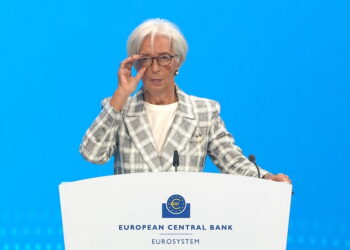


Brussels – The European Central Bank is set to raise interest rates at its meeting on 17 December. A concrete intention, but one that has merely been postponed. Because in the minutes of the October meeting, during which it was decided to keep the three key interest rates unchanged, it was made clear that the intention to tighten monetary policy was already in place. Still, the decision was taken to postpone what appears to be an inevitable course of action.
“Several members noted that, given that the data received since the Governing Council’s September meeting had confirmed the case for a further tightening of monetary policy, they might have supported an increase in interest rates as early as this meeting,” that is, the October meeting, according to the minutes. In the end, however, despite general concerns, “all members, including those seeing a case for acting at the current meeting, supported the decision to keep policy rates unchanged.”
The conditions for raising the cost of borrowing had therefore already materialised. Still, the ECB’s Governing Council opted for a cautious approach because, as the minutes emphasise, “given that a further rates hike is necessary, unless the inflation outlook improved significantly, the only issue is timing.“
Ultimately, it appears that the ECB, judging by the reports, has chosen to meet market expectations in order to avoid creating tensions: “Financial markets and analysts expected no rate change at the current meeting and attached a high probability to a hike at the next monetary policy meeting in December.” This, then, explains the reason for the pause.
Barring any major changes, therefore, the ECB could be set to deliver a Christmas present that would certainly not be welcomed by households and businesses, who would see the cost of mortgages and loans rise. But the situation seems inevitable, not least because it was already averted by the postponement in October.
Behind the ECB’s intentions is the observation that “the spread between the price of refined diesel and that of crude oil has widened, owing in large part to supply disruptions in the Middle East and Russia, as well as a reduction in supply from China,” with knock-on effects for inflation. “Current high levels of prices for refined products are seen as worrying, as they could feed into transport, shipping, agricultural and production costs, spreading the impact beyond that of the direct energy component of inflation.” Furthermore, food commodity prices, particularly in Asia, “are also coming “under pressure owing to adverse weather conditions linked to the “El Niño” phenomenon.” These are all reasons for tightening monetary policy.
English version by the Translation Service of Withub