Brussels – The second-to-last stop on António Costa‘s tour of the Western Balkans is North Macedonia. The president of the European Council visited the country this morning (May 15) to reiterate to Premier Hristijan Mickoski his personal commitment to finishing Skopje’s European Union accession process. However, as the host pointed out, blocking the small nation’s path to the twelve-star club is mainly an obstruction from Bulgaria, an issue that also seems to frustrate Costa.
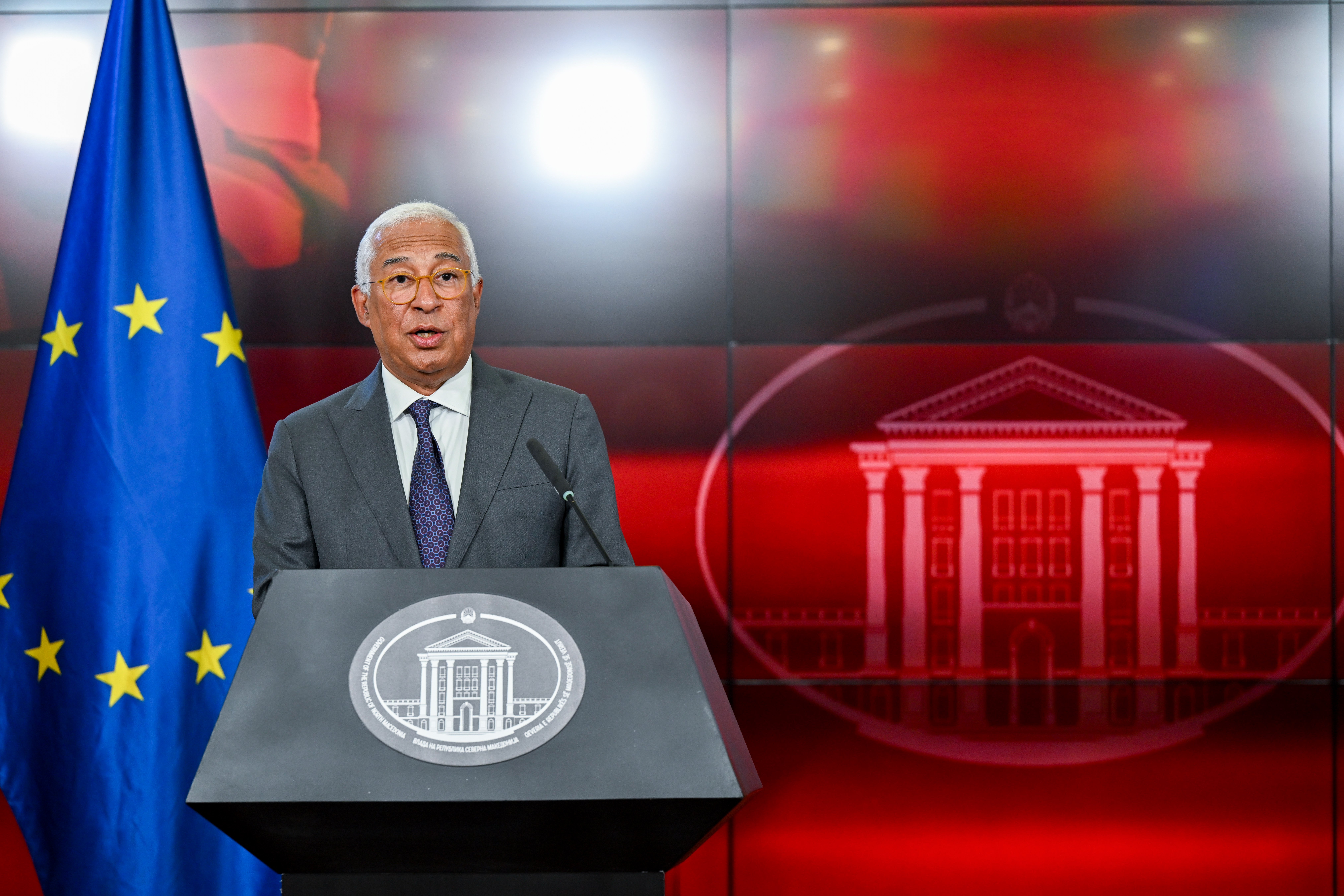
With a delay of over an hour (due to an “extensive but very constructive” bilateral meeting), European Council President António Costa and Macedonian Prime Minister Hristijan Mickoski held a brief joint press conference late this morning. The Portuguese socialist congratulated the conservative leader on the “excellent work accomplished by North Macedonia and your government on the reform agenda” and the progress made so far, beginning with alignment with the Union’s Common Foreign and Security Policy (CFSP).
Now, there is a need to “forge ahead with reforms” and take advantage of the opportunity to “conclude strategic investments,” Costa added, noting that Skopje and Brussels “are already getting closer,” as evidenced by the partnership on defense and security signed in November. The accession process “is a marathon, not a sprint,” Costa said. However, he urged his interlocutor to “stay the course” and hold on through a “path that can be challenging.”

It was a prophetic phrase and a bitter note for the host, who did not miss the opportunity to point the finger at neighboring Bulgaria, which has long stood in the way, effectively blocking the Macedonian path to the Union. “We are walking along the most difficult of paths,” Mickoski admitted, only to question whether “we are really walking” since, he lamented, “we are in the same spot where we were 20 years ago.”
“We are convinced that the future of Macedonian citizens is within the European family,” he said. However, he continued, his country deserves to be treated “with dignity,” both as a candidate and, eventually, as an EU member. “We have a problem with Bulgaria, and we want to solve it, but it’s a two-lane road,” he said, arguing that only one side is really working to make progress.
“We have done a lot to join the EU,” Mickoski reiterated, referring to the various changes made over the years to the country’s Constitution, flag, and name, adding that he is willing “to sit at the table, discuss and find a solution.” However, for now, he says, Sofia does not share a similar willingness. “The integration process should be driven by values and not bilateral negotiations,” he concluded, arguing that he cannot “amend the Constitution for the umpteenth time knowing that one member state is questioning our national identity.”
Costa offered his support. “This process has taken too long; now is the time for results,” he agreed, stressing that both Macedonia and Bulgaria must implement the contents of the agreement reached in July 2022. That pact called for Macedonia to recognize the Bulgarian minority (which led to the amendment of the Constitution) and for Sofia to lift its veto to Skopje’s accession.
However, the persistence of Bulgarian opposition led to a delay in accession negotiations last fall. “What has been agreed has been agreed,” the president of the European Council cut in short. “We need to ensure that no one now asks for anything more than what has already been agreed.” Let the message be understood by those for whom it is meant.
Skopje is the fifth stop on Costa’s Balkan tour. In the past few days, he made four visits to as many countries in the region: Tuesday to Serbia (where he met President Aleksandar Vučić, fresh from a trip to Vladimir Putin‘s court) and Bosnia-Herzegovina; yesterday he was in Montenegro (to congratulate Podgorica’s “impressive” progress toward accession) and Pristina, the capital of Kosovo (which, to date, five out of 27 member states do not recognize yet).
Costa’s final destination is Tirana, where he is heading during these hours. The former Portuguese premier will meet tomorrow (May 16) with leaders of some 40 countries on the Old Continent at the sixth summit of the European Political Community to discuss security, competitiveness, migration, and democracy.
English version by the Translation Service of Withub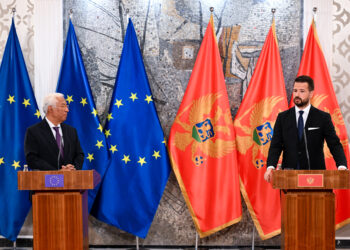


![Da sinistra: il presidente del Consiglio europeo, Antonio Costa; il presidente dell'Ucraina, Volodymir Zelensky: la presidente della Commissione europea, Ursula von der Leyen [Bruxelles, 18 giugno 2024. Foto: European Council]](https://www.eunews.it/wp-content/uploads/2026/06/euco_ua260618-120x86.jpg)
![[foto: Saverio De Giglio/imagoeconomica]](https://www.eunews.it/wp-content/uploads/2026/10/cpt-120x86.png)