- Europe, like you've never read before -
Sunday, 18 January 2026
No Result
View All Result
  • it ITA
  • en ENG
Eunews
  • Politics
  • World
  • Business
  • News
  • Defence
  • Net & Tech
  • Agrifood
  • Other sections
    • Culture
    • Diritti
    • Energy
    • Green Economy
    • Finance & Insurance
    • Industry & Markets
    • Media
    • Mobility & Logistics
    • Sports
  • Newsletter
  • European 2024
    Eunews
    • Politics
    • World
    • Business
    • News
    • Defence
    • Net & Tech
    • Agrifood
    • Other sections
      • Culture
      • Diritti
      • Energy
      • Green Economy
      • Finance & Insurance
      • Industry & Markets
      • Media
      • Mobility & Logistics
      • Sports
    No Result
    View All Result
    Eunews
    No Result
    View All Result

    Home » Politics » INTERVIEW / MEP Chloé Ridel urges EU to ‘counter transnational repression’

    INTERVIEW / MEP Chloé Ridel urges EU to ‘counter transnational repression’

    According to the European Parliament's rapporteur, the EU must equip itself with effective regulatory instruments to counter the methods used by authoritarian regimes to silence opponents around the world, including across Europe

    Francesco Bortoletto</a> <a class="social twitter" href="https://twitter.com/bortoletto_f" target="_blank">bortoletto_f</a> by Francesco Bortoletto bortoletto_f
    3 July 2025
    in Politics, World politics
    Chloe Ridel

    Chloé RIDEL in the EP in Strasbourg

    Brussels – The repression of dissent by authoritarian regimes can take many forms. In addition to crackdowns at home, the governments of several states are also increasing their capacity to strike abroad, targeting political opponents and activists far beyond their national borders. To better understand the dynamics of this phenomenon and the legislative shortcomings in the European Union, Eunews asked a few questions to Chloé Ridel, MEP for the French Parti Socialiste (S&D) and EP’s rapporteur on the subject. The Chamber will discuss a her draft report, dated 16 June, in the coming months.

    “Transnational repression (TNR) occurs when an authoritarian government reaches outside its national borders to coerce, control, or silence dissidents, human rights defenders, journalists, activists, the communities of the diaspora, and in general their own citizens abroad,” Ridel explains. States are mainly responsible, she continues, and “they often rely on proxies, which may be private companies, criminal networks, or collaborators in the diaspora.”

    Concretely, as far as the modalities of TNR are concerned, “the most common tactic is detention.” Other tactics “include physical threats, enforced disappearances, and kidnappings, often aimed at forced repatriation, as well as extradition requests and abuse of Interpol alerts for political reasons and various other forms of administrative pressure: travel bans, denial of identity documents and consular or banking services,” and so on.

    Recently, Ridel notes, “digital repression is on the rise: online surveillance, hacking, use of spywares, harassment on social networking sites and doxing”, a form of cyberbullying that consists of spreading private data online. Above all, “women are disproportionately subjected to gender-based violence online,” Ridel points out.

    Xi Jinping Vladimir Putin
    Chinese president Xi Jinping (left) and his Russian counterpart Vladimir Putin (photo via Imagoeconomica)

     It is a growing phenomenon globally; however, around 10 regimes are responsible for about 80 percent of the cases: Belarus, Cambodia, China, Egypt, Iran, Russia, Tajikistan, Türkiye, Turkmenistan, and Uzbekistan. “In 2023 alone, at least 300 human rights defenders were killed” at the behest of these governments, the MEP said, “in an attempt to silence them and stop their work.”

    What is the situation in Europe? “The lack of a shared legal definition and the scarcity of official data are allowing the phenomenon to grow and expand, in a global context where the number of authoritarian regimes is increasing,” she says. The MEP points out that “coordination remains weak” within the Union, with national provisions proceeding autonomously. “We hope to change this situation with this report,” which will be the first to be ever drafted by the Chamber on the subject.

    Among the 27 member states, she explains, “only a handful of governments have introduced specific provisions to address TNR, and policies to translate them into concrete action are just beginning.” Some member states (Germany, Slovakia, and the Baltic states) have signed the Declaration of Principles to Combat Transnational Repression, a voluntary initiative that Freedom House launched in 2023. In Sweden (as well as in other non-EU countries such as Norway and Switzerland), espionage against refugees is codified as a criminal offense.

    In Italy, in particular, she underlines “the arrest, in 2016, of the Iranian activist Mehdi Khosravi based on an Italian red flag to Interpol. Italy acted as a “transit and reception center where the people responsible for these violations tried to manipulate the cooperation with Interpol or the local police,” she continued. 

    Indeed, the legislative gap is much broader: “There is no single legal definition at the international level,” Ridel admits, adding that “implementation is also uneven across the board.” What urgent measures can be taken to mitigate the phenomenon in the EU? According to the MEP, there are at least three things Europe can – and should – do.

    For starters, it can act on “improving the mechanisms to collect, track, and report data on incidents of repression” through “contact points in the Member States and a EU-wide mechanism for collecting and tracking incidents.”

    Ursula von der Leyen
    European Commission president, Ursula von der Leyen (photo: European Council)

    Then, “member states could include TNR in their domestic laws and make full use of the flexibility allowed by their visa policies to protect human rights defenders.” This means including “the training of professionals“, i.e. employees of government and state agencies, external service providers, cyber security officers, law enforcement, and all personnel involved in the management of migration flows (including extradition practices).

    Secondly, it is necessary to “reduce the use of politically motivated Interpol alerts.” This is a task for Europol, which should “thoroughly analyse incoming alerts and extradition requests involving human rights defenders, journalists, opposition figures, or other persons at risk for thorough examination.”

    Finally, serious action must be taken against online repression. For instance by “implementing stricter regulations on enablers, including social media and industries that produce spyware,” Ridel said, proposing a embargo on the sale of this software to states that are responsible for these criminal actions, and penalizing operators that continue to export to countries included in a hypothetical blacklist.

    “Today, technology is a powerful weapon of oppression by authoritarian regimes,” she reiterated; but, unfortunately, “legislation is far behind.” The EU executive should update its toolkit, she argues, and can do so in various ways: “Involving social platforms and fully applying the Digital Services Act (DSA)” is a first step, but also “mobilizing civil society and human rights defenders to leave no room for repression and instead promote a free and safe online environment.”

    English version by the Translation Service of Withub
    Tags: Chloé Rideldissensohuman rightsregimi autoritarirepressione transnazionale

    Related Posts

    [foto: Gibrán Aquino/Wikimedia Commons]
    Briefs

    Spyware, 11 organisations call on Brussels for urgent action

    27 June 2025
    proteste Georgia
    Diritti

    Civil society and opposition in Georgia appeal to Europe to act against authoritarian drift

    18 June 2025
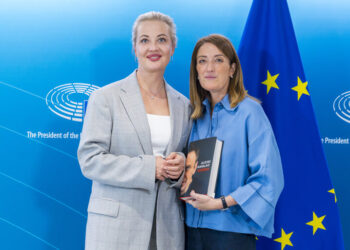
    Roberta METSOLA, EP President meets with Yulia NAVALNAYA, Alexei NAVALNY's wife
    World politics

    Yulia Navalnaya to the EU Parliament: ‘Support Russians resisting the regime, Putin will fall’

    5 June 2025
    A group of migrants embark on an Italian coast guard ship at the Shengjin port in Albania on February 1, 2025. Dozens of migrants departed from Albania under Italian custody on February 1, after a ruling by judges in Rome struck a fresh blow against Italian prime minister's embattled migrtion scheme. On January 31, Rome's Court of Appeals referred the case to the European Court of Justice (ECJ), meaning the 43 migrants in Albania had to be transferred to Italy, a government source told AFP. (Photo by Adnan Beci / AFP)
    Politics

    Why the EU considers Egypt and Bangladesh safe countries of origin

    17 April 2025
    map visualization

    Mercosur reshapes Italy’s alliances in Europe: PD with FdI and FI, League with M5S

    by Emanuele Bonini emanuelebonini
    16 January 2026

    The plenary session of the European Parliament has the free trade agreement with South American countries as the main item...

    Defence: Commission approves first SAFE disbursements to eight Member States

    by Emanuele Bonini emanuelebonini
    16 January 2026

    The Council has been asked to authorise disbursement for Belgium, Bulgaria, Cyprus, Croatia, Denmark, Portugal, Romania, and Spain. Von der...

    Migrazione frontiere pushback

    EU, decline in asylum applications continues, down 28 per cent in October compared to 2024

    by Enrico Pascarella
    15 January 2026

    The countries that received the most requests in October were Spain and Italy, but with lower figures than in the...

    Air Canada flights show as cancelled at Pearson International Airport as flight attendants go on strike in Toronto on Saturday, August 16, 2025. Photo by Sammy Kogan/CP/ABACAPRESS.COM

    Flight cancelled, airlines must also reimburse commission costs

    by Ezio Baldari @eziobaldari
    15 January 2026

    This has been established by the Court of Justice of the European Union. When purchasing from a travel agency or...

    • Director’s Point of View
    • Letters to the Editor
    • Opinions
    • About us
    • Contacts
    • Privacy Policy
    • Cookie policy

    Eunews is a registered newspaper
    Press Register of the Court of Turin n° 27


    Copyright © 2025 - WITHUB S.p.a., Via Rubens 19 - 20148 Milan
    VAT number: 10067080969 - ROC registration number n.30628
    Fully paid-up share capital 50.000,00€


    No Result
    View All Result
    • it ITA
    • en ENG
    • Politics
    • Newsletter
    • World politics
    • Business
    • General News
    • Defence & Security
    • Net & Tech
    • Agrifood
    • Altre sezioni
      • European Agenda
      • Culture
      • Diritti
      • Energy
      • Green Economy
      • Gallery
      • Finance & Insurance
      • Industry & Markets
      • Letters to the Editor
      • Media
      • Mobility & Logistics
      • News
      • Opinions
      • Sports
    • Director's Point of View
    • L’Europa come non l’avete mai ascoltata
    • Draghi Report
    • Eventi
    • Eunews Newsletter

    No Result
    View All Result
    • it ITA
    • en ENG
    • Politics
    • Newsletter
    • World politics
    • Business
    • General News
    • Defence & Security
    • Net & Tech
    • Agrifood
    • Altre sezioni
      • European Agenda
      • Culture
      • Diritti
      • Energy
      • Green Economy
      • Gallery
      • Finance & Insurance
      • Industry & Markets
      • Letters to the Editor
      • Media
      • Mobility & Logistics
      • News
      • Opinions
      • Sports
    • Director's Point of View
    • L’Europa come non l’avete mai ascoltata
    • Draghi Report
    • Eventi
    • Eunews Newsletter

    Attention