Brussels – The European Union is simultaneously trying to
save face and its valuable relationship with Israel. The agreement reached
in extremis last week between Brussels and Tel Aviv for the massive entry of
humanitarian aid into Gaza allows the 27 to free themselves from the urgency of
taking stronger measures against Benjamin Netanyahu’s government. So,
for now, Brussels welcomes “the positive signals” coming from the
Strip and calls for “more concrete measures”, freezing possible
actions to be taken if the humanitarian situation does not improve.
These
are the conclusions reached today by the foreign ministers of the 27,
gathered in the European capital for the last Council meeting before the
summer break. Following the review exercise of the EU-Israel
Association Agreement, which confirmed
violations on the Israeli side, it was the EU heads of state and government
themselves who asked the High Representative, Kaja Kallas, to put on the table
a range of possible measures to be taken against Tel Aviv. “We will keep
all options open and be ready to act if Israel does not fulfil its
commitments,” the head of European diplomacy said at the end of the
meeting.
Kallas, well aware of the deep divisions between the capitals on the issue, appeals to the “positive signals” coming from the Strip: “We are seeing more trucks and supplies coming in, more open crossings and repairs to power lines.” In short, enough to hope that something has been set in motion. “This is clearly
not enough, the EU will continue to closely monitor the implementation of this
joint agreement and will provide updates every two weeks,” the High
Representative assured.
The outcome seemed a foregone conclusion, to the extent that the Israeli foreign minister himself, Gideon Sa’ar, said last night in Brussels, during a summit of Mediterranean countries, that “none of the 10
proposals in the report will be implemented by the 27 member states tomorrow.”
The agreement brokered by Kallas on 10 July provides that “large-scale aid
will be delivered directly to the population”—cutting out the
controversial Gaza Humanitarian Foundation—and that Israel will allow a
substantial increase in the number of daily trucks transporting food and
non-food items into Gaza, the opening of several more border crossings in the
north and south, the reopening of the Jordanian-Egyptian humanitarian routes,
the distribution of food through bakeries and public canteens throughout the
Strip, the resumption of fuel supplies for humanitarian facilities, the
protection of aid workers, and the repair and facilitation of work on vital
infrastructure.
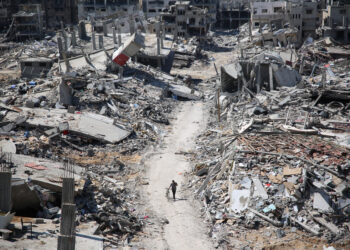
While it is true that some measures were already implemented
over the weekend by Tel Aviv, it is also true that the raids on Gaza continued,
killing dozens of Palestinian civilians. “For the first time in 130 days,
a small amount of fuel entered Gaza this week. This is a positive development,
but it is only a small part of what is needed every day to ensure daily life
and relief operations,” several UN agencies in the territory said in a joint statement. Meanwhile, today, six Palestinian citizens died
in an attack in Gaza City.
“The only guarantee we have is that all options are on the table, and if the situation does not improve, we can use them,” Kallas admitted to reporters, pointing out the fragility of the terms of the understanding with Israel. On the sidelines of the meeting, Irish Foreign Minister Thomas Byrne said, “We have nothing written,
Kallas only told us about the forecasts.”
The next meeting of EU foreign ministers will not take place until October, more than two months from now.
Until then, whatever the developments on the ground, Brussels will certainly
not budge. A risk, underlined by the 5 Star Movement MEP Danilo Della Valle: “We cannot be satisfied with an agreement on the delivery of humanitarian aid
and simple monitoring, when Israel is guilty of genocide and continues to
have the freedom to exterminate an entire population,” he said in a note.
English version by the Translation Service of Withub


![Il presidente del Consiglio europeo, Antonio Costa (sinistra) con il primo ministro sloveno, Robert Golob [Bruxelles, 26 giugno 2025. foto: European Council]](https://www.eunews.it/wp-content/uploads/2025/06/costa-golob-350x250.jpg)



![[credits: Dietmar Rabich / Wikimedia Commons / “Münster, Stadtweinhaus, Beflaggung Ukraine und EU -- 2022 -- 0219” / CC BY-SA 4.0]](https://www.eunews.it/wp-content/uploads/2026/03/ue-ucraina-120x86.jpg)