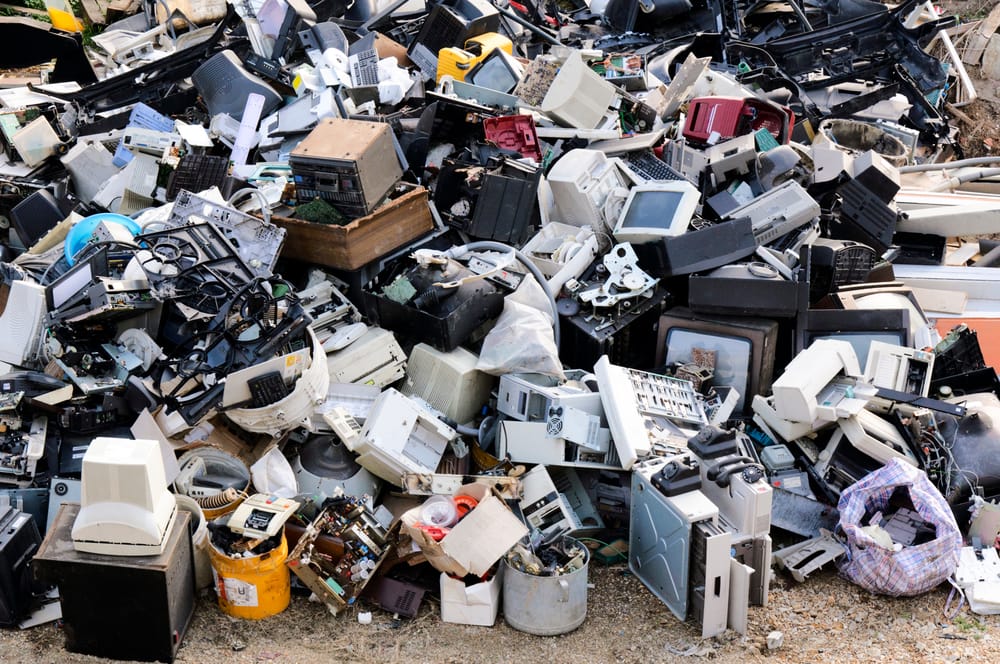
Brussels – The European Union could recover between 0.9 and 1.5 million tonnes of critical raw materials(CRM) per year by 2050, according to the report ‘Critical Raw Materials Outlook for Waste Electrical and Electronic Equipment‘, compiled by the FutuRaM consortium and funded by the EU on the occasion of International Electronic Waste Day. The document emphasizes that electrical and electronic equipment (EEE) is fundamental to Europe’s economy and everyday life and that, with Europe’s demand for essential raw materials on the rise, along with geopolitical tensions and supply risks, Europe is called upon to harness its urban mine of e-waste by improving the collection, design, and recycling of waste electrical and electronic equipment (WEEE).
“Discarded phones, laptops, servers, cables, appliances, and other e-products in the EU27+4 (EU, UK, Switzerland, Iceland, and Norway) annually now contain roughly 1 million tonnes of critical raw materials (CRMs): essential metals and minerals for powering green technologies, digital infrastructure, and modern defense,” the report states.
A vital situation to watch out for and act on: According to European Commissioner for the Environment, Jessika Roswall, “recycling is both an environmental imperative and a geopolitical strategy.” Currently, “Europe depends on third countries for more than 90 percent of its critical raw materials, yet we only recycle some of them as little as 1 percent,” Roswall notes. For this reason, “we need a real change in mindset in how Europe collects, dismantles, and processes this fast-growing e-waste mountain into a new source of wealth.” Especially at a time of “trade disruptions, from export bans to wars, expose Europe’s vulnerability.”
In 2022, according to the latest available data, 10.7 million tonnes of E-waste, approximately 20 kg per person, were generated in the EU+4. This e-waste contained 29 critical raw materials, with 1 million tonnes of these materials incorporated into the stream. Fifty-four percent of this waste (5.7 million tonnes) was managed in compliance with EU regulations, while 46 percent (5 million tonnes) was managed outside compliant channels. From compliant treatment, approximately 400,000 tonnes of critical raw materials were recovered, including 162,000 tonnes of copper; 207,000 tonnes of aluminium; 12,000 tonnes of silicon; 1,000 tonnes of tungsten; and 2 tonnes of palladium. Even within compliant systems, approximately 100 thousand tonnes of critical raw materials were lost, mostly rare earths in magnets and fluorescent powders. On the other hand, non-compliant pathways resulted in significant losses, totaling 3.3 million tonnes, which were mixed with scrap metal and achieved partial recovery at best. Additionally, 700,000 tonnes of e-waste were disposed of in landfills or incinerated, while 400,000 tonnes were exported for reuse.
And the rest has not been documented. This is a snapshot of the most recent past. However, looking to the future, the report specifies that, by 2050, the total volume of waste electrical and electronic equipment (WEEE) in the EU+4 is projected to increase from 10.7 million tonnes in 2022 to between 12.5 and 19 million tonnes per year. The exact trajectory of the variation range will depend on which of the three scenarios Europe will follow: business-as-usual, recovery, or circularity. “The amount of critical raw materials (CRM) incorporated in this stream is expected to increase from about 1.0 million tonnes in 2022 to between 1.2 and 1.9 million tonnes per year by 2050. In other words, even if the overall e-waste stabilises within a circular economy, the concentration of valuable materials in products such as photovoltaic panels, electric vehicle chargers, and servers will continue to increase,” the paper explains. Therefore, depending on policy choices, collection rates, and recycling efficiency, “Europe could recover between 0.9 and 1.5 million tonnes of CRM per year by 2050. In a business-as-usual scenario, recovery levels remain modest, leaving much of this resource unused,” it reads. “In the recovery scenario, investments in infrastructure and processing technologies increase returns, while the circularity scenario achieves similar recovery volumes despite generating less e-waste overall, demonstrating that smarter design, repair, and reuse strategies can balance waste reduction with a high return on materials,” the paper clarifies.
The report recalls that the circularity route offers “a double advantage” because, on the one hand, “it keeps annual WEEE volumes close to the current 10.7 million tonnes, while still allowing the recovery of more than 1 million tonnes of CRM each year.” At the same time, such stability “reduces environmental pressure, the risk of hazardous leakage, and guarantees Europe a resilient source of metals such as copper, aluminium, and palladium.” In addition, the report emphasises the importance of focusing not only on the amount of e-waste generated, but also on how effectively Europe designs products for disassembly, collects them at end-of-life, and recycles them through advanced recycling processes.
Specifically, over the next 25 years, waste from large appliances, such as washing machines and dishwashers, will increase from 4 million tonnes to a maximum of 7.5 million tonnes; small appliances from 3.2 million tonnes to a maximum of 4.5 million tonnes; heat exchange equipment from 1.8 million tonnes to a maximum of 3.3 million tonnes; small IT devices from 800 thousand tonnes to a maximum of 1 million tonnes. Screens and monitors, on the other hand, will drop from 800 thousand tonnes to between 700 thousand and 400 thousand tonnes. In comparison, photovoltaic panels will grow from 150 thousand tonnes (2022) to a maximum of 2.2 million tonnes (2050), demonstrating Europe’s transition to solar energy. Approximately 100 thousand tonnes of waste will come from lamps.
English version by the Translation Service of Withub