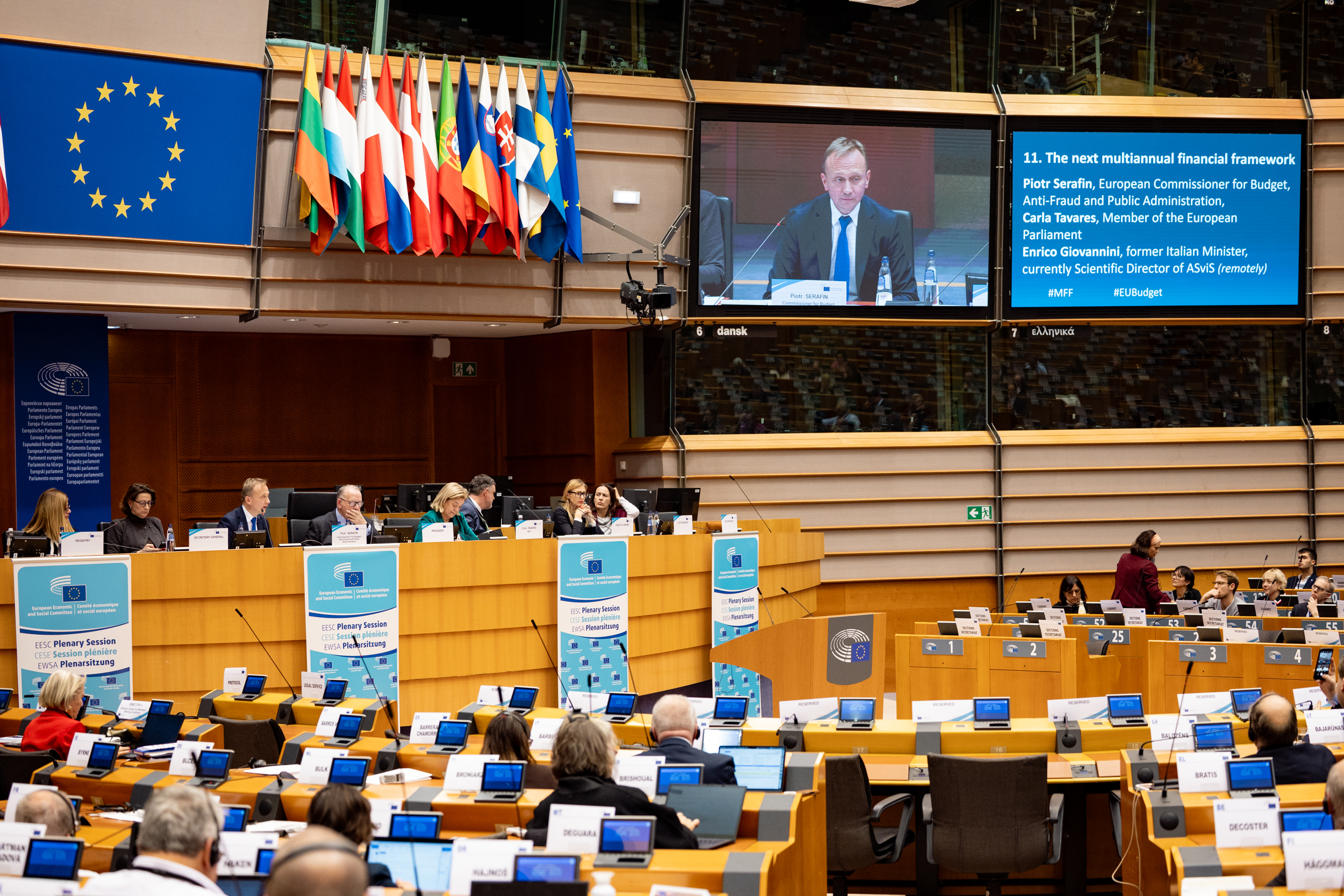

Brussels – The Commission’s draft MFF, the EU’s long-term budget for 2028–2034, was presented in July 2025 and amounts to EUR 1.816 trillion. The EESC discussed the draft during the plenary session as part of the preparations for an opinion, due in January 2026 and building on the EESC’s April 2025 mid-term revision assessment. The Committee calls for a transparent, forward-looking, and inclusive budget that fully involves regional and local authorities, the social partners and civil society.
‘The Commission’s proposals for the MFF take some steps in the right direction, rationalising instruments and increasing flexibility to respond to the multi-layered crises Europe faces. But flexibility must always be accompanied by robust guarantees of transparency, inclusiveness, and accountability,’ said EESC president Séamus Boland. ‘Our Union can only remain resilient if those closest to the ground – regional and local actors, social partners and organised civil society – remain fully involved in shaping where and how funds are spent.’
Shifts in budget structure raise questions
The Commission proposes a significant restructuring of the EU budget, with the merging of cohesion, agricultural and fisheries funding into new National and Regional Partnership Plans (NRPPs). These plans, developed jointly by the EU and Member States, would combine investments with reforms.
EESC members voiced concerns that this new architecture could lead to excessive centralisation in the management of EU funds. In response, Piotr Serafin, Commissioner for Budget, Anti-Fraud and Public Administration, stressed that regional authorities would play a substantial role in designing and implementing the NRPPs. He went on to explain that ‘If you look at the NRPPs’ rules, you will see that they largely mirror current co-management rules. However, having understood the regions’ worries, we proposed additional guarantees in November to ensure that regions can interact and negotiate directly with the Commission.’
Participants also warned against repeating the shortcomings seen with the pandemic-era Recovery and Resilience Plans, where civil society often reported limited or no consultation. They called for a careful reassessment of the new MFF structure to ensure meaningful involvement across all levels.
Concerns were further raised that linking NRPPs to challenges identified under the European Semester could amount to unnecessary macroeconomic conditionality. Greater clarity on this point was deemed essential.
Carla Tavares MEP called for an ambitious, transparent, and predictable EU budget, pointing out that ‘The Commission’s EUR 2 trillion headline hides a real budget freeze at 1.26% of EU GNI, limiting funding for European public goods.’ She stressed that flexibility must not undermine long-term objectives or the European Parliament’s role and reaffirmed its commitment to constructive cooperation with the EESC, Council and Commission.
Revenue sources and funding priorities
The Commission has proposed several new revenue sources for the next MFF. The EESC is in favour of making use of revenue from the Emissions Trading System (ETS1) and the Carbon Border Adjustment Mechanism (CBAM). However, members were opposed to the proposed Corporate Resource for Europe (CORE), a new levy on large companies, recommending a digital services tax instead.
Participants flagged up the importance of maintaining the European Social Fund Plus (ESF+) and the Just Transition Fund as stand-alone instruments with increased resources. They welcomed the strong emphasis on competitiveness and supported the creation of a European Competitiveness Fund (ECF), alongside higher allocations for Horizon Europe. However, they noted that the ECF would mainly consolidate existing programmes and called for clear governance and guidance on priorities.
There was also broad support for an increase in funding for the Connecting Europe Facility to strengthen transport and energy interconnections, improve connectivity across the EU and reduce energy price disparities.
Lastly, the EESC welcomed the Commission’s proposed AgoraEU programme, a EUR 9 billion framework merging Creative Europe, the MEDIA strand and the Citizens, Equality, Rights and Values programme. Designed to support culture, media pluralism, independent journalism, democratic participation, and civil society, it is seen as a key step towards promoting shared European values, simplifying funding and strengthening Europe’s cultural and democratic resilience.
Enrico Giovannini, former Italian minister in the Draghi government and Scientific Director of the Italian Alliance for Sustainable Development (ASviS), closed the debate: ‘Stronger involvement of local and regional communities can deepen the connection between people and institutions. With clearer targets, better technical design, and greater transparency, we can improve the current proposal and reinforce the democratic strength of European policy.’
English version by the Translation Service of Withub

![La Presidente del CESE, Nicoletta Merlo [fonte Eunews]](https://www.eunews.it/wp-content/uploads/2026/07/WhatsApp-Image-2026-07-22-at-12.21.14-350x250.jpeg)