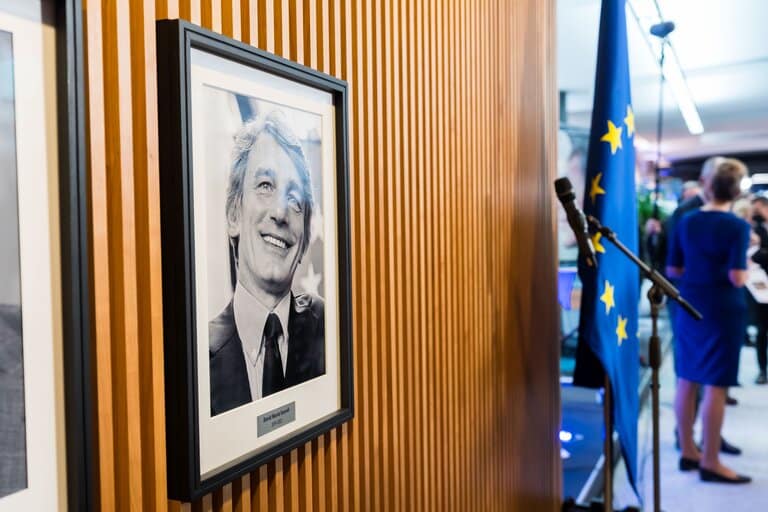
Brussels – On 11 January 2022, David Sassoli passed away after a brief hospitalisation at the Aviano Cancer Centre in Italy due to complications arising from an immune system disorder. The President of the European Parliament died while still in office. Four years later, the European Union is going through one of the most complicated phases in its history, marked by precarious internal political balances and dangerous instability on the international stage. The legacy of Sassoli, who showed the way during the first crisis of the decade, the COVID-19 pandemic, is now more relevant than ever.
“You are always in our hearts. On the anniversary of his passing, we remember him with gratitude and honour his courage and commitment,” said Roberta Metsola, who replaced him as President of the European Parliament, paying tribute to him with a post on X. In this spirit, an event entitled “What reforms for a freer and more united Europe” was held today at the European Parliament’s offices in Rome in memory of David Sassoli.
Representatives of European institutions from across the political spectrum took part, either in person or remotely: Raffaele Fitto, current Executive Vice-President of the European Commission, Pina Picierno, Vice-President of the European Parliament, Roberto Gualtieri, Mayor of Rome, and MEPs Salvatore De Meo, Nicola Zingaretti, Susanna Ceccardi, Ilaria Salis and Camilla Laureti.
Picierno (PD), visiting Lithuania, dedicated a video message to Sassoli from the border with Belarus, which “marks the distance between the autocracies on the other side and our common space.” A “coincidence”—smiled the Democratic Party MEP—useful for remembering how much the former journalist and presenter of Tg1 “taught us to defend Europe not through press releases and theoretical statements, but in the field, through constant and daily politics.”
In the storm that the Union is currently navigating, “David would have helped us to combine the clarity of the vision of a federalist and democratic Europe with a gentle ability to build it starting from what we have,” said Roberto Gualtieri. For Salvatore De Meo (Forza Italia), Sassoli was a leader who “never spoke about people but to people.” A “bridge between institutions and humanity.”
The current head of the Democratic Party delegation to the European Parliament, Nicola Zingaretti, emphasised that “Sassoli’s thinking is extremely useful in understanding how we should behave in the world today.” The former Democratic Party secretary borrowed one of his phrases: “If Europe is a better place, we owe it to the European Union and the achievements it has been able to accomplish.”
Sassoli was a figure who united all political sensibilities, even those furthest from his own. Susanna Ceccardi, MEP for the Lega party, highlighted this: “Even though his views were extremely different from mine, Sassoli truly believed in the European Parliament, considering it the democratic heart of the Union, a place for debate and dissent.” Not only that: “On several occasions, he called on Europe not to become a distant and self-referential machine, because a Union that does not listen to its people is destined to lose legitimacy,” Ceccardi insisted.
From right to left, for Ilaria Salis, elected to the Strasbourg chamber with the Green and Left Alliance, “Sassoli’s Europeanism was a concrete Europeanism, based on social rights and solidarity between states, on attention to work, free information, and the fight against inequality.”
Camilla Laureti, MEP for the PD, offered a suggestion for moving beyond mere remembrance: “Given that today we are asking ourselves what reforms we should pursue, I think we should continue to fight to overcome the veto and unanimity. Otherwise, we will not be able to create a stronger Europe that is better prepared to face challenges.”
Raffaele Fitto closed the ceremony, summing up Sassoli’s work in two words that also serve as the title of a book summarising his official speeches: wisdom and audacity. “Two very significant words, seemingly contradictory.” On the one hand, “a wise, balanced and dialogue-based approach;” on the other, “the need, at times, to take more decisive and courageous action.”
English version by the Translation Service of Withub



![Il ministro dei Trasporti, Matteo Salvini [Bruxelles, 5 dicembre 2024. Foto: Emanuele Bonini per Eunews]](https://www.eunews.it/wp-content/uploads/2024/12/salvini241205-120x86.jpeg)