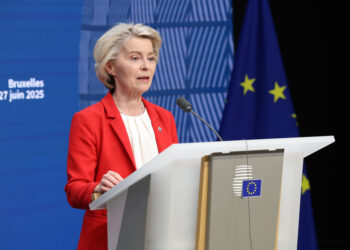

Brussels – There remains a desire and willingness to engage in dialogue with the United States, which continues to be considered an ally, but at the same time, “the consultations confirm the readiness to defend ourselves against any form of coercion.” The President of the European Council, António Costa, sums up the political sentiment of the European Union, which is called upon to discuss the increasingly tense relations with Washington at an extraordinary summit of leaders convened for 22 January. US President Donald Trump has launched a new offensive over Greenland, announcing the increase in tariffs against those States (Denmark, Sweden, France, Germany, and Norway) that are sending troops to guard the Danish autonomous island.
The new threats from the US president have heated up the situation. French President Emmanuel Macron is calling for the activation of the anti-coercion instrument, a mechanism to protect against unfair trade practices, which in this case, would mean economic retaliation against the US worth 93 billion euros. The reactions from Paris, which are the most decisive and combative, have prompted Costa to call an extraordinary summit, “given the significance of recent developments and in order to further coordinate,” the President of the European Council explains.

In Brussels, the heads of state and government of the EU countries will therefore have to seek a common, united, and unified strategy in response to the bullying of an ally with whom they would like to maintain cordial relations, but towards whom decisive action is needed. The message that will emerge will undoubtedly be one of EU solidarity with Denmark and Greenland, with concrete demonstrations of support, above all political. On Costa’s part, this sentiment is already clear in the statement convening the summit, from which some are distancing themselves.
Well said. Good point! https://t.co/qZLx5Vrwlc
— Viktor Orbán (@PM_ViktorOrban) 15 January 2026
English version by the Translation Service of WithubHungarian Prime Minister Viktor Orban believes that the issue should be discussed bilaterally between Denmark and the United States. This statement was made on the official X channel in response to a post on the subject, in which Polish President Karol Nawrocki supported Orban’s idea.