By claiming his stake to take over Greenland, US President Donald Trump has caused an enormous problem for transatlantic relations. Greenland is an autonomous region of Denmark, a member state of the European Union (EU) and a founder of the North Atlantic Treaty Organization (NATO) – the military alliance established to provide mutual defence between Europe and the US post-WWII. If the US were to follow true on their intention to acquire Greenland with any means, including force, to allegedly secure their national security, that would deeply upset transatlantic relations. Yet, the way how Denmark, and Greenland, play this game matters – and so far their strategy has been self-defeating.
As the Brexit precedent show, the only way a small country can successfully deal with a much larger and more powerful neighbour is by playing as a loyal member of a larger team. When the United Kingdom (UK) decided to leave the EU, Ireland – which borders the UK, and indeed shares with it a complicated land border separating the republic from Northern Ireland – could have tried to strike a one-to-one deal with the UK, as a way to settle problems emerging in movement of people and goods in the island of Ireland. In fact, the UK was betting on this, as this it could have easily outweighed Ireland one-to-one. Yet, in 2016, the Irish government made a strategic choice, which ultimately led it to a stunning success: instead of negotiating with the UK one-to-one, it teamed with the EU, and made sure that its negotiating priorities would become those of the whole bloc. As that happened, the Brexit mess was largely solved in a way that preserved Irish preferences and interests.
Admittedly, Brexit and negotiations with the UK are different that a military threat to seize Greenland and negotiations with the US. But Denmark is so far making a strategic blunder. On 14 December envoys from Denmark and Greenland travelled on their own to Washington DC to meet with Secretary of State Marco Rubio. Unsurprisingly though, their requests for US respect of territorial sovereignty were dismissively rebuffed.
If Denmark wants stand a chance in this negotiation, it needs to start thinking and acting European. It should stop making this an out-of-time battle for the control of a colony (which in fact was terribly brutalized for centuries), and turn this into a continental issue. Admittedly, this does not come naturally in Denmark, or indeed Greenland. Bluntly put, Denmark has never been the poster child of a committed EU member state. Since Brexit, no other EU country has had as many opt-outs from EU policies as Denmark. The country is outside the Eurozone; it does not participate in most EU laws on immigration and home affairs; and until Russia’s invaded Ukraine, it also had an opt-out from the (innocuous) EU security and defense policy. Denmark is furthermore a member of the so-called group of frugals, which have been opposing any effort to strengthen the EU budgetary resources, and it did not shine for its solidarity towards Southern member states when they were facing economic hardships or sudden waves of asylum seekers. The EU flag never ever appears behind Prime Minister Friedricksen, when she speaks at the podium. As for Greenland, the track-record is even worse: in 1985 the region – at the time recently endowed with autonomy from Denmark – voted to leave the EU, effectively the only precedent of a territory seceding before Brexit.
Yet, as geo-politics changes, national attitudes can change too. Denmark, could, and should start thinking and acting as a country of 5 million, which is now part of large bloc: the EU, and demand that the Greenland issue be dealt with by EU institutions. While Greenland indeed left the EU (then the Economic communities), its foreign policy is still handled in Copenhagen, so as an EU member state Denmark could request that the EU High Representative for Foreign and Security Policy take over in negotiating the matter with the US. Kaija Kallas is unlikely to scare off President Trump, and the EU would also be unable to defend Greenland if the US invaded it by force, but that’s not the point. By making this a European, rather than Danish matter, the stakes at the negotiating table would change. The EU has no army, but it has the largest market in the world – half a billion consumer, who are prime customers for US goods and services. The EU moreover has extensive regulatory authority on digital platforms, and trade defence instruments, which it has so far refrained from using to their full extent. In summer 2025 the EU accepted a trade deal with Trump, which imposed limited across-the-board tariffs, and opted to de-escalate. But all that could be reconsidered if Greenland were to become part of the negotiations.
In sum, if Denmark wants to stand a chance in dealing with the US over Greenland, it should quickly learn the Brexit lesson. In fact, Greenland could be the canary in the cold mine for all the EU member states: unite or perish. Surely, uniting also requires enhancing the fiscal and defence powers of the EU, and reforming its decision-making structures, so it can effectively act as one and deliver. But at the minimum it entails playing with team Europe: facing a military superpower which is not shy of leveraging its muscle, this is really the only way EU states – small and large – can hope to secure their strategic interests and economic prosperity.

Federico Fabbrini is Full Professor of EU Law and the Founding Director of the DCU Brexit Institute, and a Fellow in International Security at the Kennedy School of Government at Harvard. He was formerly Associate Professor at the University of Copenhagen.
English version by the Translation Service of Withub

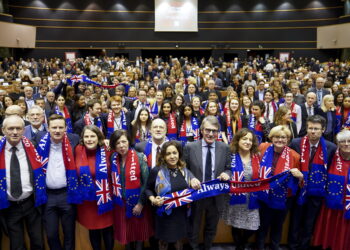
![Proteste per la brexit [Foto: Unsplash]](https://www.eunews.it/wp-content/uploads/2026/06/alexander-andrews-qDni9uoarQ-unsplash-350x250.jpg)


![[foto: European Council]](https://www.eunews.it/wp-content/uploads/2026/03/euco-260319-120x86.jpg)