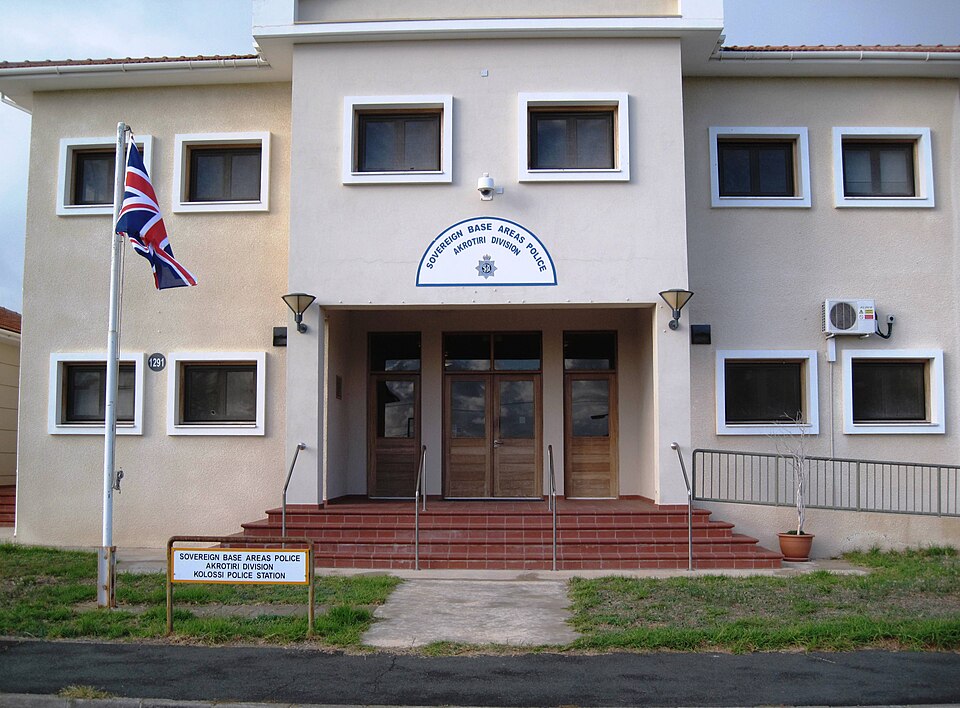
Brussels – The British presence in Cyprus is now beginning to pose a problem, and the part of the island that is part of the EU is fuelling new nationalist and pro-independence sentiments that are directed against His Majesty’s military bases – a remnant of a past that people would like to erase. The European Union is ready to take charge of the situation, in this new and changing world which, for Cyprus, changed radically on 1 March this year, when Iranian drones posed threats to security and led to the cancellation of events and meetings organised by the rotating EU Council Presidency. Security threats were posed by the British military base at Akrotiri, one of the two outposts on the island alongside the one at Dhekelia.
The Iranian attacks, prompted by the presence of the bases, are becoming a serious issue for the government in Nicosia – currently among the countries that favour neutrality – not least because of the very particular circumstances that characterise this Eastern Mediterranean state.
Cyprus, an unresolved issue: a divided country and the British bases
Cyprus presents a unique situation. It is a divided country, with an independent south and a north controlled by Turkey. The Turkish Republic of Northern Cyprus is a territory that has declared itself independent but has never been recognised as such by the international community. It enjoys the support of Turkey, following the coup d’état of July 1974 orchestrated by Greece, which the colonels then led. Having forcibly deposed the Cypriot president Makarios, Greece attempted to gain control of the island, whose population was 82 per cent Greek and 18 per cent Turkish. That forced move by the junta of colonels gave rise to a dispute with Turkey over the island that has never truly been resolved: even today, a one-kilometre-wide line separates the independent Greek south, part of the EU, from the de facto independent north. The dividing line is a long corridor under UN administration.
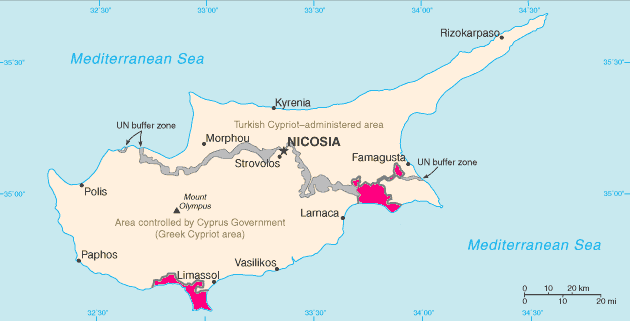
The British presence on the island dates back to before the Cyprus question itself. A former British colony, Cyprus gained independence from London in 1960. The independence agreement stipulated that two British military bases must remain on the territory, classified as overseas territories as they are “sovereign” bases. These are therefore not areas that Cyprus has granted under concession, but rather genuine British military exclaves: Dhekelia and Akrotiri. The former is situated in the south-east, on what has been the border between the two divided parts of the country since 1974; the latter is in the south, within EU territory.
The Treaty of Zurich and London of 19 February 1959 laid the foundations for Cyprus’s independence as a presidential republic. The Treaty of Nicosia of 16 August 1960 became the legal instrument, recognised by the UN, establishing Cyprus as an independent and sovereign actor on the international stage.
Article 1 of the international treaty stipulates that “the territory of the Republic of Cyprus shall comprise the Island of Cyprus,
together with the islands lying off its coast, with the exception of the two areas
defined in Annex A to this Treaty, which areas shall remain under the sovereignty
of the United Kingdom. These areas are in this Treaty and its Annexes referred to
as the Akrotiri Sovereign Base Area and the Dhekelia Sovereign Base Area.“
Annex B, Section 5, of that agreement goes on to set out the conditions under which the United Kingdom may use its sovereign bases and the manner in which the independent State of Cyprus is to relate to its neighbouring country. There is therefore a strong legal basis for the British presence on the island, intended to maintain a foothold in the heart of the Mediterranean, an area considered of strategic interest from a geographical perspective.
Brexit and the present day
The “Leave” victory in the 2016 referendum on the UK’s membership of the EU and the resulting exit in 2020 have raised the issue of the British bases at Dhekelia and Akrotiri once again. Following the United Kingdom’s withdrawal from the EU, Trade Commissioner Maroš Šefčovič recalls that the Protocol on the Sovereign Base Areas of the United Kingdom in Cyprus, included in the Withdrawal Agreement, ensures that EU law continues to apply in the sovereign base areas. However, he explains in response to a parliamentary question on this matter, “the Protocol on the SBA (Sovereign Base Area ) does not cover matters related to the EU security architecture and
strategic autonomy, nor its security or external relations.”
The Cypriot far right is now trying to corner the UK. The world has changed; the EU of peace has become the EU of rearmament, with defence and security taking centre stage as never before. According to Geadis Geadi, a Conservative MEP (ECR) and member of the National Popular Front (ELAM), partito dalle tendenze neo-fasciste e neo-nazi tendencies, “The existence of military infrastructure operating outside the EU’s institutional and legal framework may have implications for the EU’s strategic autonomy, security architecture and ability to act coherently in external relations.”
So what is the way forward? The rights acquired by the United Kingdom are legally robust and well-established. Admittedly, the Republic of Cyprus itself has begun to consider how to manage the presence of what is now a third country. The conclusions of the European Council summit held on 19 March this year made clear in black and white the Nicosia government’s intention to enter into discussions with London regarding the sovereign military bases at Dhekelia and Akrotiri. Legally speaking, however, there may be little room for manoeuvre. The bases are the result of bilateral agreements; for this reason, discussions will, for the time being, proceed along those lines. Of course, Šefčovič reiterates, the European Council, speaking on behalf of all the leaders, “has expressed its willingness to provide assistance, if necessary.” The Commission will do the same, because “the EU has a strategic interest in a stable and secure Eastern Mediterranean.” In short, the British bases in Cyprus are now an issue that needs to be resolved.
English version by the Translation Service of Withub