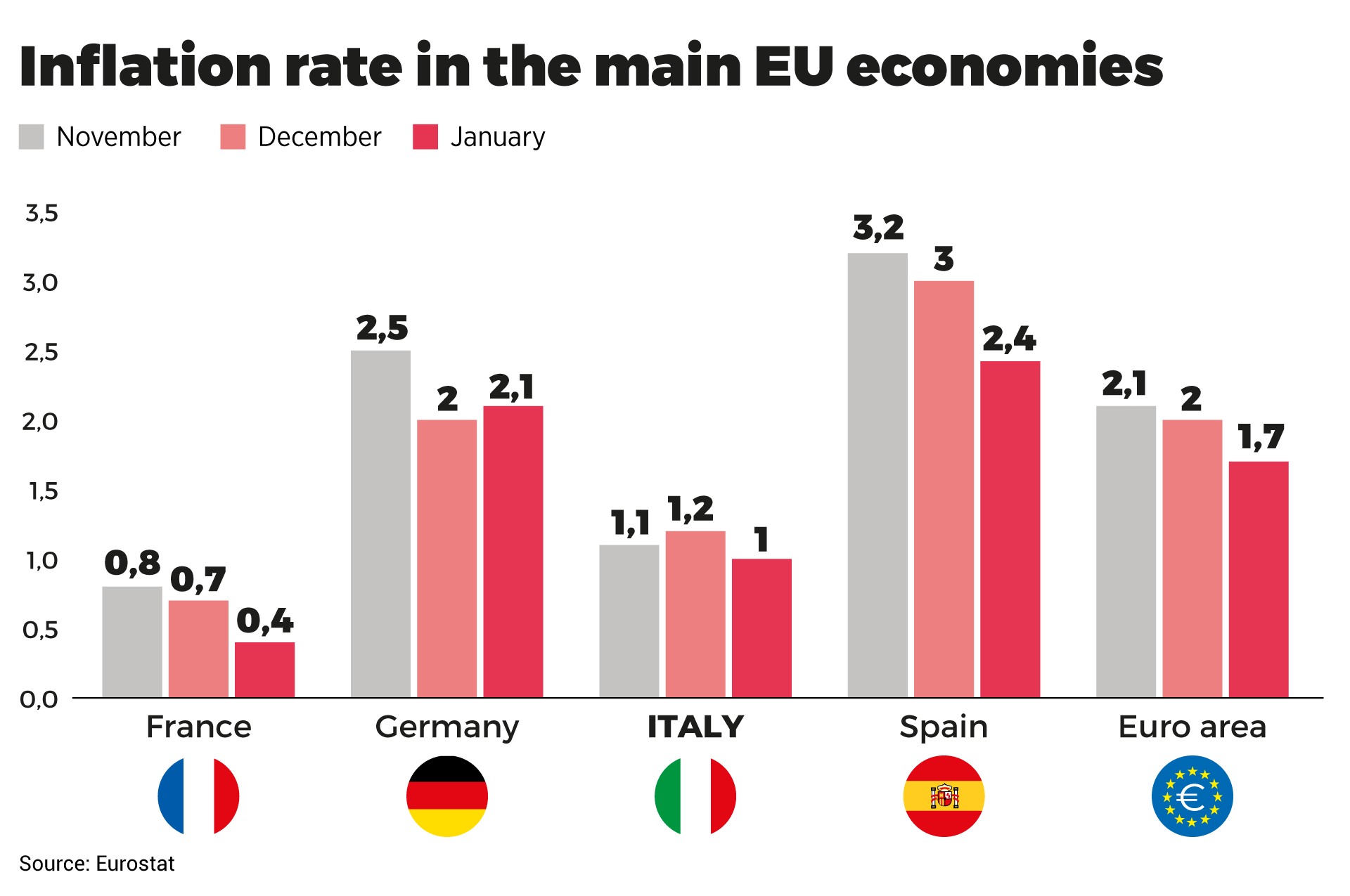
Brussels – Inflation rises: according to a preliminary estimate by Eurostat, the statistical office of the European Union, the expected rate for February 2026 is 1.9 per cent, 0.2 percentage points higher than the previous month. This figure reverses the downward trend in place since last February. In Italy, the expected figure is 1.6 per cent, up 0.6 per cent on January.
The services and food products sectors are exerting the greatest pressure on prices in the euro area. The former will record the highest annual rate in February, estimated at 3.4 per cent, up from 3.2 per cent in January. The food, alcohol, and tobacco sector has a rate of 2.6 per cent. Within this category, the figure for unprocessed food stands out, reaching 4.6 per cent, a sharp increase from 4.2 per cent in the previous month. Less significant increases were seen for non-energy industrial goods, which recorded a more modest rate of 0.7 per cent. There is positive news for the energy sector, which continues to show a negative change (-3.2 per cent) compared to February 2025, meaning that prices are lower than a year ago, although the decline is less marked than the -4.0 per cent recorded in January.
Among euro area countries (which, as of 1 January 2026, also includes Bulgaria), those with the highest annual inflation rates in February 2026 were Slovakia, with the highest inflation at 4.0 per cent, followed by Croatia with a rate of 3.9 per cent, and Estonia and Lithuania with 3.2 per cent. Italy recorded an estimated inflation rate of 1.6 per cent, up from 1.0 per cent in January, but still below the euro area average (1.9 per cent). In contrast, the lowest rate was recorded in Cyprus (0.9 per cent). It is important to note that these figures are based on flash estimates and that the complete and final figures for all European Union countries will be published on 18 March 2026.
The European Central Bank expresses strong concern for the attacks by the United States and Israel on Iran, which caused oil prices to surge to their highest levels since early 2025. President Christine Lagarde fears that a new energy shock could fuel inflation and slow growth, making the interest rate cut planned for 19 March unlikely. In this scenario, monetary policy is likely to remain cautious to avoid undermining the progress made in stabilising prices following the previous energy crisis.

![La presidente della BCE, Christine Lagarde, in audizione in Parlamento europeo [Bruxelles, 26 febbraio 2026]](https://www.eunews.it/wp-content/uploads/2026/02/lagarde-260226-350x250.png)


![[foto: European Council]](https://www.eunews.it/wp-content/uploads/2026/03/euco-260319-120x86.jpg)