Brussels – The European Union expects the United States of America to honour the trade commitments made in the agreement signed in July and is ready to react to protect its interests. This is the clear formal response from the European Commission’s spokesperson for Trade, Olof Gill, to the latest threats by US President Donald Trump to impose an embargo on Spain over Madrid’s position on Washington and Tel Aviv’s attack on Iran.
“The EU and the United States concluded an important trade agreement last year. The European Commission expects the United States to fully respect the commitments made in our joint statement. The Commission will ensure that the interests of the European Union are fully protected. We stand in full solidarity with all Member States and all their citizens, and, through our common trade policy, we are ready to act if necessary to safeguard the interests of the EU,” Gill said early this morning. “We will continue to support stable, predictable, and mutually beneficial transatlantic trade relations for the benefit of all,” he said, after recalling that “trade between the European Union and the United States is deeply integrated and mutually beneficial” and that “safeguarding these relations, especially at a time of global crisis, is more important than ever and is clearly in the interests of both sides.”
The Commission points out that it is responsible for the Union’s trade policy and warns of the White House’s threats to break up the EU-27. “Germany is doing a great job, NATO Secretary General Mark Rutte is fantastic. But Spain is terrible, they are a great people, but they don’t have good leadership,” Trump said at a press conference with German Chancellor Friedrich Merz. In addition, he said, “We could impose an embargo on Spain tomorrow.” The White House occupant described the Iberian country as “really uncooperative” and said he had instructed Treasury Secretary Scott Bessent to “cut off all business” with Madrid. “We will cut off all trade with Spain. We don’t want to have anything to do with Spain,” Trump said.
The American president does not take no for an answer. Especially when it comes from a “repeat offender” country like Spain, which was initially reluctant to comply with the US request to NATO allies to increase defence spending to 5 per cent of GDP and is now saying “no to war,” as Sanchez has made clear. Spain will not be “complicit in something negative for the world,” such as war in Iran, “simply for fear of reprisals from anyone,” the prime minister said in an official statement at the Moncloa Palace after Trump’s threats yesterday, reiterating that Spain is a key member of the Atlantic Alliance that respects its commitments and makes a significant contribution to the defence of European territory. In particular, Madrid says no to Washington’s use of the military bases in Rota and Moron for operations related to attacks on Tehran. “They don’t want us to use the bases? They have nothing we need,” the American president claimed. However, he threatens retaliation.
Merz did not particularly oppose Trump’s words. On the contrary, instead of defending Madrid, the Chancellor explained that he would “try to convince Spain” to contribute more to NATO and agreed with Trump that “all other allies are increasing their spending.” Berlin, therefore, wants to avoid a confrontation with Washington, even at the cost of backing a member of the EU family. He pointed out that the United States and Germany “are on the same wavelength when it comes to removing this terrible regime in Tehran.” “We will talk about the day after, about what will happen next,” Merz continued, “we hope that this war will end as soon as possible,” he concluded.
Thus, a posture of alignment with Washington that goes even further than that of the U.K., its historic ally, whose stance Trump has said he is “not happy” with. At the heart of the matter is the use of British bases in the Mediterranean. “It took us three or four days to figure out where we could land,” Trump complained, adding that “this is not Winston Churchill that we’re dealing with.” The US president said he was “shocked” by London’s “stupid” decision to hand over the Chagos Islands to Mauritius and attacked the energy and migration policies of Keir Starmer‘s government.
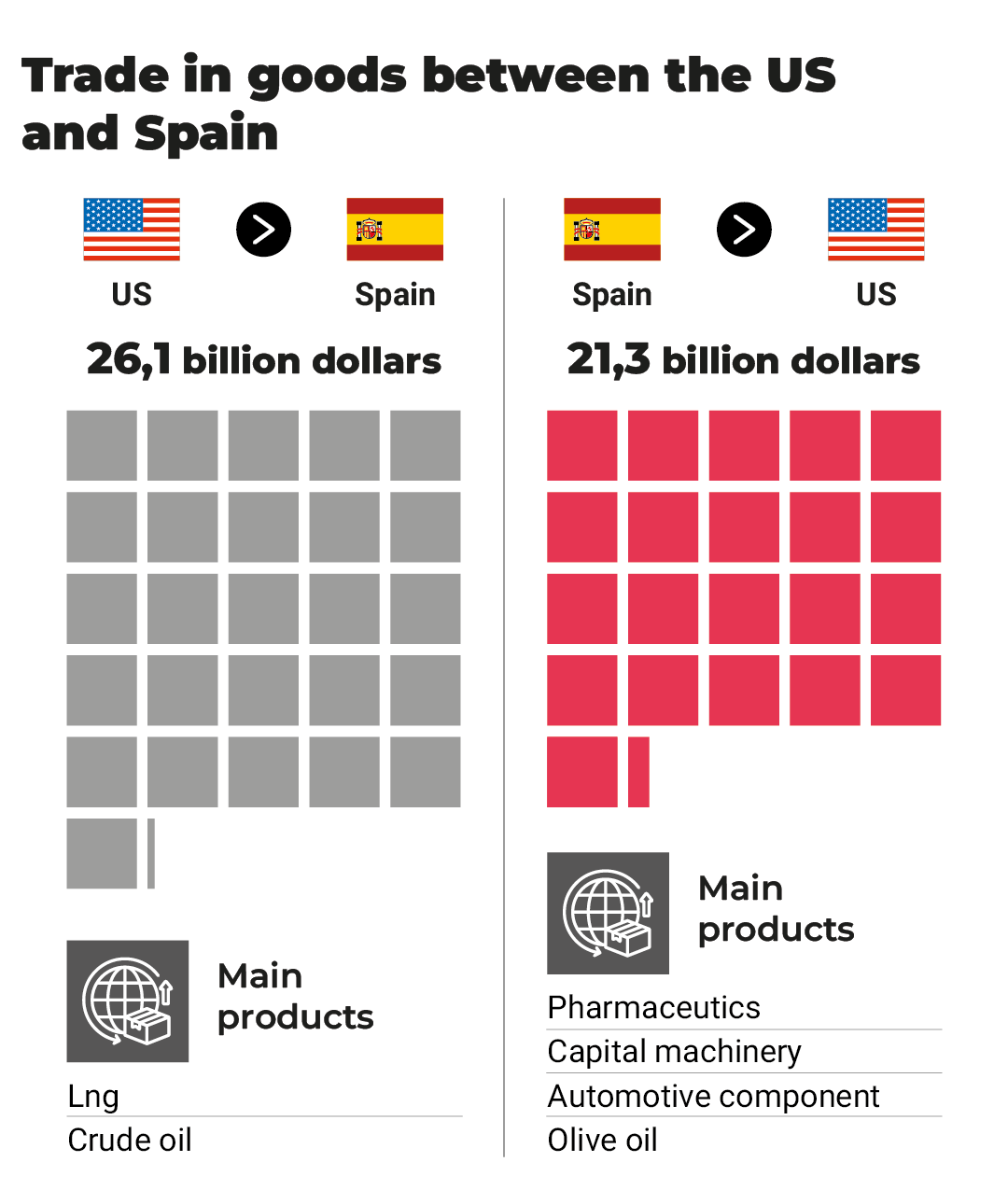
In today’s response, one that the German Chancellor failed to provide on the spot, Brussels reiterated that a unilateral trade blockade by the US clashes with the fact that trade policy is an EU matter. Therefore, any such measure would face a highly complicated legal and political path. Meanwhile, according to the data, in 2025, trade in goods between the US and Spain closed with a US surplus of 4.8 billion dollars, with US exports to Spain totaling 26.1 billion and imports totaline 21.3 billion. On the energy front, according to Enagas, in 2025 the United States covered about 30 per cent of Spain’s gas supplies/imports, confirming American LNG as the cornerstone of procurement, and US crude oil remains among the top exports to the Iberian Peninsula. Madrid, on the other hand, maintains its position in the segments with the highest added value: pharmaceuticals are among the main items sold to the United States (approximately 1.3 billion dollars in the estimates used), together with mechanical engineering and automotive components integrated into North American supply chains. In the agri-food sector, olive oil remains a key driver.
![Il presidente del Consiglio europeo, Antonio Costa [Lussemburgo, 4 marzo 2026]](https://www.eunews.it/wp-content/uploads/2026/03/costa-260304-350x250.png)