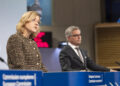
Brussels – Firm and strengthened commitment to strategic partnership on energy. At a time of concern for oil and gas prices following the Israeli and US attack on Iran and the subsequent closure of the Strait of Hormuz, the European Union and the Republic of Azerbaijan have confirmed and reaffirmed their joint efforts in this sector. Yesterday (3 March), Baku hosted the Ministerial meeting of the 12th Southern Gas Corridor Advisory Council and 4th Green Energy Advisory Council, attended by representatives of 27 partner governments and 60 institutions and companies, including European Commissioner for Energy and Housing, Dan Jørgensen, and the Azerbaijani Minister of Energy, Parviz Shahbazov. The meeting highlighted the strong commitment of both sides to their strategic partnership in the energy sector, which includes affordable, stable, and secure natural gas supplies, the promotion of renewable energy, energy efficiency, hydrogen production, methane emission reduction, and environmental protection.
“Our energy partnership with Azerbaijan is advancing in step with Europe’s clean energy transition,” said Jørgensen. “Today, we strengthened cooperation across the entire energy spectrum, from securing gas supplies and reducing methane emissions to modernising grids and expanding renewable energy,” he explained, emphasising that “Azerbaijan and the wider region hold immense potential for further cooperation in renewables, energy efficiency, and regional connectivity.”
During the sessions, the parties reaffirmed the importance of the Southern Gas Corridor (SGC) as a reliable infrastructure for diversifying the European Union’s supplies. According to the Directorate-General for Energy, it is a “transmission system delivering Azerbaijani gas to an increasing number of customers in a reliable and competitive manner. Regional partners acknowledged the successful operations of the SGC for the fifth consecutive year, marking a significant contribution to the EU’s energy supply diversification.” In this regard, the data presented indicates that in 2025, Azerbaijan and SOCAR – Azerbaijan’s wholly state-owned oil and gas company – supplied EU Member States with 12.5 billion cubic metres of natural gas, an increase of 53.8 per cent compared to 2021 volumes.
The debate then moved on to the development of transport infrastructure and the financing conditions for future investments. A central point of discussion was the environmental sustainability of the gas industry, with a particular focus on reducing methane emissions through initiatives such as the Oil and Gas Methane Partnership 2.0 framework, which covers 42 per cent of global oil and gas production, to help understand the exact locations and volumes of methane emitted, allowing a shift from estimates to direct measurements of methane emissions, checked by independent verifiers.
In addition to security of supply, the meeting addressed the challenge of ecological transition. The press statement by Jørgensen and Shahbazov referred to assessments by the International Energy Agency (IEA) and the International Renewable Energy Agency (IRENA), which found that achieving climate targets by 2030 requires accelerating electrification and boosting investment in grids and energy storage.
With this in mind, the European Union and Azerbaijan have begun collaborating to create green energy corridors connecting the renewable potential of Central Asia and Azerbaijan with the European market. In this regard, Commissioner Jørgensen highlighted how the South Caucasus could emerge as a strategic hub for clean technologies and modern infrastructure, emphasising the interest of European companies in contributing capital and technical expertise. “The South Caucasus can emerge as a hub for clean technology and infrastructure development. European businesses are eager to contribute with their technology, investment, and expertise. By working among governments, financial institutions, and the private sector we can turn this vision into reality,” Jørgensen noted.
Finally, on the sidelines of the ministerial meetings, a round table on investments in “green connectivity” between the EU and Azerbaijan was held. The meeting brought together international financial institutions and private companies to define the next steps for energy efficiency and regional connectivity. The delegations confirmed their willingness to continue cooperation in view of the COP31 in Turkey, focusing on the flexibility of electricity systems and cross-border interconnections. Minister Shahbazov concluded by reiterating that Azerbaijan intends to consolidate its role as a strategic partner, complementing its historic natural gas supply with a new offering in the renewable energy sector.