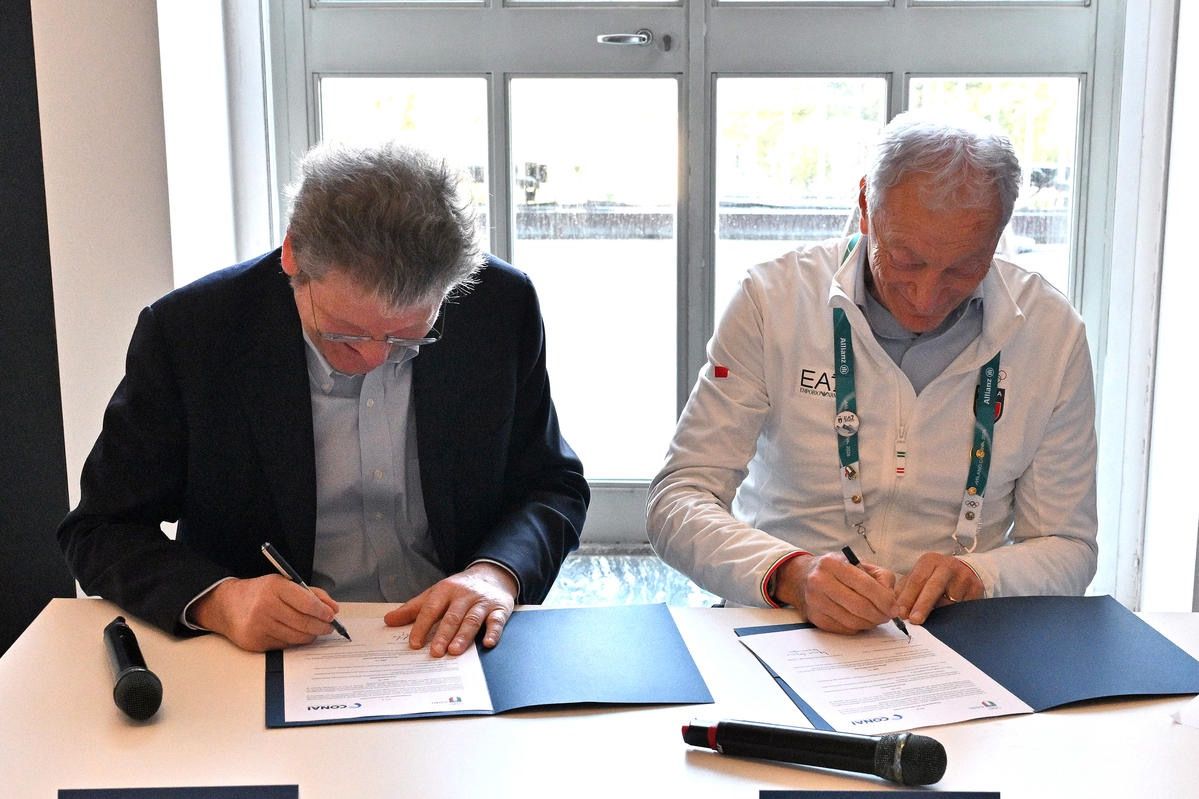
Brussels – Extending the sustainability experience gained at the Olympics to the entire Italian sports system. This is envisaged in the Memorandum of Understanding signed by the presidents of CONI, Luciano Buonfiglio, and CONAI, Ignazio Capuano, which will enable Italy to embark on a new phase to establish the sustainability model tested during the 2026 Milan Cortina Winter Games as permanent. In fact, with this document, sustainability will be integrated into all Italian sporting events until 2028, through guidelines that will place particular emphasis on separate waste collection and the recycling of packaging materials.
The protocol, valid until 31 December 2028 and for the entire four-year Olympic cycle, will integrate guidelines on recycling, waste management standards, and circular economy practices for federations, sports clubs, and event organisers at every level of Italian sport. Its ambition will be to make the environmental rigour demonstrated during the Olympic Games the benchmark for any major sporting event on Italian soil. Therefore, federations, sports clubs and event organisers will be called upon to apply more stringent environmental standards, promoting the recovery of steel, aluminium, paper, wood, plastic, compostable bioplastics, and glass. The aim is to transform the good practices adopted during the Olympics into a stable national model for all sporting events.
According to Buonfiglio, “Bringing recycling, environmental guidelines and best practices into our facilities and events means transforming every occasion into an opportunity for shared responsibility. Our athletes, with the values they embody, will be increasingly powerful role models for virtuous and environmentally conscious behaviour.” Capuano, on the other hand, pointed out that “sport has enormous communicative power” because “it can become a multiplier of virtuous behaviour.” He continued: “Italy has already exceeded 76.7 per cent recycling of packaging, a result that puts us well above European targets. But sustainability cannot stop at our doorsteps. Recycling at home is essential, but we must apply the same care when we are in the stands, in sports arenas, at major events involving millions of people. This is where a country’s environmental maturity is truly measured: every event can become a concrete example of the circular economy.”
The protocol also provides for information and training programmes aimed primarily at young people, with the aim of establishing a culture of separate waste collection in stadiums and sports arenas. “After all, sport is about discipline, responsibility, and respect for the rules —values that naturally align with the principle of responsibility on which the CONAI system is based, which ensures that Italy achieves the recycling targets set by the European Union,” reads the joint press release.
English version by the Translation Service of Withub



![[Copyright: European Union]](https://www.eunews.it/wp-content/uploads/2026/10/euco-261015-120x86.png)