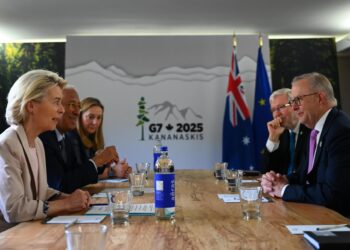
Brussels – Indonesia, the four Mercosur nations, India, and now Australia: the European Commission is pressing ahead with its trade diversification strategy and has secured a new free trade agreement, breaking the deadlock in negotiations with Canberra that began in 2018 and stalled several times over disagreements in the agricultural sector. “We are in the final phase of negotiations,” Ursula von der Leyen announced to the heads of state and government of the 27 member states on the eve of the European Council. The Commission President has already booked her tickets: she will be in Australia next week, from 23 to 25 March.
In a statement, Brussels explains the purpose of the visit to Sydney and Canberra (where von der Leyen will meet Australian Prime Minister Anthony Albanese). “To strengthen EU ties with a trusted, like-minded partner in the strategically vital Indo-Pacific region.” The EU leader, in a letter on competitiveness sent to European capitals on Monday, emphasised: “This will mark another milestone in the diversification of Europe’s international partnerships and in strengthening our strategic engagement globally.”
The EU-Australia free trade agreement has been in the pipeline since 2018. Back in 2023, the European Commission tried to speed up the negotiations, but without success: talks broke down twice within a few months, stalling in particular over the degree of market access in one of the most sensitive sectors, agriculture. Australia was seeking effective access to the European market for its meat producers (primarily beef and mutton), while the EU insisted on restricting Australian farmers’ use of geographical indications for European products.
However, removing trade barriers between two such close partners is of paramount importance: in 2024, the value of trade in goods and services between the European Union and Australia exceeded 91 billion euros. Last year, the EU and Australia traded goods worth over 47 billion euros, of which 36.9 billion were EU exports to Australia and 10.2 billion were EU imports from Australia. Over the course of a decade, trade in goods has increased by almost 50 per cent.

So, last May, Albanese’s confirmation as the country’s leader – coupled with Donald Trump’s aggressive trade stance towards both partners – gave new impetus to negotiations. First came the partnership on critical raw materials, followed by the launch of negotiations for closer defence and security cooperation.
“In addition to removing trade barriers, the agreement will also facilitate access to critical raw materials – such as lithium, cobalt, rare earth elements, and hydrogen – and strengthen Europe’s presence in one of the world’s most dynamic economic regions,” von der Leyen explained. The EU leader added that the agreement forms part of a “broader Indo-Pacific strategy, linking trade, investment, and geopolitical engagement.”
English version by the Translation Service of Withub![[Credits: AgainErick/Wikimedia Commons]](https://www.eunews.it/wp-content/uploads/2026/02/containers-350x250.jpg)




![[Copyright: European Union]](https://www.eunews.it/wp-content/uploads/2026/10/euco-261015-120x86.png)