Brussels – Ready to contribute to ensuring safe navigation in the Strait of Hormuz, without making any specific reference to the easing of tensions or a ceasefire as a precondition for their involvement. An official statement issued by the leaders of Germany, France, Italy, Japan, the Netherlands and the United Kingdom appears to mark an initial opening by these six countries to US President Donald Trump’s requests for allied participation in operations to ensure the security of the Strait.
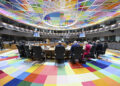
On their arrival at the European Council this morning (19 March), EU leaders reiterated a firm stance of refusal in the face of pressure from the White House, making it clear that any European involvement requires a legal basis endorsed by the United Nations and, above all, a ceasefire. Yet, following the Israeli offensive on Iran’s South Pars gas field—one of the largest in the world—and Tehran’s subsequent response targeting oil sites in Qatar—described by the Revolutionary Guards as “linked to the United States”—the five European states and Japan have changed their tune. This has created a potential rift with the positions of other European Union capitals.
“We condemn in the strongest terms
recent attacks by Iran on unarmed commercial vessels in the Gulf,
the attacks on civilian infrastructure, including oil and gas facilities, and the de facto closure of the Strait of Hormuz by Iranian forces,” the six countries begin. “We express our deep concern at the escalation of the conflict. We call on Iran to immediately cease its threats, mine-laying operations, drone and missile attacks, and any other attempts to block the Strait to commercial shipping, and to comply with United Nations Security Council Resolution 2817,” they state.
Rome, Berlin, Paris, London, The Hague and Tokyo point out that “freedom of navigation is a fundamental principle of international law, in particular under the United Nations Convention on the Law of the Sea;” that “the consequences of Iran’s actions will be felt across the globe, particularly by the most vulnerable,” and stress “that such interference with international navigation and the disruption of global energy supply chains constitute a threat to international peace and security.” In this regard, “we call for an immediate and complete moratorium on attacks against civilian infrastructure, including oil and gas facilities.”
It is at this point that the six countries state they are “ready to contribute to the efforts required to ensure the safety of navigation in the Strait,” but without making any reference to a ceasefire or a de-escalation of tensions, as reiterated by their EU counterparts. Furthermore, they
“welcome the commitment of nations who are engaging in preparatory planning.” On the strictly energy-related front, they also welcome “the decision by the International Energy Agency to authorise a coordinated release of strategic petroleum reserves” and explain that they will adopt “further measures to stabilise energy markets, including by working with certain producer countries to increase production.” At this very level, meanwhile, the consequences of the escalation in the Gulf are also reflected in energy prices: the price of Brent, for May delivery, surged by 10 per cent to $118 a barrel before falling back to $114.50 (+6.75 per cent); its US equivalent, WTI, for April delivery, showed greater caution, rising by 0.88 per cent to $97 per barrel, but the Dutch TTF futures contract, considered the European benchmark for natural gas, rose by 21.18 per cent to €66.24 per megawatt hour, after reaching a peak of 35 per cent.
And whilst the leaders of the six countries conclude their statement by pledging to “support the countries most affected, including through the United Nations and international financial institutions,” reiterating that “maritime security and freedom of navigation benefit all countries” and urge “all states to respect international law and uphold the fundamental principles of international prosperity and security,” from Washington Trump announces that he will not send troops and that the war will end soon. “I won’t be sending troops anywhere, and if I did, I wouldn’t tell you,” he declared at the White House whilst meeting with Japanese Prime Minister Sanae Takaichi, one of the six countries in the declaration. The tycoon added that “it will end very soon,” because “their navy is gone, their air force is gone, their air defences are gone, we fly wherever we want… their leadership is gone.” And he took the opportunity to praise Japan whilst denigrating the North Atlantic Treaty Organisation. For Trump, Tokyo “will shoulder its responsibilities” and “is committing itself” to the war “unlike NATO.” And he pressed on: “We are defending the Strait of Hormuz for the good of the world. NATO doesn’t want to help us, but they are the ones who need it.” He then acknowledged that the allies “are becoming much kinder, more helpful, but as far as I’m concerned, it’s too late. You know, the UK wants to send aircraft carriers now. And I said I wanted the aircraft carriers before the war; I don’t want them after the war has been won.”
Italy
Meanwhile, defence sources in Rome have made it clear that any Italian participation in a mission with other countries to safeguard commercial shipping through the Strait of Hormuz could only take place under the auspices of the UN. And this morning, the Defence Minister, Guido Crosetto, clarified that “Europe is perceived as an ally of the United States, because that is the case within NATO” and “a European fleet would be perceived as a NATO fleet, and therefore as a fleet entering the war alongside the United States and Israel.” For the minister, “the UN flag, all the more so, even though it has been lowered in recent years, represents a fleet that brings together Europe, China, Asia, India and all the countries of the world, those most affected by Hormuz and Asia”. Thus the Deputy Prime Minister and Minister for Foreign Affairs, Antonio Tajani, emphasised on the TV programme “Tagadà”: “Should there be a UN mission, we are ready to play our part. Participating in a war? Absolutely not.” Secretary-General Antonio Guterres himself, speaking today at the European Council, recalled that “the Security Council has ordered the reopening of the Strait of Hormuz” and that “the prolonged closure of the Strait of Hormuz is causing immense suffering to countless people around the world who have nothing to do with this conflict.” And given that “it is time to end this war, which risks spiralling completely out of control and spreading to the global economy,” the Europeans’ compass seems to be pointing towards a UN mandate that would allow them to stand alongside their US and Israeli allies. Meanwhile, the Tehran regime has warned that “if the attack on Iranian infrastructure is repeated, the next attacks on your energy infrastructure and that of your allies will not stop until they are completely destroyed, and the response will be even harsher than last night’s.”
English version by the Translation Service of Withub![[foto: imagoeconomica, rielaborazione Eunews]](https://www.eunews.it/wp-content/uploads/2025/03/inflazione-difesa-350x250.png)

![[foto: European Council]](https://www.eunews.it/wp-content/uploads/2026/03/euco-260319-350x250.jpg)