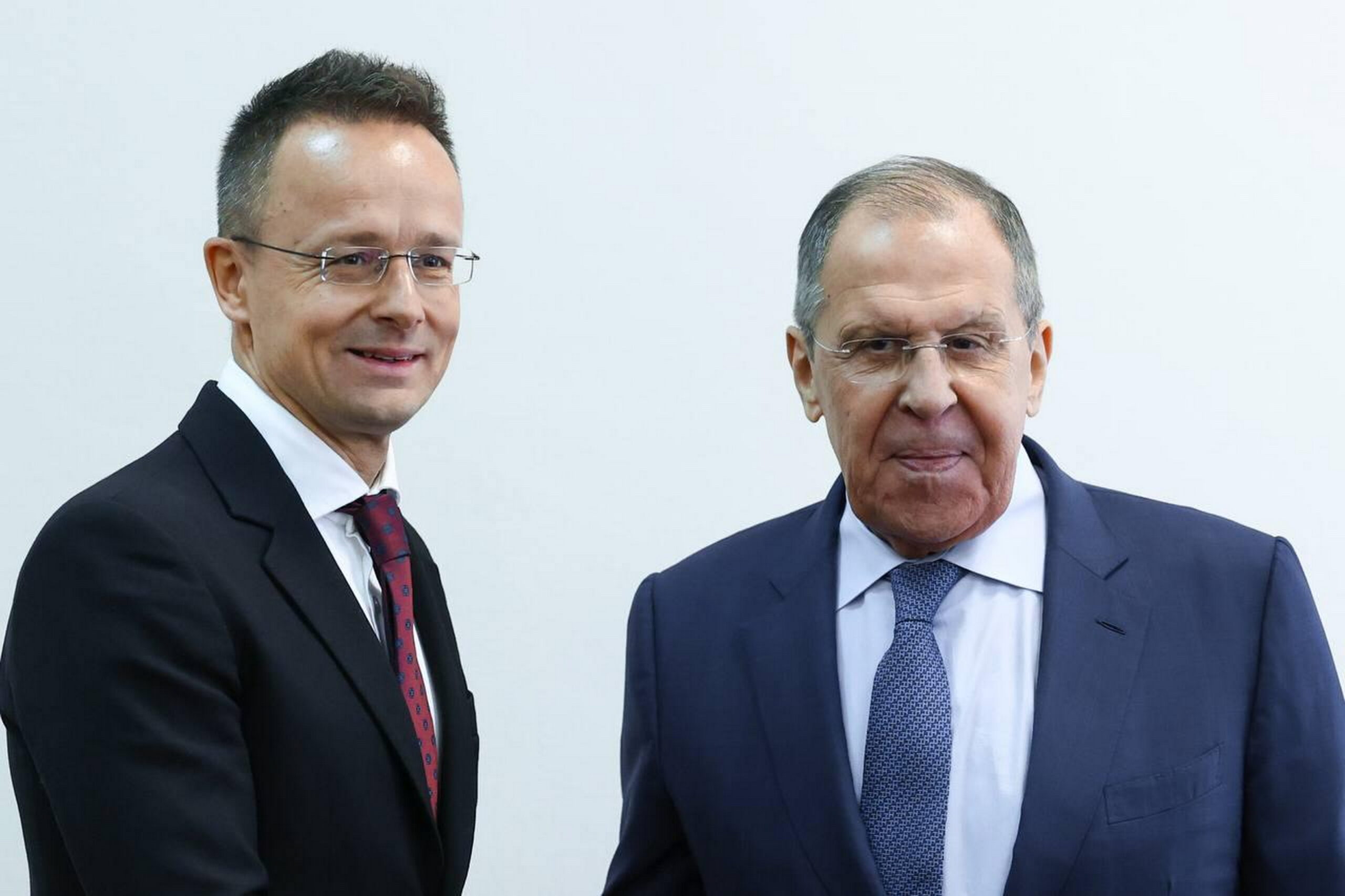
Brussels – Hungary’s Foreign Minister, Péter Szijjártó, has finally admitted that he has regular contact with his Russian counterpart, Sergey Lavrov, to keep him informed in real time of what is happening during meetings of the European Union’s Foreign Affairs Council. The news was reported last Saturday (21 March) by the Washington Post. The US newspaper had gathered testimonies on the matter from some officials and diplomats based in Brussels, and a few hours later, several prominent politicians from EU countries, including Polish Prime Minister Donald Tusk, confirmed that they had long suspected the existence of a genuine direct telephone line between Budapest and Moscow.
Yesterday, Szijjártó had dismissed the allegations as “fake news and lies“, but late in the evening, he was forced to backtrack, confirming the American newspaper’s revelations during an election rally in the town of Keszthely. “Before and after EU Council meetings, I speak not only with the Russian foreign minister, but also with those of the United States, Turkey, Israel, Serbia, and all our country’s other partners,” said Budapest’s foreign minister from the stage, naming—perhaps not coincidentally—a series of states with which Brussels does not currently have exactly idyllic relations.
According to Szijjártó, the reason why these phone calls are necessary is very simple: “During meetings between Member States, many decisions are taken that affect Hungary’s relations and cooperation with third countries on issues such as energy, the automotive industry, and security,” he explained. After all, according to Szijjártó, “this is how foreign policy works: I’m probably saying something that’s hard to accept, but diplomacy consists of talking to the leaders of other countries.”
In a video published this morning on Facebook, the right-hand man of the Hungarian Prime Minister, Viktor Orbán, also rejected accusations that he had breached the principle of sincere cooperation, which governs relations between EU Member States, stating that information exchanged during meetings between government representatives must be considered confidential. “At interministerial level, secret matters are never discussed,” he explained, “and all ministers—except me—bring their phones into the room: the idea that security protocols exist belongs in the realm of stupidity.”
The European Commission, having yesterday described the Washington Post reports as “extremely worrying” and called on Budapest “to provide immediate clarification on the matter”, has today stated that the EU High Representative for Foreign Affairs and Security Policy, Kaja Kallas, will speak with the Hungarian minister. “The High Representative expects the legal obligation of sincere cooperation to be respected at all times,” said the spokesperson for Foreign Affairs, Anitta Hipper, “and that all Member States support the Union in achieving these objectives, avoiding any action that might undermine them. High Representative Kallas will contact the Hungarian Minister for Foreign Affairs” to address these issues.
.
English version by the Translation Service of Withub
![[credits: Dietmar Rabich / Wikimedia Commons / “Münster, Stadtweinhaus, Beflaggung Ukraine und EU -- 2022 -- 0219” / CC BY-SA 4.0]](https://www.eunews.it/wp-content/uploads/2026/03/ue-ucraina-350x250.jpg)