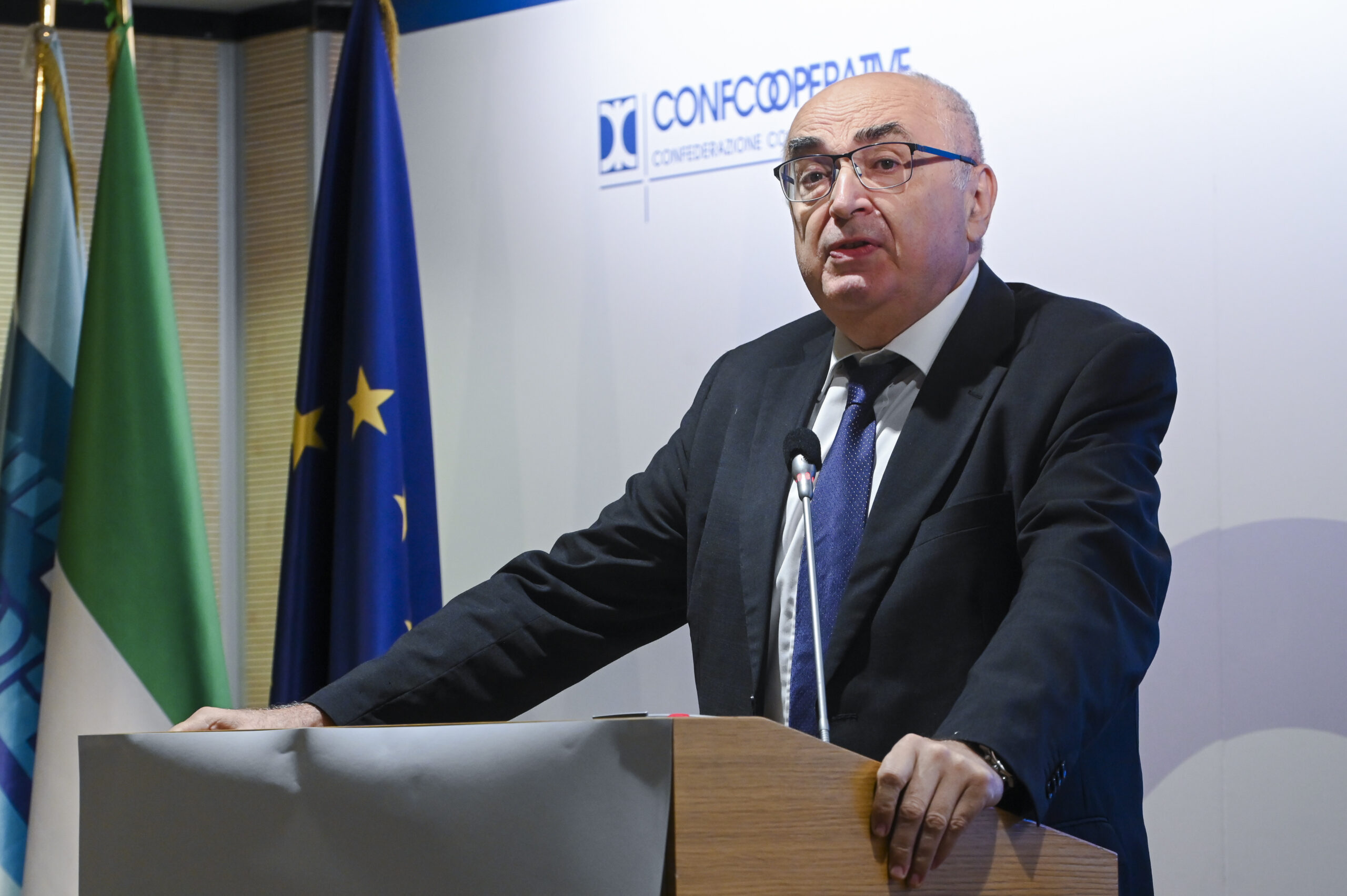
Brussels – Inclusive competitiveness, encompassing the social economy; cohesion; the Common Agricultural Policy (CAP); public procurement rules that do not prioritise the lowest bid; bank credit and the role of cooperative credit banks: these are some of the issues that the Confcooperative Executive Board, led by President Maurizio Gardini, is taking to Brussels today (24 March) for discussions with Raffaele Fitto, Vice-President of the European Commission and Commissioner for Cohesion and Reforms; Tommaso Foti, Minister for European Affairs, Cohesion Policy and the National Recovery and Resilience Plan (NRRP); a delegation of Italian MEPs and the President of the European Parliament, Roberta Metsola. The broader aim is to call for “a stronger Europe,” Gardini explains.
Speaking to reporters ahead of the start of the closed-door event entitled “The Europe of the Future: Confcooperative at the Heart of the Debate” the president of Confcooperative explained that “the aim is to put forward a whole series of non-partisan, well-articulated proposals which, given the current situation in Europe, we believe are important for the country.” An opportunity which, in a brief press briefing, Fitto describes as “very useful” for a dialogue with the cooperative sector, “across various key sectors, from agriculture to the issue of services, to social affairs.” According to the Executive Vice-President, “these are also decisive issues for the choices that the Commission is implementing, as well as for the debate on the new budget proposal for 2028–2034, on which the European Commission presented its own proposal, and today this discussion is underway at the Council and Parliament level.” And he confirms, on the eve of tomorrow’s presentation of the final results of the Mid-term review of Cohesion Policy (namely the instrument that allows countries to reprogramme the use of funds by redirecting them towards five new EU priorities in light of the changed global geopolitical context) that “Italy is among the countries that have made use of the mid-term review” and that “almost all countries have done so.”
“This is also the moment when the EU’s multiannual financial framework is defined,” Gardini points out, adding that “it is important” for “the decisions to strike a delicate balance.” On the one hand, competitiveness, “not only for its own industrial manufacturing sector, but also including all those who are key players in social economy enterprises” and, on the other hand, “the Cohesion funds which are necessary and indispensable, just as they have been in the past and will be even more so in the future, to support the regions and, above all, to support the development of those regions that are progressing more slowly or economically lagging.”
On this point, Minister Foti acknowledged to journalists that “the 2028–2034 multiannual financial framework is a crucial instrument for the future of Europe.” In particular, the Common Agricultural Policy, “precisely because it must be common certainly cannot be subject to individual states’ assessments in terms of disbursement,” and “then Cohesion Policy, for which we believe there is no conflict with competitiveness.” In particular, “I believe that Cohesion Fund resources should remain at least at the financial level of the previous framework and, above all, a model could be introduced regarding the objectives: without prejudice to the role of the Regions, which we consider to be of the utmost importance and decisive, a target-based model could be introduced based on what was the National Recovery and Resilience Plan drawn up by us, Next Generation Europe, more broadly across Europe,” he explains.
On the agricultural front, Gardini refers to the “large-scale protests by farmers” and “by fishermen” and the “initial responses received” from the EU. But “we would like to see resources guaranteed to support agriculture through the transition and and to organise supply chains,” so as to “enhance them, process the product in the best possible way, primarily through our PDOs, and deliver them to the market in the most efficient way to transfer as much income as possible to our businesses.” As for procurement, “we hope that the legislation will not be one that favours the lowest bid, but that it will respect the most representative collective agreements,” explains the president. “We expect that no value will be given to dumping practices, which undermine honest work, drive honest companies out of the market, and favour the unscrupulous,” he emphasises.
Among the other issues that Confocooperative is bringing to Brussels and the EU is credit. “We have been working on a recommendation that the European Union had issued to Member States regarding the social economy. We have helped to develop an action plan in our country, an excellent piece of work that has fully recognised the role of the cooperative sector, including cooperative credit banks amongst the key players in the social economy,” he points out. For Gardini, this is “a starting point for achieving further objectives so that resources for competitiveness and cohesion take into account that on certain issues, in certain contexts, in certain areas—I am thinking of inland areas, I am thinking of less developed areas—if the social economy isn’t there, and in this case cooperation is the preferred vehicle, speculative finance won’t go there either,” he points out.
Finally, a specific chapter concerns the energy repercussions of the ongoing geopolitical crisis involving the US and Israel’s war against Iran. This is “a very worrying issue” because “our businesses, especially the most energy-intensive ones, are suffering, they are in great distress, the entire supply chain is in great distress, including road haulage.” In this context, “the initial measures on excise duties cannot be definitive measures; they are a small breath of fresh air,” and “we hope the war will end soon, even though we haven’t understood the reasons why it started, and we’re also struggling to make any assessments.” But beyond that, “we must be prepared because we need to combat an inflationary spiral that could be triggered by rising costs, primarily energy costs.” Therefore “we hope and have welcomed the fact that the ECB is not raising rates: this initial stabilisation is certainly positive, because it would not be consumer-driven inflation, but rather inflation caused by rising energy costs” and “a response of raising interest rates would fuel stagflation, which is a far worse phenomenon than inflation,” concludes the president.
English version by the Translation Service of Withub



![Il ministro dei Trasporti, Matteo Salvini [Bruxelles, 5 dicembre 2024. Foto: Emanuele Bonini per Eunews]](https://www.eunews.it/wp-content/uploads/2024/12/salvini241205-120x86.jpeg)