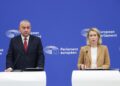
Brussels – GMOs: clash between the EU Commission and the European Parliament. MEPs are set to vote on a motion for a resolution opposing the EU Commission’s decision to authorize the cultivation, production, and sale of genetically modified MON 94637 soybean. The text is not binding, but it undermines the work of the von der Leyen team politically. The European Parliament’s Environment Committee has already rejected the GMO product with 45 votes in favor of withdrawing the measure, 29 against, and 1 abstention. There is, therefore, also a section of the European People’s Party (EPP) speaking out against the President of the European Commission, Ursula von der Leyen, and her College of Commissioners.
In February, the European Commission decided to authorize the placing on the market of MON 94637 GM soya, sparking a major outcry in the European Parliament, leading to the reintroduction of the proposal. The text of the motion for a resolution to be voted on in the Chamber next week explicitly calls on the European Commission to “withdraw its draft implementing decision proposal“, and effectively ban the genetically modified product. This is for at least two reasons: firstly, the EU Parliament considers that “risk assessment remains incomplete, in particular with regard to molecular characterization, toxicological assessment and environmental risk assessment.”
Secondly, the report criticizes the “lack of sufficient evidence on long-term impacts on biodiversity, food safety, farmers’ livelihoods, and animal health.” For this reason, the Commission is urged “not to authorize the GM soybean,” as otherwise proposed.
The tone of this inter-institutional clash becomes even more heated and tense in the passage of the resolution, where it is stated, in black and white, that “the draft Commission implementing decision exceeds the implementing powers provided for” in the regulation for genetically modified food and feed. The EU executive is therefore accused of overstepping its mandate, prompting an outcry in the European Parliament, complete with criticism and opposition from the EPP, to which von der Leyen belongs.
The decision to authorize a GMO product in a manner deemed hasty and excessive has led the European Parliament to call for a reform of the authorization system for genetically modified organisms. Given the lack of a clear framework that allows Member States freedom of choice, the anti-GMO motion calls on the European Commission to “submit, without delay, a legislative proposal to reform the decision-making procedure on GMOs in order to respond to the consistent objections of Parliament and the lack of qualified majority support among Member States.”
This renews the clash over agriculture and biotechnology, coming just after the EU Council vote on new genomic techniques (NGT), calling for clear rules to support a more competitive and sustainable agri-food sector. Unlike GMOs, NGTs allow genome editing without the insertion of foreign DNA, using sequences or combinations of sequences from the same species or a closely related species. There appears to be less resistance to the latter, while GMOs continue to divide public opinion.
English version by the Translation Service of Withub