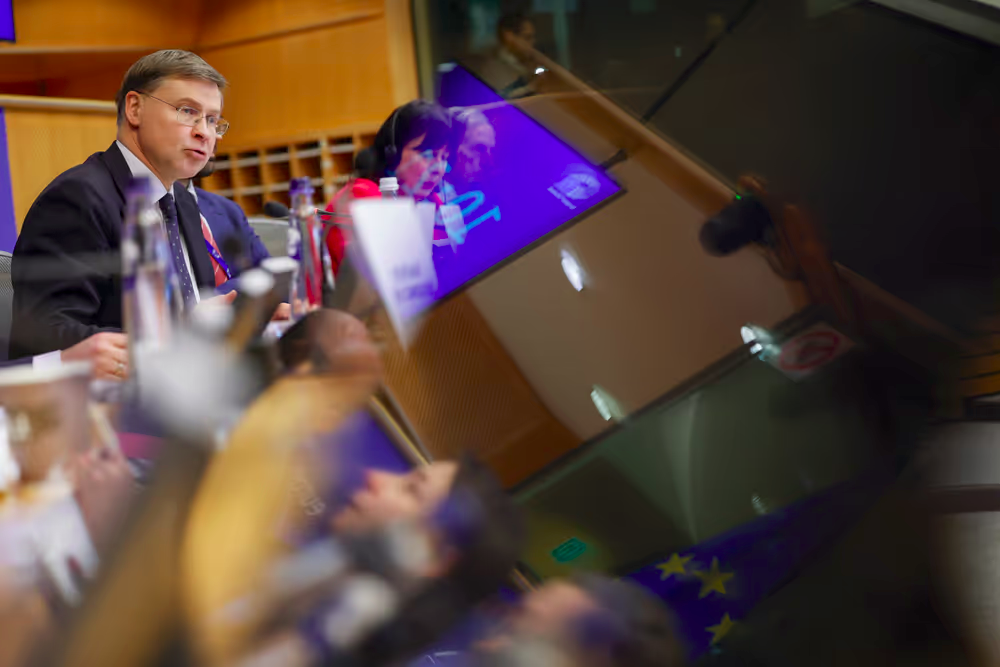
Brussels – “At the moment, we do not know what scenario we are facing.” This admission of an inability to act comes from the European Commissioner for the Economy, Valdis Dombrovskis, who acknowledges that it is impossible for the EU executive to decide how to proceed regarding the war in Iran and the crisis in the Middle East, given the objective difficulties in understanding the direction events are taking or might take. The only thing that is known, and which is practically the one point on which everyone, both within and outside the College of Commissioners, agrees, is that “we need to reduce tensions and reopen the Strait of Hormuz” to freight traffic, adds Dombrovskis during the hearing in the Legal Affairs Committee of the European Parliament.
This difficult-to-decipher situation appears to be a criticism—and perhaps even an accusation—directed at US President Donald Trump, regarding military manoeuvres that are proceeding without any consultation with the Europeans and contradictory statements: first the threat of further air strikes, then the announcement of ongoing negotiations with the Ayatollahs’ regime, denied by the Islamic Republic. This approach certainly does nothing to create a degree of certainty and, therefore, room for manoeuvre.
In a situation where it is difficult to find one’s bearings, it is even harder to know how to proceed. The European Central Bank is well aware of this; whilst acknowledging the deterioration in inflation and growth, it has chosen to leave rates unchanged and postpone the relevant decisions until the end of April. The European Commission also appears inclined to bide its time, as can be inferred from Dombrovskis’s remarks, though he cautions that, whether it be a relaxation of state aid rules or support measures for households facing fresh rises in energy prices, “we must not abuse our instruments” designed to manage temporary exceptional situations.
Certainly, the crisis in the Middle East and the war in Iran are bringing the reform agenda back to the fore: “The challenges facing Europe in terms of growth and productivity have been mounting for some time,” notes Dombrovskis, adding: “The urgency of addressing these challenges has increased significantly in today’s world, which is rapidly evolving and becoming increasingly complex.”
English version by the Translation Service of Withub![ferrosilicio [foto: FocalPoint/Wikipedia Commons]](https://www.eunews.it/wp-content/uploads/2026/03/ferrosilicio-350x250.jpg)