



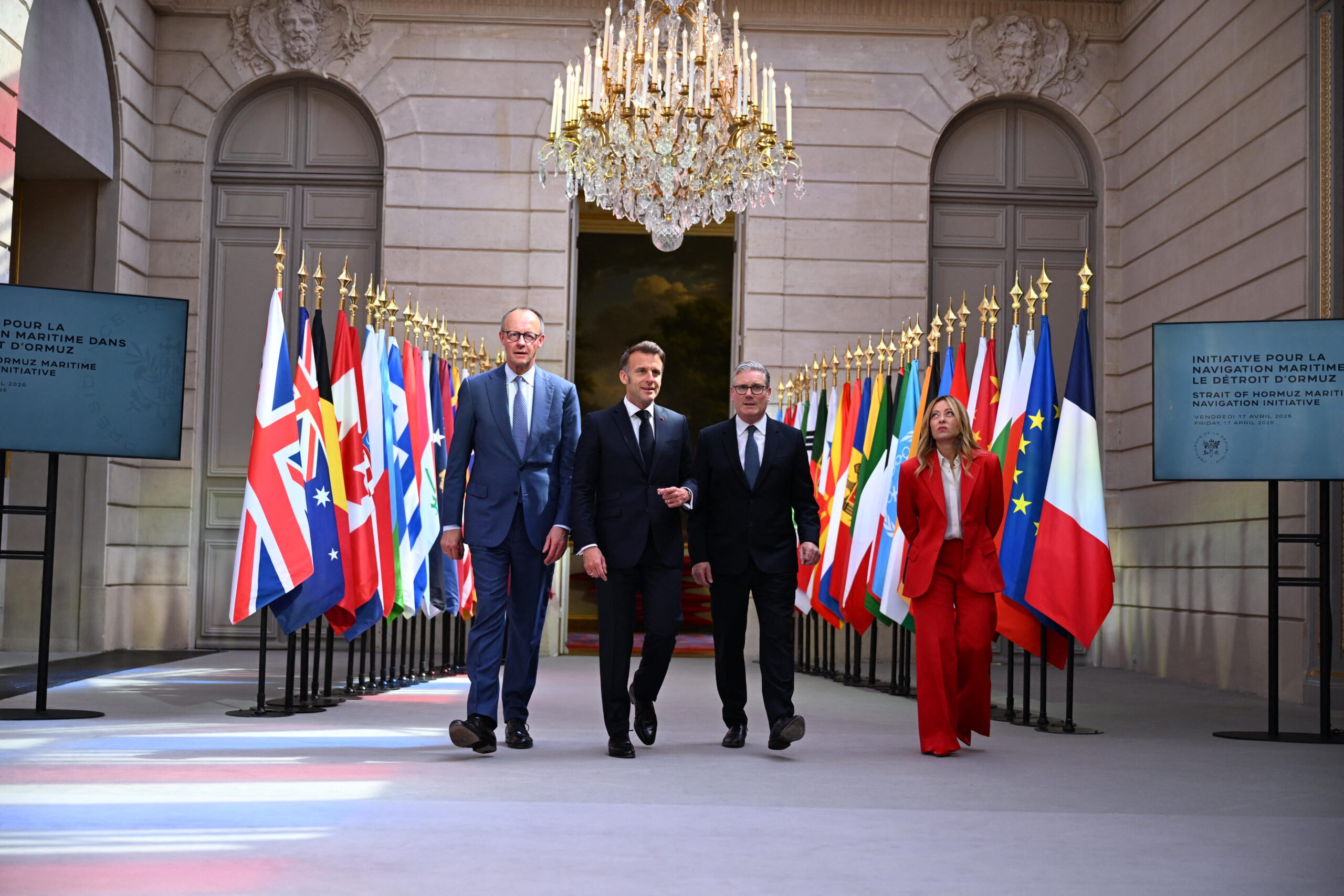
Brussels – “Together with more than fifty countries, we are leading an initiative to ensure freedom of navigation in the Strait of Hormuz,” writes on X French President Emmanuel Macron, following the “Summit of the Willing”, the meeting organised by the Élysée Palace alongside British Prime Minister Keir Starmer, today (17 April). Also at the table were the Italian Prime Minister, Giorgia Meloni, and the German Chancellor, Friedrich Merz. The other participants, from Europe, the Middle East, Asia, and even Latin America, took part via videoconference, as did the President of the European Commission, Ursula von der Leyen, and the High Representative of the European Union for Foreign Affairs and Security Policy, Kaja Kallas. Sources at the Élysée Palace clarified that this involved “around fifty countries and international organisations, including over thirty at the level of heads of state and government.” The United States was absent. “We all call for the full, immediate, and unconditional reopening of the Strait of Hormuz by all parties. We call for the restoration of free passage and full respect for the law of the sea. We all oppose any attempt to privatise the Strait and the introduction of a toll system,” commented Macron. For Meloni, today’s meeting in Paris “demonstrates that Europe is ready to play its part in the context of international security, alongside its partners.”
“Restoring full and permanent freedom of navigation in the Strait of Hormuz is an urgent and shared priority,” von der Leyen states. “During the video conference convened by Macron and Starmer, I emphasised the EU’s role” in “sharing satellite data via the European Maritime Safety Agency (EMSA), strengthening Operation Aspides, and working closely with partners in the Middle East and the Gulf to reinforce our partnerships. This includes connectivity, which can ease the pressure on the Strait,” she explains. Meanwhile, Kallas highlights via X states that, “under international law, transit through waterways such as the Strait of Hormuz must remain open and free” and that this “is what the leaders made clear in their call for the reopening of the Strait today.” For the former Estonian prime minister, “any payment scheme for passage will set a dangerous precedent for global shipping routes” and “Iran must abandon any plans to impose transit fees.” In this context, “Europe will play its part in restoring the free flow of energy and trade once a ceasefire comes into force.” Meanwhile, “the EU’s Aspides naval mission is already operating in the Red Sea and can be rapidly reinforced to protect shipping throughout the region. This could be the quickest way to provide support,” notes Kallas.
At the end of the meeting, Starmer highlighted that next week, the mission led by Paris and London to ensure freedom of navigation in the Strait of Hormuz will take shape. “Next week there will be a new meeting in London, and at that meeting we will define the composition of the mission,” he said, specifying that “some countries have already made their assets available” and that “it will be a defensive and peaceful mission.” Berlin remains cautious for now, with Chancellor Merz stating that Germany is willing to participate in the France-UK-led mission to ensure freedom of navigation in the Strait of Hormuz, but only if there is “a strong legal basis,” such as the go-ahead from the German Parliament or a UN Security Council resolution. Meanwhile, Prime Minister Meloni has stated that “an international naval presence in Hormuz can only be launched once hostilities have ceased, in coordination with all regional and international actors, and with an exclusively defensive posture.”
Meanwhile, news has come in that the Strait of Hormuz has reopened, with US President Donald Trump thanking Tehran for this move. “Iran has just announced that the Strait of Hormuz is fully open and ready for transit. Thank you!” he wrote on Truth. The news was welcomed by the coalition of the willing. Starmer welcomed the announcement “with approval.” “We must ensure that the reopening is lasting and workable,” he emphasised. As for Macron, following Tehran’s announcement, the mission “is even more legitimate because it is what will make it possible to consolidate these announcements in the short term and, above all, give them the chance to endure in the long term.” Meanwhile, Meloni described the reopening of Hormuz as “part of any serious negotiation plan for the crisis in the Middle East,” “but clearly not the only one: we know that the issue of Iran abandoning its nuclear programme, as well as building a security framework in which no nation is threatened in the future, will be the other fundamental elements, but it is the reason why we are here today.”
English version by the Translation Service of Withub![[foto: imagoeconomica via aeroporto tra] Carburanti allarme](https://www.eunews.it/wp-content/uploads/2026/03/Imagoeconomica_2633103-350x250.jpg)

![Il presidente del Consiglio europeo, Antonio Costa [Doha, 15 aprile 2026]](https://www.eunews.it/wp-content/uploads/2026/04/costa-260415-350x250.png)



![Ilze Brands Kehris [foto: European Council]](https://www.eunews.it/wp-content/uploads/2026/10/ilze-120x86.png)
